



Where Knowledge Bows, and the Soul Takes Root in God

Being Thankful


Photo by Museum of New Zealand Te Papa Tongarewa on Unsplash
Thanksgiving Begins with Praise
A Catholic Reflection for Thanksgiving Day
J.M.J.
Thanksgiving arrives late in the year. The leaves have fallen, the harvest has been gathered, and the long shadows of winter begin to stretch across the landscape. Perhaps that is fitting, because thanksgiving itself often arrives late in life. Children rarely begin by saying "thank you." Parents must teach them those words. Yet long before they learn gratitude, children possess another gift: they know how to praise.
A child who receives a treasured gift does not quietly analyze it. He runs through the house announcing his joy. He wants everyone to see it, touch it, and share in his happiness. Delight spills over naturally because goodness longs to be shared. Blessed Fulton J. Sheen recognized this profound truth when he reflected on thanksgiving. Gratitude, he wrote, often comes later. It develops as we mature and begin to realize how much of our lives has been received rather than earned, how deeply dependent we are on others, and how little we accomplish entirely on our own.
The older we become, the more we discover that our lives are built upon gifts. We inherit language before we can speak it. We receive love before we can return it. We benefit from the sacrifices of parents, grandparents, teachers, priests, neighbors, and friends long before we are capable of appreciating what they have given. We harvest fruit from trees we did not plant and rest in the shade of blessings we did not create. It is only with time that memory matures into gratitude.
St. Paul asks a question that cuts directly through our illusions of self-sufficiency: "What do you possess that you have not received?" The question is as unsettling as it is liberating. In a culture that prizes achievement, independence, and personal success, we are constantly tempted to believe that we are self-made. Yet the deepest truths of our lives testify otherwise. We are recipients before we are achievers. We are gifted before we are productive. Every breath, every opportunity, every relationship, and every grace comes to us first as a gift.
This is why thanksgiving is much more than good manners. It is far more than a polite response to a blessing received. True thanksgiving is relational because every genuine gift points beyond itself to the giver. We know this instinctively in our human relationships. A gift is precious not because of its price but because it reveals the love of the one who offers it. The same is true in our relationship with God. Every blessing becomes a signpost pointing back to the One from whom all blessings flow.
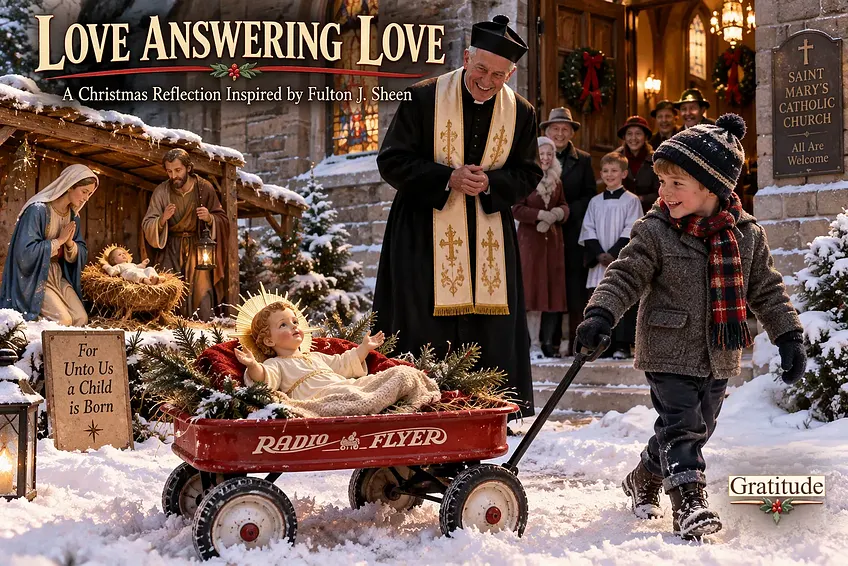
Sheen delighted in illustrating this truth through the story of a young boy who prayed for a wagon at Christmas. The child promised the Infant Jesus that if his prayer were answered, Jesus would receive the first ride. Christmas morning arrived, the wagon appeared beneath the tree, and shortly thereafter the statue of the Christ Child disappeared from the family Nativity scene. After a brief search, the family discovered the boy proudly pulling the Infant Jesus through the neighborhood in his new wagon. To an adult the scene appears charming. To the child it was simply logical. Love had answered love. Gratitude naturally sought communion.
Perhaps that is why Our Lord continually places children before us as models of faith. Before adulthood burdens us with calculation and anxiety, children understand something we often forget. Joy is meant to be shared. Praise rises spontaneously from wonder. Their hearts run naturally toward delight, and delight naturally becomes thanksgiving. The Psalms reveal the very same pattern. Ancient Israel did not begin with demands. The people first praised God for who He is and only then thanked Him for what He had done. Praise came first because praise recognizes reality.
Indeed, praise may be the purest form of prayer because it recognizes that God is God. Pope Benedict XVI observed that praise is the prayer which most immediately acknowledges God's sovereignty and goodness. Before we ask, before we petition, before we even thank, we stand in awe. We recognize the Creator behind creation, the Giver behind every gift. Thanksgiving grows from that recognition like fruit from a living tree.
That truth feels especially important in our own age. We are surrounded by comforts that previous generations could scarcely imagine, yet gratitude often seems harder to find. The modern heart is frequently trained to concentrate on what is missing rather than what has been given, on what is desired rather than what has been received. Entitlement slowly replaces wonder, and comparison suffocates gratitude. A society can enjoy abundance and still believe itself impoverished if it loses the capacity for praise.
Perhaps that is why Thanksgiving Day remains such a precious gift. It interrupts the restless pursuit of more and invites us to pause before the blessings already present. It asks us to remember. It invites families to gather not merely around a table, but around a shared recognition that life itself is gift. As St. John Paul II beautifully taught, gratitude is "the memory of the heart." To give thanks is to remember rightly.
For Catholics, that remembrance finds its highest expression in the Holy Eucharist. The very word Eucharist means thanksgiving. At every Mass, the Church gathers the joys and sorrows of the world, the successes and failures of humanity, the labor of our hands and the longings of our hearts, and offers them back to the Father through His Son. The Eucharist reveals that thanksgiving is not merely an annual holiday. It is the very rhythm of Christian life.
The saints understood this well. St. Francis of Assisi looked upon the sun, the moon, the wind, and the waters and saw reasons for praise. St. Ambrose declared that no duty is more urgent than that of returning thanks. Pope Francis has repeatedly reminded believers that everything is grace and that the Christian life is a continual act of thanksgiving. Across the centuries their message remains remarkably consistent: gratitude flourishes wherever wonder survives.
As families gather this Thanksgiving, perhaps the greatest gift we can pass to our children is not another recipe, tradition, or photograph, valuable though those things may be. Perhaps the greatest gift is teaching them how to see. Teach them to notice the blessings hidden in ordinary days. Teach them to recognize gifts before they count possessions. Teach them to praise before they demand. For a child who learns wonder today may become an adult capable of profound gratitude tomorrow.
And so, before the meal is served and before the conversations begin, let us pause. Let us remember those whose sacrifices made our lives possible. Let us thank God for blessings seen and unseen. Above all, let us begin where the Psalms begin, where the saints begin, and where every truly grateful heart begins.
With praise. Gratitude remembers the gift, but praise remembers the Giver. And when the Giver becomes more precious than the gift, thanksgiving ceases to be a day and becomes a way of life.
Have a Blessed Thanksgiving.
God Love You!
Inspired by the writings of Blessed Fulton J. Sheen.
About the Author


