On the Logos

The Blessed Sacrament
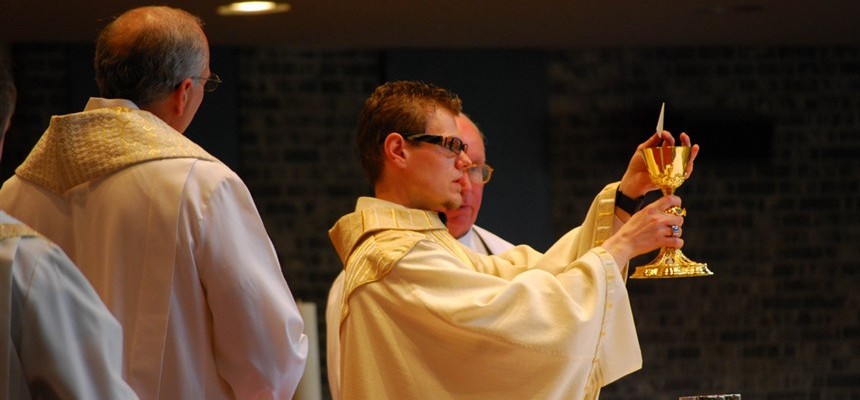
As we journey through the Lenten season toward Easter, it seems fitting that we take time to reflect on the Eucharist and the theology surrounding this wonderful gift Christ left His Church. The term Eucharistic Sacrifice refers to the real sacrifice present in the Eucharist, meaning Christ died in a very public and bloody way for our sins, a perfect sacrifice which is re-created at each mass around the world. As the Catechism explains “Because it is the memorial of Christ’s Passover, the Eucharist is also a sacrifice. The sacrificial character of the Eucharist is manifested in the very words of institution: “This is my body which is given for you” and “This cup which is poured out for you is the New Covenant in my blood
The Church uses term representation to indicate the manner in which the Eucharist is a sacrifice. Christ died once for our sins, an act which need not be actually repeated. He continues to offer His perfect sacrifice to the Father in Heaven through His role as our eternal High Priest (see Hebrews). The Eucharist is a representation of this sacrifice, or a memorial, to this holy and perfect sacrifice of the cross. The catechism states “The Eucharist is the memorial of Christ’s Passover, the making present and the sacramental offering of his unique sacrifice, in the liturgy of the Church which is his Body. In all the Eucharistic Prayers we find after the words of institution a prayer called the anamnesis or memorial.”
When we approach the Eucharist, we must be ever mindful of the real presence of Christ in the Eucharist. Blessed John Paul II reminds us of the words of Christ in John 6:55 “My flesh is food indeed, and my blood is drink indeed” and because of this “Faith demands that we approach the Eucharist fully aware that we are approaching Christ himself” (Mane Nobiscum Domine). The Catechism expands in saying ““Christ Jesus, who died, yes, who was raised from the dead, who is at the right hand of God, who indeed intercedes for us,” is present in many ways to his Church: in his word, in his Church’s prayer, “where two or three are gathered in my name,” in the poor, the sick, and the imprisoned, in the sacraments of which he is the author, in the sacrifice of the Mass, and in the person of the minister. But “he is present... most especially in the Eucharistic species.”
The real presence of Christ in the Eucharist is made possible through the act of transubstantiation which, as Saint Thomas explains, is the change of the substance of the bread and wine while the accidents (appearance) of the bread and wine remain unchanged. The Catechism explains as follows: “The Council of Trent summarizes the Catholic faith by declaring: “Because Christ our Redeemer said that it was truly his body that he was offering under the species of bread, it has always been the conviction of the Church of God, and this holy Council now declares again, that by the consecration of the bread and wine there takes place a change of the whole substance of the bread into the substance of the body of Christ our Lord and of the whole substance of the wine into the substance of his blood. This change the holy Catholic Church has fittingly and properly called transubstantiation.”
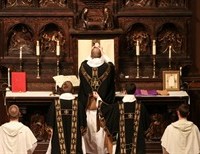
Each Holy Mass is a memorial of the passion, death, and resurrection of Christ. Through the mass we bring ourselves to the foot of the cross on Calvary, bearing witness to the passion of Christ. We do this because “[Christ], our Lord and God, was once and for all to offer himself to God the Father by his death on the altar of the cross, to accomplish there an everlasting redemption. But because his priesthood was not to end with his death, at the Last Supper “on the night when he was betrayed,” [he wanted] to leave to his beloved spouse the Church a visible sacrifice (as the nature of man demands) by which the bloody sacrifice which he was to accomplish once for all on the cross would be re-presented, its memory perpetuated until the end of the world, and its salutary power be applied to the forgiveness of the sins we daily commit (Catechism of the Catholic Church).”
The Sacrament of Holy Eucharist is commonly referred to as Holy Communion, for by approaching the Blessed Sacrament and participating in the Supper at His Table we are truly in communion with our Lord. Additionally, one must be in communion with the Church, abiding by her teaching and free from the stain of mortal sin, to receive Holy Communion. Holy Communion is truly the center of the Christian life, for “Through the ministry of priests the spiritual sacrifice of the faithful is completed in union with the sacrifice of Christ the only Mediator, which in the Eucharist is offered through the priests’ hands in the name of the whole Church in an un-bloody and sacramental manner until the Lord himself comes.”
Recommended Stories
About the Author
Chris Boyer is originally from the coal region of Pennsylvania. He is a cradle Catholic who is married to a convert to the faith. He works to catechize the faithful at his home parish through his participation in the RCIA program and youth religious education. He also coordinates the baptismal preparation program for his local parish. Chris holds the Master of Sacred Theology degree from Saint Joseph’s College of Maine and is currently pursuing the Doctor of Business Administration Degree. He resides with his family in coastal Delaware.