The Old Testament-where did it come from?

Catechumens, Candidates, and RCIA

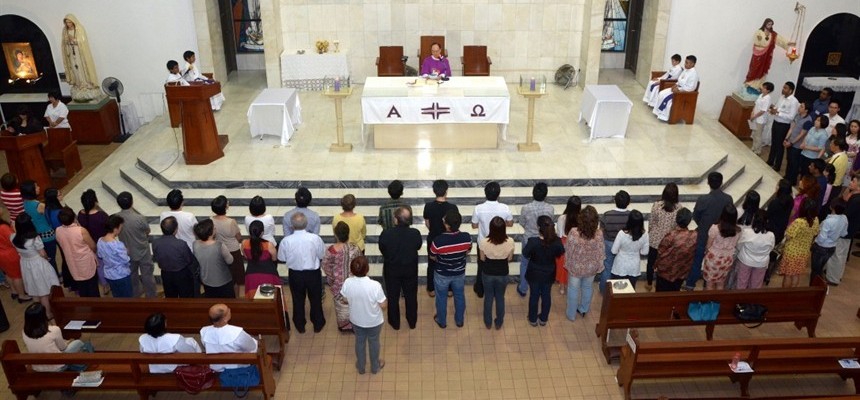
Photo By: Flickr/John Ragai
The Second Vatican Council revived the period of the Catechumenate in stating “The catechumenate for adults, comprising several distinct steps, is to be restored and to be taken into use at the discretion of the local ordinary 1. The council instructed for the rites of baptism for both infants and adults to be revised, with the revision for the baptism of adults necessitating a simpler and more solemn ceremony that takes into account the restored catechumenate. The period of the catechumenate draws back to the ancient times of the Church, with the Didache noting those who are not baptized are to be excluded from the celebration of the Eucharist so as to not give what is holy “to the dogs 2”. Galatians 6.6 tells those that are already instructed in the word to communicate with those needing instruction. The Greek in this text for those needing instruction is where we derive the word catechumen.
Pagans seeking to enter the Church initially entered a pre-catechumenate phase that would require them to be dismissed immediately after the sermon. Their instructors could then elevate them to the level of the catechumenate, at which point they would be called a Christian, although they were not looked upon as one of the faithful3. Although the catechumens were not dismissed with the inquirers, they did leave prior to the Liturgy of the Eucharist, after a prayer was said over them. The period of the catechumenate culminated with the scrutinies (an examination and presentation of the candidates) after which the catechumens were accepted into the Church and became neophytes.
The Church revived the catechumenate through the Rite of Christian Initiation of Adults, or RCIA. RCIA has been documented to retain up to 64% of converts with 50% of those who completed RCIA active in parish ministries and committees4. These fantastic statistics caused the U.S. bishops to proclaim that RCIA “has the power to transform parishes when implemented as the rite is intended.” Despite the early success of the program, the number of adult baptisms dropped 49% between the year 2000 and 20144. Nick Wagner notes many parishes have not implemented a full RCIA process, with a recent report citing 80% of parishes utilizing “some form” of RCIA5. Rather than seeking out and evangelizing the unbaptized, many parishes (according to Wagner) have engaged in a “member transfer process” in which the RCIA is utilized as a means to bridge the gap between various Protestant faith traditions and the Catholic Church. While this is certainly a noble undertaking, it often becomes a watered-down process that fails to proclaim the mystery of Christ and enter the way of faith conversion as the RCIA rite commands. This is further exacerbated by the shortened RCIA in many parishes, with only 34% of parishes actually requiring a full year of preparation in RCIA for catechumenates.6
The Rite of Christian Initiation for Adults, therefore, properly belongs to the unbaptized (catechumens). Does this mean that candidates do not belong in RCIA? The answer, like many aspects of catechesis, is not quite as simple as the question. Since many of us do not have the luxury of time nor manpower to have a separate class for Candidates seeking full initiation into the church (those baptized in another faith tradition), we (by necessity) combine the candidates and the catechumen into a single RCIA class.
The U.S. Bishops do note that those with minimal knowledge of their Christian faith can participate in the catechumenal formation, they are not to participate in the rites intended for the unbaptized catechumens. The danger of blending those well-versed in the aspects of the Protestant faith they are converting from and the unbaptized is two-fold: 1.) the potential for disrupting the conversion process of the unbaptized is increased and 2.) we fail to recognize the dignity of the baptism of the convert.
After the Liturgy of the Word, for example, the catechumenates are dismissed from the congregation to reflect on the scriptures more fully while the remainder of the congregation celebrates the Liturgy of the Eucharist. While the candidates may find the reflection over the scriptures fulfilling, to dismiss them from the Eucharistic celebration (even though they cannot yet received the Blessed Sacrament) is to equate them with the unbaptized and thus deny the dignity of their own baptism. The Rite of Dismissal is intended for those in the catechumenate who are required to attend Mass but cannot participate in the Eucharistic celebration.
What about children? Although RCIA stands for the Rite of Christian Initiation for Adults, it also incorporates any child who has passed the age of reason and has not been received into the Church. The Rite of Baptism for Children is to be used for children under seven who lack the use of reason, while the Rite of Christian Initiation of Adults notes the Rite is for Children that are seven and older who have the use of reason. The Code of Canon Law, 852.1, specifically states “the prescripts of the canons on adult baptism are to be applied to all those who, no longer infants, have attained the use of reason7.” Any child, therefore, who has reached the age of reason and is not baptized is to be catechized through RCIA and, when ready, be received into the church at the Easter vigil. Candidates who have reached the age of reason are to also be treated as adults in RCIA and be welcomed into the church at the Easter Vigil.
The process for catechizing these children, however, cannot be the same as adults. The Rite notes that their initiation requires a conversion that is proportional to their age with necessary educational assistance. Parishes must be careful, then, to tailor the RCIA process to these children. This ideally will be done with other children who are on the same faith journey. Children who are candidates and are of the same age as those preparing to receive their first communion can join the parish religious education program if appropriate, but children who have passed the typical age for this sacramental preparation should not be integrated into the standard religious education program.
So where does this leave us with RCIA? The answer for Catechumenates is simple: they are incorporated in the full RCIA catechetical process culminating (God willing) with the sacraments of initiation. For candidates, the answer is a little murkier and needs to be decided on a case-by-case basis. What we cannot do, however, is simply assume the candidates and catechumens are on a similar faith journey. RCIA can be as complicated as it is necessary but we must ensure we are providing the necessary catechesis to each candidate and catechumenate that seeks full communion in Christ’s Holy Catholic Church.
1. Second Vatican Council. SACROSANCTUM CONCILIUM.; 1987.
2. Chap I. The Teaching of the Lord by the Twelve Apostles to the Gentiles . 2015:1-8.
3. The Catholic Encyclopedia. Catechumen. http://www.newadvent.org/cathen/03430b.htm. Accessed December 14, 2015.
4. Ferrone R. Room at the Font Is the RCIA Still Working? Commonweal. 2013:6.
5. Wagner N. A More Authentic Way. America (NY). 2014;(31):20-23.
6. Yamane D. Initiation Rites in the Contemporary Catholic Church: What Difference Do They Make? Rev Relig Res. 2012;54(4):401-420. doi:10.1007/s13644-012-0078-x.
7. The Holy See. Code of Canon Law. http://www.vatican.va/archive/ENG1104/_INDEX.HTM. Published 1983. Accessed December 14, 2015.
Recommended Stories
About the Author
Chris Boyer is originally from the coal region of Pennsylvania. He is a cradle Catholic who is married to a convert to the faith. He works to catechize the faithful at his home parish through his participation in the RCIA program and youth religious education. He also coordinates the baptismal preparation program for his local parish. Chris holds the Master of Sacred Theology degree from Saint Joseph’s College of Maine and is currently pursuing the Doctor of Business Administration Degree. He resides with his family in coastal Delaware.