A Biblical Defense of the Papacy

On The Eucharist


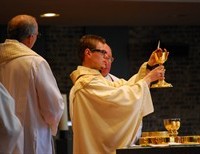
Photo By: Flcikr/Fr Lawrence Lew, O.P.
Recently, many Catholic news agencies began to report on a historical development in the interfaith relations between the Catholic and Lutheran churches. This current release follows other developments, such as the 1999 Joint Declaration on the Doctrine of Justification which states that both faith traditions have reached a “common understanding of our justification by God’s grace through faith in Christ.” In the most recent release both faiths expressed a belief in the Real Presence of Christ in the Blessed Sacrament, although they both believe in this Real Presence occurs in a different manner. So what, then, is the Catholic understanding of the Real Presence?
Many Catholics already know that the Church receives its understanding of the Blessed Sacrament in large part from the 6th Chapter of John's Gospel. John Chapter 6 details a discourse between Christ and many disciples who are following Him a day after He multiplied five loaves of bread and two fish into enough food to feed about five thousand men (with the possibility of many women and children also being present). During this discourse many of those who witnessed this miracle of the multiplication of the loaves the day before remained to hear Christ speak. Christ tells His followers that he is “the bread of life” and “whoever comes to me will never hunger, and whoever believes in me will never thirst.” He goes on to tell them that not only is He the bread of life, but that as the living bread it is His flesh they must eat and His blood they must drink to have eternal life. In perhaps one of the saddest sections of the Gospels, it is noted that many of His disciples left Him and returned to their former way of life. Christ turns to His friends (the 12 Apostles) and asks if they are going to leave as well, to which Peter responds “Master, to whom shall we go? You have the words of eternal life.”
While this section of John's Gospel is important for our understanding of the Blessed Sacrament, it is certainly not the only source of our understanding. The First Letter to the Corinthians, written around 55 AD by Saint Paul, contains the earliest written account of the Blessed Sacrament. In 1 Corinthians 11:24 we read of the tradition of the Blessed Sacrament dating back to the Last Supper in which Christ took bread, broke it, and said “this is my body that is for you. Do this in remembrance of me” (remember this text by Paul was written about 20 years before these words would be written in Matthew's and Luke’s Gospels). Saint Paul goes on to tell the Corinthians that the reason many of the members of the church in Corinth are sick and infirm is because they are eating and drinking the Blessed Sacrament in an unworthy manner! He instructs the faithful to discern whether they are worthy to receive the Blessed Sacrament before partaking in the Eucharistic celebration (as Catholics, we must be free from the stain of mortal sin to receive Communion). This punishment for approaching the Blessed Sacrament in an unworthy manner ties directly with the Old Testament punishment for touching the Ark of the Covenant (2 Samuel 6:6-8).
Where, then, would the tradition of offering bread and wine to the Lord originate? We can look to the Old Testament for this answer. We read in Leviticus 7:12-15 of one of the sacrificial offerings to the Lord made by the Jewish people. This Todah offering, or offering of Thanksgiving (Todah in Hebrew translates to Thanksgiving in English) is an offering of bread by the people to the Lord. In addition to offering this sacrifice to the Lord, it was also common for the Jewish faithful to partake in the sacrifice, such as the eating of the Passover lamb after offering it to the Lord.
We also see an offering of bread and wine being made by Melchizedek in Genesis Chapter 14, in which the great priest and king offers bread and wine to Abraham to thank him for achieving a victory that the five local kings were unable to achieve. We read in the Letter to the Hebrews that Melchizedek, the king of Salem and priest of God Most High, is an Old Testament preconfiguration of Christ who is to be our eternal High Priest. While the offering of bread and wine by Melchizedek and the others living under the Old Testament covenant was to be temporary, the sacrifice of Christ is to be eternal (Hebrews 10:10).
Luther, as well as others during the reformation, balked at what they believed was the “re-sacrifice” of Christ on Catholic altars during the Mass. Luther pointed to Hebrews 10 as proof that Christ’s sacrifice was “once for all” and not an act that was to be re-created. The Catholic Church does not teach, however, that the Blessed Sacrament is a re-sacrifice of Christ but rather that Christ’s sacrifice is an eternal sacrifice offered to the Father in heaven and that, through the consecration of the Blessed Sacrament, we are partaking in the sacrifice of Christ in a non-bloody manner (note I stated participation, an aspect of sacrifice that we have already previously stated was an important aspect under the Old Covenant).
The Apostolic Fathers also taught us a great deal about the Blessed Sacrament. Saint Ignatius of Antioch, who was the second Bishop of Antioch after being elevated by Saint Peter, tells us in his Epistle to the Philadelphians (late 90’s AD) that we are to “take head, then, to have but one Eucharist. For there is on flesh of our Lord Jesus Christ and one cop to show forth the unity of His blood; one altar, as there is one bishop, along with the presbytery and deacons.” Saint Justin Martyr, writing his First Apology in the 150’s AD, tells us of the celebration on the Lords Day was very similar to the current form of the Catholic Mass. Readings (from the Apostles and the Apostolic Fathers) were proclaimed, followed by prayers. Bread and wine were brought forward to be blessed by the presbyter or bishop, which was then disseminated to the faithful by the deacons. This bread and wine was not merely a symbol in this ancient time but rather the bread and wine (mixed with water) “is the flesh and blood of that Jesus who was made flesh.”
Transubstantiation, the term used to describe this consecration of bread and wine mixed with water, does not appear in scripture but rather is the best term the Council of Trent could utilize to describe the church’s teaching on the Blessed Sacrament that dates back to Saint Paul and the Apostolic Fathers. The Council of Trent also declared (in Session 22) that Christ left His church with a visible sacrifice to be offered after His death (the Blessed Sacrament). Through transubstantiation, the Bread and Wine cease to become Bread and Wine but rather become the true presence of the Body, Blood, Soul, and Divinity of Our Lord. The council specifically states “By the consecration of the bread and of the wine, a conversion is made of the whole substance of the bread into the substance of the body of Christ our Lord, and of the whole substance of the wine into the substance of His blood; which conversion is, by the holy Catholic Church, suitably and properly called Transubstantiation.”
What, then, is the Lutheran understanding of the Real Presence? While I am certainly not an expert in Lutheran Theology, I will try my best to answer this question. Luther proposed a union with Christ in the Blessed Sacrament referred to as a Sacramental Union. Under this understanding, the Blessed Sacrament remains Bread and Wine but is also joined with the Body and Blood of our Lord through His grace. In doing so they also reject the concept of Consubstantiation, which is another Protestant theology (used, for example, in the Episcopal faith), which states that the bread and wine becomes bread and wine AND the body and blood of Christ (consubstantiation=with the substance). Through the concept of Sacramental Union, the bread and wine remain bread and wine (no change of substance or essence) but are also the Body and Blood of Christ. This obviously differs from the Catholic teaching of Transubstantiation in which the substance of the Bread and Wine truly become the Body, Blood, Soul, and Divinity of Christ (transubstantiation=crossing of substance). This is why both faith traditions are able to stipulate that they both believe Christ is present in the Blessed Sacrament but in a different form. Luther taught this out of what he believed was reverence for the scriptures, which refers to the consecrated bread as bread. The Catholic Church would point out, however, that in 1 Cor 11:29 we must discern the body being present in the bread and in John 6 Christ tells us the bread is his flesh.
Recommended Stories
About the Author
Chris Boyer is originally from the coal region of Pennsylvania. He is a cradle Catholic who is married to a convert to the faith. He works to catechize the faithful at his home parish through his participation in the RCIA program and youth religious education. He also coordinates the baptismal preparation program for his local parish. Chris holds the Master of Sacred Theology degree from Saint Joseph’s College of Maine and is currently pursuing the Doctor of Business Administration Degree. He resides with his family in coastal Delaware.