On The Eucharist

An Exegeses of the Sacrament of Baptism Part I


Photo By: Flickr/Waiting For The Word
As the first of two posts on the Sacrament of Baptism, this post will serve to explore the theological foundation for the Sacrament of Baptism. The second post will explore the gifts received from the Sacrament.
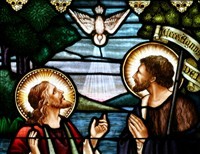
The Sacrament of Baptism remains a pivotal part of the Christian life and is indeed necessary for salvation. Baptism serves as the first sacrament of initiation (with Holy Communion and Confirmation rounding out the remaining sacraments of initiation) and constitutes the foundation of communion among all Christians (CCC #1270). We read of the origins of the sacrament in sacred scripture, with Christ undergoing the baptism of John in the Jordan. Following Christ’s immersion in the baptismal waters, the heavens where opened for Him and the three persons of the Triune God (Father, Son, and Holy Spirit) manifested themselves in our world (Matthew 3:13-17). Christ, who is without sin, undergoes this baptism, not to cleanse Himself of original sin, but to demonstrate for us the effects of the sacrament He is instituting (O'Neill 109). Christ’s second baptism, which he undergoes on the cross, is the source from which the sacrament actually derives its power (O'Neill 109). After His resurrection, Christ tells His apostles to “ go therefore and make disciples of all nations, baptizing them in the name of the Father and of the Son and of the Holy Spirit, teaching them to observe all that I have commanded you” (Mt 28:19-20). This command by Christ both confers the necessity of the Sacrament and demonstrates the Trinitarian formula which we must follow.
During the sacrament, the recipient is immersed in water three times. This immersion in water symbolizes death and purification as well as regeneration and renewal. In the waters of baptism the newly baptized Christian is reborn as an adopted brother or sister of Christ (CCC #1262). The effects of the sacrament positions the soul in a state of sanctifying grace, which is the condition of the soul that allows a man to live a life in correspondence with God. Through the grace of the sacrament all sins are forgiven, including original and personal sins. The temporal consequences of original sin (suffering, death, illness) remain as well as the concupiscence or tinder for sin (CCC #1264). Concupiscence makes us vulnerable to sin, but susceptibility to temptation is not sin. How we act in response to the temptation determines the rightness or wrongness of the act, requiring a continued flow of grace from God to allow us to remain on the path toward salvation (King 28). The fact that the immersion is done three times is not done by accident, but rather serves to symbolize Christ’s burial for three days as well as the newly baptized Christian’s resurrection with Christ.
The newly baptized is now configured to Christ, sealing the Christian with the character of the sacrament and demonstrating his belonging to Christ (CCC #1272). It is only through the sacrament of baptism that we can enjoy the fullness of life in God’s household (Hahn 43). The seal of the sacrament consecrates the recipient for Christian worship, not only allowing them to participate in the liturgy but obligating them to do so. Through the grace of the sacrament the recipient enters into the common priesthood which calls them to live holy lives and practice charity (CCC #1273). Furthermore, the baptismal grace that includes the forgiveness of sins allows for the birth into a new life by which a man becomes the adopted son of the Father, a member of the Body of Christ, and a temple for the Holy Spirit (CCC #1279).
Bibliography
Hahn, Scott. Swear to God The Promise and Power of the Sacraments. New York, NY: Doubleday, 2004. Print.
King, Will. "What is Concupiscence?" Catholic Answer 27.3 (2013): 26-29. Electronic.
O'Neill, Coleman E. Meeting Christ in the Sacraments. Staten Island, NY: St. Pauls Press, 1991. Print.
United State Conference of Catholic Bishops. Catechism of the Catholic Church. Huntington: Our Sunday Visitor, 200. Print.
Recommended Stories
About the Author
Chris Boyer is originally from the coal region of Pennsylvania. He is a cradle Catholic who is married to a convert to the faith. He works to catechize the faithful at his home parish through his participation in the RCIA program and youth religious education. He also coordinates the baptismal preparation program for his local parish. Chris holds the Master of Sacred Theology degree from Saint Joseph’s College of Maine and is currently pursuing the Doctor of Business Administration Degree. He resides with his family in coastal Delaware.