If I have faith, why do I need works?

A Biblical Defense of the Papacy

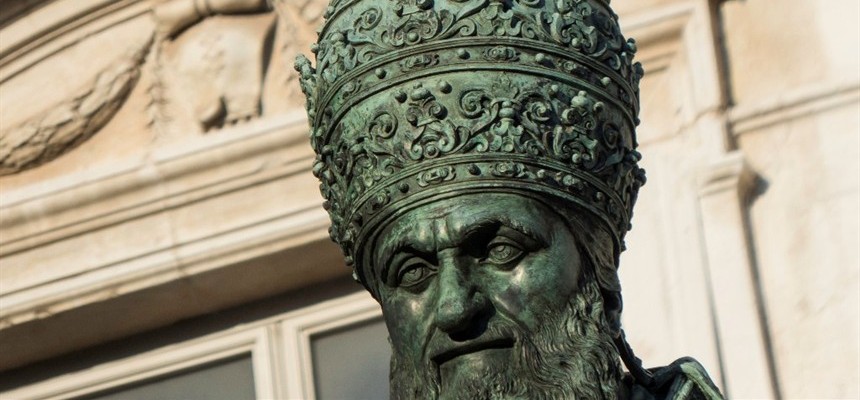
Photo By: Flickr/Riccardo
The recent visit of the Holy Father to the United States has ignited interest in the office of the Pope by Catholics, our Protestant brothers and sisters, and non-Christians. While faithful Catholics hold firm to the primacy of the Holy Father, many are unaware of the biblical roots of this office. Many of our protestant brothers and sisters object to the Papacy for the term Pope does not appear anywhere in Sacred Scripture. The focus of this blog post will be to point toward some of the most relevant aspects of Sacred Scripture that we can look toward in reflecting on the office of the Pope.
First, where does the Holy Catholic Church derive its teachings in the office of the Pope? The answer to this question lies in Matthew Chapter 16. Christ asks his Apostles who the folks they are evangelizing believe Jesus is. The Apostles reply that Christ is believed to be one of the great profits (Elijah, Jeremiah, and the recently beheaded John the Baptist are provided as examples). When Christ asks who the Apostles say that Jesus is, Simon Peter replies “You are the Messiah, the Son of the living God (Matthew 16:16 NAB).” In response to this proclamation by Simon, Christ refers to Simon as Peter for the first time (the original Greek word used in the Gospel is Cephas which means rock). While Kepha is the actually Greek word for rock, the word Kepha is considered a feminine term so Kephas is more appropriate in referring to Peter (this is an important point for one objection to the office of the Pope is the term Kephas actually refers to a pebble. This point is not linguistically accurate). Christ continues to tell Peter that the gates of hell will never prevail against the church that Christ will build upon Peter. He also provides Peter with the keys to the kingdom with the power to bind and loose.
The handing off of the keys, with the ability to bind and loose, is where the Church derives its teaching on the primacy of the office of the Pope in relation to doctrinal issues. The Holy Father is the successor to Saint Peter, who was granted the keys. But where in scripture does it say this office is transferable? To answer this question, we look toward the Old Testament and the tradition of the handing over of keys. We read in Isaiah Chapter 22 of the prophesied fall of the kingdom of Judah. During this prophecy, the current master of the palace (in our current world terms prime minister would be an appropriate analogy) is replaced by a new servant called Eliakim. In this transfer of authority the keys to the kingdom are transferred, with these keys symbolizing authority and the ability to make decisions on behalf of the kingdom. This passage in Isaiah provides the understand of the importance of bestowing keys on a leader and how these keys are meant to be transferred to ensure this important office remains intact after a leader can no longer fulfill their position. We also learn of the appropriateness of the term Pope for this office. In Isaiah the office that is being transferred is described as one in which the descendants and offspring’s glory will be hung, which in effect is describing a father. We derive the word Pope from the Latin word Papa or Greek pappas, which is the way in which a child would refer to their father.
But do we have any biblical evidence of the primacy of Peter? The simple answer is a resounding yes! Peter is always listed first whenever the Apostles are listed in the scriptures, indicating his importance. After the miracle at Pentecost occurs in Acts, Peter stands up and instructs the faithful in the same manner that Christ would have prior to His death and resurrection (2:15-36). After Peter’s speech, the faithful ask Peter and the Apostles how they can become followers of Christ, to which Peter replies “repent and be baptized (Acts 2:38 NAB)” again demonstrating the primacy of his position.
If we move forward to Acts 15, we learn of an event that can be viewed as the first ecumenical council. As Paul and Barnabas were converting the Gentiles, a debate arose surrounding circumcision and its necessity under the new covenant. Rather than decide this on his own, Paul approaches Peter in Jerusalem to seek a ruling on this debate. We read in acts that the “Apostles and presbyters (priests) met together about this matter (Acts 15:6).” During this meeting Peter teaches them that the Gentiles are saved through the grace of Christ in the same manner that the Jews are, negating the burden of circumcision on them (this was an important discussion at the time because of the risk of infection associated with being circumcised in the ancient world). This teaching by Peter demonstrates his primacy over the Apostles and presbyters meeting to discuss matters of faith, a primacy he handed over through Christ’s bestowing of the keys on Peter. This office has continued for the 2,000 year existence of the Catholic Church just as Christ promised.
Recommended Stories
About the Author
Chris Boyer is originally from the coal region of Pennsylvania. He is a cradle Catholic who is married to a convert to the faith. He works to catechize the faithful at his home parish through his participation in the RCIA program and youth religious education. He also coordinates the baptismal preparation program for his local parish. Chris holds the Master of Sacred Theology degree from Saint Joseph’s College of Maine and is currently pursuing the Doctor of Business Administration Degree. He resides with his family in coastal Delaware.