The Reluctant Roman: or Why I Converted to the Catholic Church, Part II: Worship and the Physical Man

Fight or Die: What it means to be a Catholic Man


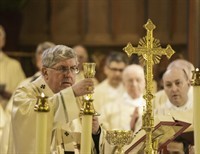
Photo By: Flickr/Ed Alkema
Recently I was asked to sit on a panel for a new class of catechumens beginning RCIA in my local parish. The panel was discussing the question, “What does it mean to be a Catholic?” I had previously been on this same panel a year before, and at that time, I had answered this question in terms of my then-recent conversion. To the question, “what does it mean to be a Catholic?”, I answered, “It means to have the Eucharist!”
And I would still answer this way.
But my first time on the panel, all of my explanations dealt with this in terms of why I converted. In a sense, I was actually answering the question, “Why did you become a Catholic?” And that was fitting then because I had just joined the Catholic Church. I had a freshman take on “What it means to be a Catholic.”
But I would say I am no longer in the freshman period of being a Catholic.
Things have certainly changed since then. My wife and I welcomed our first child, James. We have moved beyond the honeymoon stage of being brand-new Catholic converts. Now we have moved on into the daily grind, into the nitty gritty.
Now we have moved on to the business, not of becoming a Catholic, but of being a Catholic. Of continuing on. Of persevering. Of, as Paul says in Philippians 3:13-14, “forgetting what lies behind but straining forward to what lies ahead, …continu[ing] my pursuit toward the goal, the prize of God’s upward calling, in Christ Jesus.”
I recently read an article on The Catholic Gentleman blog called, “Fight or Die,” so I have borrowed that phrase as my title. And that was the theme of my discussion on the panel: Christian growth, particularly from a male perspective.
In my experience, this is a place where Protestant churches utterly and absolutely fail. Because Protestantism in America is dominated by evangelicals, churches become dominated by an unceasing refrain of “Get saved, get saved, get saved!” Yet they often go no deeper than this.
As a child growing up in the Baptist church, I heard this refrain every Sunday during the altar call: “Come down to the altar, pray, and get saved!”
And I remember praying the “Sinner’s Prayer” that evangelicals teach: I am a sinner. I need Christ. I accept you as my Lord and Savior. Amen.
Seven, eight, nine years old, I prayed that prayer. And I was born again. And in the Christian life, that is absolutely something that needs to happen. Absolutely. Christ tells us that in John Chapter 3.
Yet even as a 7 year old kid, I remember asking, “Now what?”
So I asked adults, “What do I do now?” And though I am generalizing, of course, their responses were typically, “You’re saved. Act like it.”
But there seemed to be no follow up.
“I’m confused how to grow,” I would say.
“Doesn’t matter, you’re saved!
“But where do I go from here?” I asked.
“Doesn’t matter, you’re saved!”
“How can I know what teachings to follow?”
“Doesn’t matter, you’re saved!”
“Yeah, but what if I’m having trouble and falling into sin again and again?”
“Ooh, maybe you weren’t ever really saved at all…”
This is where the Protestant doctrine of “Once Saved, Always Saved” reveals a problem. For it is a flawed way of looking at Salvation, because it tells people either you are saved and you’re suddenly good as gold, nothing more required; or you sinned again, continue to sin, and that is evidence that you were never really saved at all.
I even remember thinking as a seven-year-old, “Did I say the ‘Sinner’s Prayer’ right? Am I really saved? Because I keep sinning really badly.”
So I prayed the Sinner’s Prayer again, you know, just to be sure. But that is not how it works! That is not how Salvation works!
The prayer of repentance and acceptance of Jesus is merely the starting point. What it means to be Catholic is to press on from that starting point, to fight to sin no more, to fight to live as Christ!
It is for this reason that Catholics don’t like to say, “I am saved.”
And what’s interesting is that Paul would not say he was either. In Philippians 3 again, he says in verses 8-12:
“…that I may gain Christ and be found in him, not having any righteousness of my own based on the law but that which comes through faith in Christ, the righteousness from God, depending on faith to know him and the power of his resurrection and the sharing of his sufferings by being conformed to his death, if somehow I may attain the resurrection from the dead. It is not that I have already taken hold of it or have already attained perfect maturity, but I continue my pursuit in hope that I may possess it, since I have indeed been taken possession of by Christ Jesus.” [Emphasis added]
Catholics don’t like to say, “I am saved.” We have more of a Trinitarian viewpoint; we might say, “I was saved, I am being saved, and I will be saved.” It’s kind of like the Glory Be prayer, “As it was in the beginning, is now, and ever shall be.”
So being a Catholic means actively participating in the saving work that Christ is doing. Let me be absolutely clear, however, especially for any Protestant readers: Catholics do not mean you can work your way into Heaven.
On our own, our work is nothing. In fact, Paul calls it “dung.” Paul says he has been taken possession of by Christ. In other words, he cannot work or attain Salvation on his own. He cannot climb the mountain on his own, so Christ has reached down to pull him up it. But at the same time, Jesus expects and wants us to work in participation with Him.
This image of a mountain came to me from Revelation 21:10, where the apostle John describes in his vision how an angel “took me in spirit to a great, high mountain and showed me the holy city Jerusalem coming down out of heaven from God…” In verse 22, he writes, “I saw no temple in the city, for its temple is the Lord God almighty and the Lamb.”
I will refer back to this idea of this great mountain of God, the Mountain of the Most High, where God and the Lamb are. Because that is the goal, which Paul talked about—the summit with God—that is the prize of God’s upward calling.
Our Christian life ought always to be a continuing toward the goal. The straining forward. Because it is a straining forward. Christ said in John 16:20, “Amen, amen, I say to you, you will weep and mourn, while the world rejoices.” It is not easy to be Christian.
C.S. Lewis once said, “I didn’t go to religion to make me happy. I always knew a bottle of Port would do that. If you want a religion to make you feel really comfortable, I certainly don’t recommend Christianity.”
If your Christianity is comfortable all the time, that may be the time to worry. The Devil loves men to be in comfort. Men especially! Here I will turn my attention specifically to men. For men are woefully undernourished spiritually in our churches.
Men need a straining forward, not comfort! Comfort placates men. It pacifies us. It gets us into trouble. There is a lot of truth to the old saying, “Idle hands are the Devil’s playthings.” Again, for men especially! For men are meant to toil. To work. To sweat. To strain forward to what lies ahead.
As Tyler Blanski points out in a great article entitled, “Was I Made for Pillows?”, in 2 Samuel 11, when David sleeps with Bathsheba, the only reason that David was there on the rooftop is because he was hanging out at home in comfort, when he should have been out on the battlefield.
In modern America, I would contend that the greatest killer of men’s souls is comfort. Men who lounge about the house find comfort in pornography, in impure pursuits, in lazy and wasteful uses of our time.
We were not made for pillows! We must strain forward. We must fight, or die.
For me, as a Catholic man, what it means to be a Catholic is to push onward and upward, and the Church provides me with a very real visible framework and guideline to do this. Through the frequent reception of the Sacraments, I strain forward to become what Christ wants me to be. I climb the mountain, not on my own strength, but only with His unfailing help.
The long history of the Church gives me images of real men, fallen sinners who, through Christ, have persevered to sainthood, sometimes facing seemingly unconquerable problems. These are men’s men. Take St. Nicholas, for example. Yes, of Santa Claus fame. But there is another great story about St. Nick.
In 325 A.D., Archbishop Nicholas attended the first Ecumenical Council at Nicaea (from which came the Nicene Creed that Catholics say at every Mass). During this Council, the Church was confronting the heresy of Arianism, which denied the divinity of Christ. At one point, the heretic Arius stood up on his seat in order to be better heard. Furious at the false teaching, Archbishop Nicholas strode quickly over to Arius, pulled him down by his beard, and punched him in the face. The shocked Council fathers had St. Nicholas arrested, but after receiving a miracle validating his behavior, Archbishop Nicholas was honorably reinstated to the Council, and Arianism was eventually condemned officially.
As a Catholic man, I love this story! Not because I think we should run around punching heretics in the face, but because I believe that our fervor for God should be such that we fight, sometimes literally, for the Truth!
Men need this manly faith. A warrior faith. A faith that celebrates our masculinity. A faith that does not tell us to stop being men. A faith that does not bridle our natural tendency toward physicality and exertion.
In the 1960s, after the Second Vatican Council, the Catholic Church embarked on what they called the New Evangelization, to draw more people into the church. There is a blog online now called The New eMANgelization. And the blog’s argument—and I would agree—is that the New Evangelization and the Catholic Church (and I would say all Christian churches) have failed men in the last few decades.
Certainly, our modern secular American culture has failed men. Most American men do not want to go to church. Most American men do not want to talk about God. For whatever reason, men view religion as sissified or womanly or unmanly or feminine, or whatever.
This is a direct result of the failure on the part of churches to fight the secular culture!
Our secular culture tells us that men are buffoons. Look at any sitcom for proof. The man of the family is a fat doofus. He sits on the couch all the time. He eats, watches TV, or mindlessly enjoys sports, especially football, to the point of absurdity. His wife nags him and does not respect him. His kids take his money and do not respect him. He is weak and an object of ridicule. This is the “Modern Family” of network television; this is the image of the modern American man.
And it is an image we must fight against!
Men are meant to be fighters. As an English teacher, one of the works of literature I teach is Sir Gawain and the Green Knight, a poem based on the Arthur legends. In one section, Sir Gawain, one of the Knights of the Round Table, is about to set off on his quest. He dons his heavy war armor and prepares to leave Camelot. But then he does something awesome, something that we as Catholic men should look to as an example:
“When [Sir Gawain] was hasped in his armour…thus harnessed…he heard now his Mass, that was offered and honoured at the high altar…”
Here is this man, weighed down with heavy armor, celebrating Mass. Gawain knows that nothing he does matters at all if he loses his soul.
You see, above all, we must be fighters in Christ and fighters for Christ. As Christians, we are very truly in a spiritual war. In Ephesians 6:12, Paul tells us that “…our struggle is not with flesh and blood but with the principalities, with the powers, with the world rulers of this present darkness, with the evil spirits in the heavens.”
We, Christians, are in a spiritual war; if you don’t fight, you will die.
And if you don’t fight long enough, and if you renege on your obligation to fight forever, you will lose your soul. You will not only die here, but as Revelation 20:14 says, you will die the Second Death in hell-fire.
Fight or die, Catholic men!
We have to keep fighting, to keep climbing (always with Christ’s help, especially through reception of the Eucharist). We have to keep climbing up the Mountain of the Most High.
There is no status quo of the soul.
You cannot stay where you are spiritually. If you stop climbing, you cannot stay on the side of a mountain. You will slide down. And at the bottom is eternal death; at the bottom is a Lake of Fire.
To me, being a Catholic man means to never stop fighting; it means to never stop climbing.
Recommended Stories
About the Author
R.W. Schmidt is a 26 year old high school English teacher in Texas, and the author of the Christian fantasy novel, The Lands Beyond the Moon (Available on Amazon, Barnes and Noble, and other major book sellers).
He and his wife, Brett, are Catholic converts from Protestantism. They recently welcomed their first child, James, in November 2014. You find out more about Schmidt and receive news about upcoming books at his website: www.randalwilliamschmidt.com



Trending


