Why We Really Go To Mass

Between the Sacred and the Profane

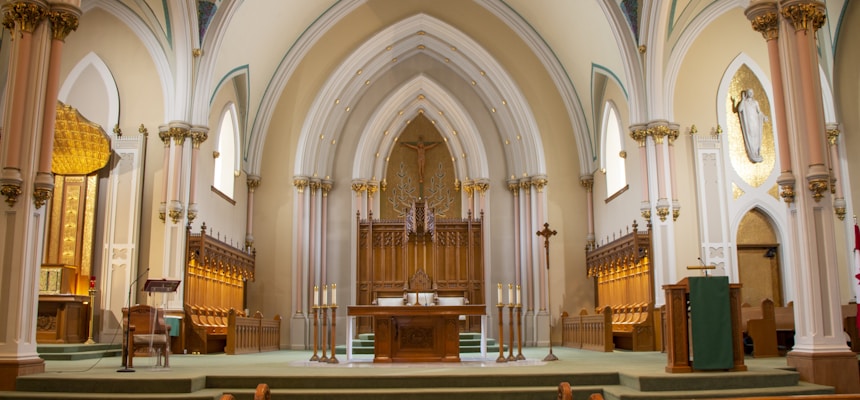
Photo by Perfectus Photography & Design Co. on Unsplash
“If only it were so simple! If only there were evil people somewhere insidiously committing evil deeds, and it were necessary only to separate them from the rest of us and destroy them. But the line dividing good and evil cuts through the heart of every human being. And who is willing to destroy a piece of his own heart? ” (The Gulag Archipelago, Aleksandr Zolzhenitsyn)
“Something there is that doesn’t love a wall.” (“Mending Wall,” Robert Frost)
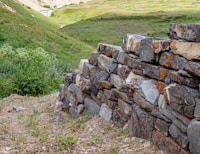
It wasn’t even an actual wall. It was a row of rocks stacked three, maybe in places, four high, but it served as a clear marker dividing our yard from our neighbor’s. Many were the days when my Dad and our neighbor, Mr. Candelario, met at the wall—that’s what we called it—to discuss for hours national and world affairs. Those meetings were among their great joys in life. Back then, I never thought how important the short rock wall was to their meeting to talk; without the wall, where could they have met. They needed a meeting place, and the wall was the most natural place available.
I don’t remember ever repairing the wall. When rocks tumbled, always into our yard—we called it the field—we just left them lay, or in a lackadaisical way boys have, would toss them back on to the wall when we would meet there for a neighborhood ballgame.
There was another wall even more dear to my father, the communion rail in our parish church. Maybe it’s not right to call it a wall. It wasn’t a property line, but it was a separation, a separation between different realms—the sacred and the profane.
I guess that’s not a popular way to look at the church building today, but I believe that there is still in the world the division between the sacred and the profane, and I remember that at one time—and in some churches—though no longer in my childhood parish church—the architecture reflected the reality of that separation.
My Dad was angry when the communion rail was taken out in the early 1970s, and I was saddened by his anger.
“Something there is that doesn’t love a wall,” as Robert Frost wrote very long ago, but something there is within us that needs one to be there.
“Mending Wall” was published by Frost in North Boston in 1914. I didn’t read it until I was made to in high school in the 1960s, after Frost’s death in 1963. The poem’s narrator meets his neighbor for the yearly spring repairs on the rock wall that separates their property. While picking up the rocks that have fallen and replacing them on the wall, the narrator wonders why they are doing it, why the yearly repetitive repair is necessary since it seems to him that there is something in nature that doesn’t want the wall there. He states his case to his neighbor who responds twice with the famous line, “Good fences make good neighbors.”
He is all pine and I am apple orchard.
My apple trees will never get across
And eat the cones under his pines, I tell him.
He only says, ‘Good fences make good neighbors.’ . . .
He moves in darkness as it seems to me,
Not of woods only and the shade of trees.
He will not go behind his father's saying,
And he likes having thought of it so well
He says again, ‘Good fences make good neighbors.’
We remember Frost as one of our great poets because he doesn’t resolve the contradiction between the two points of view. The urge to “modernize” the church and to remove the communion rails from them wasn’t bashful about resolving it in favor of the narrator. There is something that doesn’t love a wall, and there is something that can’t countenance any longer strictly separating the sacred from the profane. The something that would let walls dividing property fall is in nature; the something that would erase the separation between the sacred and the profane is in the human heart. A longing for a more comforting milieu.
The tumble down, short wall at the far end of our yard made my Dad and Ray Candelario good neighbors for several years. The communion rail brought us closer to God.
I don’t think Ray minded the removal of the rails and I believe that many in the Church today would consider my Dad to have been moving in darkness, unwilling to “go behind” his father. Maybe it is because I’m old now, but I suspect it may be a large mistake to want to “go behind” my father because of the first quote from Aleksandr Solzhenitsyn. The Gulag Archipelago was written about a gulag, after all, and gulags arose in states—the USSR and China—where the sacred was abolished and the profane declared to be sacred; that is, states in which the division between the sacred and profane had been perverted.
The sacred and the profane are two separate realms in our world. The profane is not completely evil, but it is where evil can exist, and the sacred is where there is only good. As Solzhenitsyn observed, the line between the two “cuts through the heart of every human being.” Because Solzhenitsyn is right, and knows that he is right based on the foundation of his time in the Soviet Gulag, our need for a demarcation between the two realms will never go away until the parousia when the profane will completely give way to the sacred.
Many, if not most, of the communion rails, those clear lines of demarcation are gone and won’t be coming back. The line is still there for us, though, even though we can’t see it. There is still a division between the sanctuary and the nave and the faithful indicate that they know that it’s there when, and if, they have been taught that the place where the altar and the tabernacle are is something separate from their everyday lives and that they need to approach it reverently. We will not be able to get rid of our need for reverence anymore than we will rid ourselves of our need for property lines; unless we go for a propertyless society, in which case, the churches will almost certainly be closed.
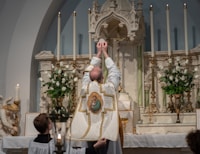
The communion rails themselves were a reduction in the division between the sacred and the profane. Before there were communion rails there were “rood screens,” which were walls that set off the sanctuary from the sight of the people. The mysteries took place behind the screen beyond the people’s vision. I have been told that there is where the elevation of the Body of Christ and the ringing of bells came from. The bells rang and the host was elevated above the wall so that the people would know that the consecration had happened. The elevation and the bells stayed in many parishes with the removal of the communion rails and they need to stay. In order to see what a rood screen looked like, you’ll need to go to an Orthodox Church which still has an iconostasis.
We are always in need of the sacred having its place in the profane world because of that line between good and evil cutting through the human heart. We’ve known this since before the coming of the Christ. What the coming of the Christ changed was not the need for a sacred place in the world, but what that sacred place meant. In Judaism, and in the archaic religions of the world, the sacred was associated with violence. Setting off the sacred from the ordinary lives of the people was the chief, and usually the only way, of sealing off the violence of the sacred from their day-to-day lives. When violence broke out in a society, as it did invariably, it had to be put somewhere, and that somewhere was the sacred place. The way it was put back there was through a sacrificial ritual—and in the beginning the sacrifices were human.
Even in the Jewish religion, the Holy of Holies in the Temple was nothing to trifle with and only the high priest could enter it once a year. If anyone else would have dared to do so, they would have died.
And in the Book of Exodus, upon reaching Mount Sinai, Moses wrote: “You shall set limits for the people all around, saying, ‘Be careful not to go up the mountain or to touch the edge of it. Any who touch the mountain shall be put to death.’”
Coming too close to the sacred, the Holiness of God, was to risk death. We have not yet completely been shorn of this lingering belief. It runs dark and deep in the human psyche. Among especially the uninitiated, there is a discomfort, an unnameable fear associated with whatever they deem to have sacred status.
The aftermath of Vatican II, and its animating spirit, was the unstated belief that we could undo this dark current by a more accommodating approach to the division between the sacred and the profane; we could blend them more, ease the tension. I sense a need on the part of many, and many of them young, to bring the division, the tension back. We have seen what the blending of holiness and secularity have wrought in our world. The world is much more unstable and the violence more unpredictable than any sane person is comfortable with. At the parish where I reside, they hired a police office for security during the Sunday Masses a couple of years ago. After Dodd, they were glad that they had done so. In the small town parishes where I was the pastor, several parishioners concealed carried into church. I didn’t object, and people seemed to be happy as long as nothing was said.
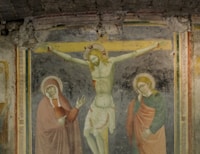
The sacred changed with the death of Jesus on the Cross. What changed was that the sacred was completely emptied of all its violence. It is the one non-violent and sinless—violence comes from sin—place in the world. Rather than blending the holy with the secular, we are more in need of it being clearly divided off from the ordinary profane. We do not live in a stable world and so we are more in need—though it is a need that will only pass with this world—of a place where God is and is known to be there.
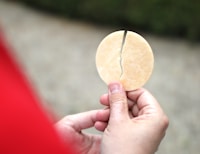
The profane is the place where sin is still possible and likely. Where sin is likely, the threat of violence remains. The Cross and Resurrection ushered into our dimly lit world the clear call from our Father that in His Son, the line between good and evil cutting though the human heart needs to be and can be erased. The heart can be filled with the only and the supreme Good itself. But we need to be aware of the line between the sacred and the profane in order to awaken the hope that the peace of the sacred can pass into us when we come up to boundary and receive Him who put an end to sacrifice, except for his, into our own hearts and souls with Holy Communion.
His is the only sacrifice that can put an end to human violence and to remove His sacrifice from our lives and from our world would be an unleashing of violence that we cannot imagine. His sacrifice made present on the altar, His glorified body reserved in the tabernacle, is the only truly sacred place in the world.
Recommended Stories
About the Author
I'm a busy retired priest living in Cape Girardeau, MO