Between the Sacred and the Profane

Why We Really Go To Mass

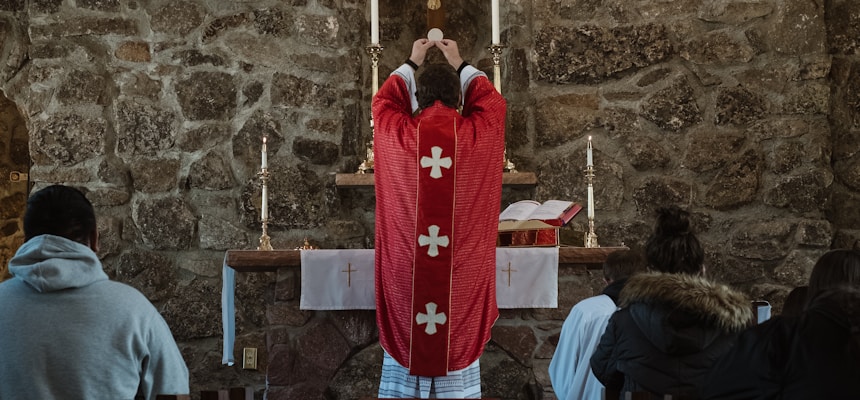
Photo by Josh Applegate on Unsplash
These are the real reasons:
1. We know that we are here but the day will come when we won’t be here.
2. Those long before us knew, and we still somewhat know, that for us to keep on living here for however long we can, someone, or even many someone’s, however many over however long a time, has to die in our place, instead of us.
3. We know deep down that’s wrong and we feel bad about it.
There is a BC and AD for this. Before Christ people only dimly, if at all, felt bad about someone dying for them, except in cases of war. Someone dying in their place is the essence of archaic religion, as well as for the secular religions practiced today, like the religions of Progress, Prosperity, Humanity. After Christ, in all of the years of our Lord, we know we should be willing to die for others, and know we’re guilty of cowardice if we’re not, and unwilling that anyone should die for us, except in instances of war or law enforcement. In the Catholic Church, one dies for all and that one is Jesus Christ.
That’s not the customary list of reason, I know, nor is it likely that they are for hardly anyone compelling reasons.
The compelling reasons for going to Mass run something like this: I go to Mass in order to worship and adore God; or, I go to Mass in order to be spiritually nourished; or, I go to Mass out of an obligation bestowed upon me by my parents; or, I’ve developed the habit; or, if I don’t go I feel guilty; or, if I don’t go to Mass I’m afraid God will punish me.
Those customary reasons aren’t working like they once did, so I think it’s time to deal with the real reasons. The real reasons involve us in the transcendent worship of God via the least transcendent looking event imaginable, the crucifixion of an innocent man, who is God. His death was a ritual death, though we may not see it as such since it was a court ordered—that is, legal—execution. And just like the sacrifices of archaic religion, such a death does produce within the members of a society the emotions associated with the sacred—awe and transcendence.
The four reasons I’ve listed for going to Mass aren’t motivational or even convincing. They’re the reasons why we go to Mass whether we want to go or not. They are foundational and the foundation has been laid upon the soil of our souls. Those who fail to go to Mass drift into the secular religions which have brought forward archaic religion but without its cathartic release. Archaic religions worked to minimize violence; the current versions maximize violence.
We Christians are often accused of maximizing the violence rampant in the world, and often we have been as guilty as anyone else for killing great numbers of other people. We had our reasons, of course, and most of them are justifiable; still, killing is killing. We don’t much, if at all, kill other members of the societies we live in. In fact, those of us who faithfully participate in the Mass aren’t violent at all. Why is that?
For the same reason that the archaic religions minimized violence. It has to do with a corpse.
If anyone has been in the presence of a corpse, they are aware of a sense of awe, a sense that they are in the presence of something sacred because it is something beyond them that they can’t explain.
What does it actually mean to die? They know they are facing a mystery that is a real as the human body that they see and which cannot be comprehended by a recounting of the physical facts of the death. Such as: he was riding his motorcycle to meet some friends for breakfast when the dump truck pulled out in front of him. Or, drug dealers were shooting at each other and she shielded her daughter with her body.
A dead body, from whatever cause, bestows on us an awareness of the transcendent sacred, and nothing else really can.
The moment we come into the presence of a corpse we are unknowingly, and even unwillingly, transported to the first death. We involuntarily ask, not, “Why did they have to die?” Genesis gives a clear answer to the question. We ask, “What does it mean for me that they had to die?”
We have been denied by our ancestors complete and full life with God. The first ancestors, the man and the woman, were also the first to be unable to leave what they had originally been given to their children. They were far from the last. We may not be fully aware, though there is a gnawing hint, that what we should have inherited and should have been able to bequeath to our children, has been taken from us. We’re pretty angry about that, and that anger is the font of our murderous violence. There is a reason Jesus commanded us not to be anger with each other.
Can anyone leave that original inheritance, complete and full life with God, to their children? Not exactly, but parents can now tell their children how to receive that life. Whether the children choose to receive it is up to them, but they want to receive our true inheritance for they are no different than any other man or woman in any time and place. If they sense that they have been cut off from that inheritance, they respond with deep anger, rage, and violence breaks forth upon the land. That is the common good, the good common to us all, and if it is taken away, then . . .
We know that our sacred worship of God is the representation of the sacrifice of Jesus on the cross without the blood, without actually seeing him suffer it, but we enter his self-offering to the Father in the bread and wine he left for us at the Last Supper.
We often say that he died for our sins, but now much meaning does that have for us? Can’t it quickly become yet another abstraction that doesn’t do anything for us. Even saying that He is God can quickly become an abstraction that shields us from what He really is.
Yes, He is God, and from His death we rise, but we rise above this fallen world. We can pick up a handful of dust and no longer be afraid. He means for us to feel bad, not for him, but for all of the victims that ever were and will always be so that we may be purified of own futile efforts to stay here for as long as we possibly can.
We go to Mass really because we feel bad, but we are meant to get over that. We go to Mass not so much for transcendence, we go to Mass because through a death like His we transcend in His death and our own.
Recommended Stories
About the Author
I'm a busy retired priest living in Cape Girardeau, MO