
Fight or Die: What it means to be a Catholic Man

The Reluctant Roman: or Why I Converted to the Catholic Church, Part III: The Body and the Blood of Christ


In Part I of this series I discussed the role of history and Tradition in my conversion to Catholicism.
In Part II, I discussed the physical nature of man and its role in Worship.
As previously mentioned, I plan to outline three major ideas that finally convinced me to convert to Catholicism. None of these was the single deciding factor in my conversion, and these three reasons are by no means the only things that influenced me in my decision. But these big three insights that God led me to changed the way I viewed Christianity and by extension, Catholicism.
And now for the third reason:
The Body and the Blood of Christ
This is perhaps the most difficult and controversial aspect of Christianity that I have discussed so far, and I fear that I will in no way be able to do it justice. It is a hard thing to write about. In fact, in the Gospel of John, many of the men following Jesus responded to it by grumbling:
“This is an hard saying; who can hear it?”
But I must speak of this aspect of Christianity, because in this aspect came a major change in my understanding of the Faith that ultimately led me to convert to Catholicism.
I am referring to Communion and the Eucharist, what most Protestant churches might refer to as the Lord’s Supper.
Almost every Christian denomination recognizes the Lord’s Supper in some way. The breaking of the bread and the offering of the cup of wine that occurred during the Passover feast just before the Lord’s crucifixion is a central story in Christianity, one that almost every child in Sunday school or Catechism knows by heart. Almost all Christians remember and honor this event, as it is recounted in Luke 22:19-20:
“And he took bread, and gave thanks, and broke it, and gave unto them, saying, This is my body which is given for you: this do in remembrance of me. Likewise also the cup after supper, saying, This cup is the new testament in my blood, which is shed for you.”
Or in Matthew 26:26-28:
“And as they were eating, Jesus took bread, and blessed it, and broke it, and gave it to the disciples, and said, Take, eat; this is my body. And he took the cup, and gave thanks, and gave it to them, saying, Drink ye all of it; For this is my blood of the new testament, which is shed for many for the remission of sins.”
Likewise, the Gospel of Mark recounts the event in a similar way.
While almost all Christians agree that this was an important event in the life of Jesus, they differ wildly on their interpretations of its broader meaning and in their ceremonies surrounding the event.
Once again, for purposes of simplicity, I will refer to the two views with which I am most familiar: Baptist and Catholic. This is actually helpful for purposes of comparison, because the non-sacramental Baptist viewpoint is so clearly different from the sacramental Catholic viewpoint that it is very easy to see the divergence.
Though Baptists honor the Lord’s Supper and agree that it is an important institution created by Jesus Himself, in my experience they do not place a great deal of importance on it. In my time during the Baptist church, the Lord’s Supper was offered very infrequently and seemed to follow no set schedule at all in its administration. In all honesty, it seemed to be that if the preacher felt that the congregation had not done the Lord’s Supper in a while, he would put it on the schedule for next week. I do not say this to be facetious; this merely illustrates the comparative lack of importance that the Lord’s Supper holds in the Baptist church.
Yet this is not to imply that Baptists do not honor the institution. When it is performed, the Lord’s Supper is always handled in an appropriate and solemn manner. I remember taking part in the Lord’s Supper and the fact that it is also known as the Last Supper was at the forefront of my mind even as young as I was. This was the last thing Jesus ate before his crucifixion, and we remembered it somberly.
“This do in remembrance of me.”
And Baptists certainly treat the Lord’s Supper with the solemn remembrance that it deserves. This, however, brings up the most important difference between Baptist belief and Catholic belief. For you see, in the Baptist conception of the Lord’s Supper, it is done in remembrance and In Remembrance Only. The Lord’s Supper is purely symbolic. The bread symbolizes Christ’s broken body. The wine symbolizes Christ’s spilled blood. These are symbolic memorials that Jesus has given to us to help us “do in remembrance” of Him. This is how I grew up understanding the Lord’s Supper, and it seemed a natural interpretation at the time. Of course Jesus was not speaking literally.
Of course he did not mean that the bread really was His Body. Of course he did not mean that the wine really was His Blood. Right?
Wrong, according to the Catholics.
In Catholic belief, the Bread and the Wine offered at the Last Supper are the real, literal Body and Blood of Christ, and are meant to be really consumed by Christians.
Catholicism calls this idea Transubstantiation, that the bread and wine actually, physically become the literal Body and Blood of Jesus.
And this was (initially) a major stumbling block for me on my road to Catholicism. You see, at first, I simply did not believe in Transubstantiation. I clung to my belief that the whole thing was symbolic. I mean, come on! It is bread! It is wine! They don’t change; they don’t suddenly transform and morph into human flesh and blood up there on the altar. That is crazy!
I was like those early followers of Jesus. I cried out, “This is an hard saying; who can hear it?”
But I had to hear it. I could not just abandon Christ as those so-called followers did. I had to be like the Twelve Apostles. I had to stick with Christ even through the hard sayings. I had to say as Peter did when Christ asked if he and the other eleven would abandon him as well:
“Lord, to whom shall we go? thou hast the words of eternal life.”
But for a long time, I struggled with these words. I struggled with the concept, because I just did not believe that the bread and wine could really turn to the Body and the Blood. It was only through much prayer and study that I finally realized something, something that I would have been much better off learning a long time ago:
I was wrong!
I had to come to terms with the fact that I had been wrong in my beliefs about the Lord’s Supper. I had to accept that a purely symbolic interpretation of the Lord’s Supper is wrong. I had to give up my individualism here; I had to sacrifice my ego and my own interpretation and accept the reality of what Jesus was teaching.
Now there was a major Scriptural realization that occurred through my study that helped me accept this. This realization, along with many other things I learned in my studies, converted my view from almost a total symbolic interpretation of the Lord’s Supper to a full belief in Transubstantiation and the real presence of Christ in the bread and wine. Now I am not going to attempt to “prove” Transubstantiation here. That is not what this discussion is about. I am only going to point out how I personally came to believe in its Truth.
The realization occurred when I read the 6th chapter of the Gospel of John. No other passage in the Bible has had such an effect on my conversion in this aspect as John 6. The astounding thing is I do not recall ever having studied this chapter of John while in the Baptist church. Before my own personal studies, I confess that I did not even know that this passage existed. I believe that there is a good reason for this. There is a good reason that Baptists ignore or drastically downplay this teaching of Jesus; it contradicts their views of the Lord’s Supper as being merely symbolic. I will not harp on this. Instead, let me just show you the portion of John 6 that I am referring to. It is rather long, but I hesitate to shorten it:
“For the bread of God is he which cometh down from heaven, and giveth life unto the world. Then said they unto him, Lord, evermore give us this bread. And Jesus said unto them, I am the bread of life: he that cometh to me shall never hunger; and he that believeth on me shall never thirst. But I said unto you, That ye also have seen me, and believe not. All that the Father giveth me shall come to me; and him that cometh to me I will in no wise cast out. For I came down from heaven, not to do mine own will, but the will of him that sent me. And this is the Father’s will which hath sent me, that of all which he hath given me I should lose nothing, but should raise it up again at the last day. And this is the will of him that sent me, that every one which seeth the Son, and believeth on him, may have everlasting life: and I will raise him up at the last day. The Jews then murmured at him, because he said, I am the bread which came down from heaven. And they said, Is not this Jesus, the son of Joseph, whose father and mother we know? how is it then that he saith, I came down from heaven? Jesus therefore answered and said unto them, Murmur not among yourselves. No man can come to me, except the Father which hath sent me draw him: and I will raise him up at the last day. It is written in the prophets, And they shall be all taught of God. Every man therefore that hath heard, and hath learned of the Father, cometh unto me. Not that any man hath seen the Father, save he which is of God, he hath seen the Father. Verily, verily, I say unto you, He that believeth on me hath everlasting life. I am that bread of life. Your fathers did eat manna in the wilderness, and are dead. This is the bread which cometh down from heaven, that a man may eat thereof, and not die. I am the living bread which came down from heaven: if any man eat of this bread, he shall live for ever: and the bread that I will give is my flesh, which I will give for the life of the world. The Jews therefore strove among themselves, saying, How can this man give us his flesh to eat? Then Jesus said unto them, Verily, verily, I say unto you, Except ye eat the flesh of the Son of man, and drink his blood, ye have no life in you. Whoso eateth my flesh, and drinketh my blood, hath eternal life; and I will raise him up at the last day. For my flesh is meat indeed, and my blood is drink indeed. He that eateth my flesh, and drinketh my blood, dwelleth in me, and I in him. As the living Father hath sent me, and I live by the Father: so he that eateth me, even he shall live by me. This is that bread which came down from heaven: not as your fathers did eat manna, and are dead: he that eateth of this bread shall live for ever. These things said he in the synagogue, as he taught in Capernaum. Many therefore of his disciples, when they had heard this, said, This is an hard saying; who can hear it?”
Jesus makes it very clear in this teaching that He is the Bread of Life and that we as believers must eat of Him to have Everlasting Life. And when those listening to Him object to this teaching, Jesus does not back down, but rather reemphasizes that only those that eat of the Bread of Life will live forever.
And what exactly is this Bread of Life?
It is the very flesh of Christ Himself! It is the literal flesh! Jesus states very clearly that unless we eat his flesh and drink his blood, we will have no life in us. There is nothing ambiguous in the language that Christ uses. He is making a stark point here. He is making a drastic claim.
It is this claim, this startling assertion, that so shocks the Jewish listeners around Him. They are aghast that this man Jesus is saying they will need to eat His flesh. And they react exactly as you can expect someone would react if you said they needed to consume your flesh. They are appalled! They are mad at Jesus. They want Him to change His teaching. But He won’t.
Jesus does not back away, does not clarify and say that he was merely speaking symbolically. He does not try to placate the upset crowd and say, “Oh, I really meant that you only need to memorialize My Body and Blood with bread and wine, and it was metaphorical.” No, instead, he hammers the point home and states that we have to eat His flesh and drink His blood if we want life!
And it is this that is the “hard saying” that I have repeatedly alluded to.
When I studied this passage, I was stunned at the clarity of Jesus’ language. It is clear that He is not speaking figuratively. Rather He really means that we must eat His flesh and drink His blood. This is necessary for Everlasting Life.
There is no getting around this.
When I came to understand this, then it became clear that the Baptist conception of the Lord’s Supper as being a mere memorial utterly misses the point of Jesus’ words. Jesus did not want a symbol; he meant for us to take the Body and Blood into us physically and literally.
If this is the case, then where was I to go? After realizing this, I felt like one of those early disciples begging, “Lord, evermore give [me] this bread.”
If I need to eat Your flesh and drink Your blood, then show me where I can get It! Give me the Bread of Life! Where is it?
And this is where the Catholic Church stepped in and said, “The real Body and Blood of Christ is here.”
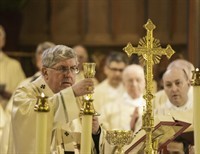
For the Roman Catholic Church is the only church on Earth that both claims the Real Presence of Christ in the Body and Blood during the Eucharist in the Mass and the only church with the authority through Apostolic Succession to make such a claim. The Roman Catholic Church offers the flesh and blood of Christ to its members at every Mass. It offers to fulfill the teaching of Christ Himself when He stated so boldly that “Except ye eat the flesh of the Son of man, and drink his blood, ye have no life in you.” It offers to allow us Christians in the present day to be literal and physical partakers in the sacrifice of Jesus Christ.
When I learned that Christ had commanded us to partake of him physically, I longed to do so!
And so I had to become Catholic.
In Part II of my conversion explanation, I discussed at length why Man is meant to worship not only spiritually but physically as well. Here is yet another (and perhaps the most important) example of that idea.
We are not called to worship God only spiritually. Likewise we are not called to partake in the Lord’s Supper only spiritually. Communion, the Eucharist, the Lord’s Supper, whatever you want to call it, it was never meant to be simply a symbol or a memorial. It is a literal thing! More importantly it is a physical act! It is a physical manifestation of a spiritual mystery. We are physically taking the Body and Blood of Jesus into us, just as we spiritually were filled with the Holy Spirit at the moment of our Salvation. It is the fullness of our Redemption made visible and evident in the physical realm. And we are to be glad partakers of this sacrament, a rite established by Jesus Christ Himself. The Catholic Church defines the sacraments as “efficacious signs of grace, instituted by Christ and entrusted to the Church, by which divine life is dispensed to us.”
The Eucharist, the actual Body and Blood of Jesus Christ, is one of the means by which the Lord dispense divine life to us. In the very words of Jesus, “For the bread of God is he which cometh down from heaven, and giveth life unto the world.” Christ is giving us Everlasting Life on the condition that we consume this bread of God: His flesh.
And it is the Catholic Church that has the authority on Earth in the present day to sanctify and to offer this sacrament. As we Men are physical beings as well as spiritual, then it is only fitting that Our Lord should dispense spiritual Salvation to us partly through physical means. We should not shy away from this. It is the teaching of Jesus, and however hard of a saying it may be, I had to give up my search and I had to listen when Christ states something as boldly as:
“Except ye eat the flesh of the Son of man, and drink his blood, ye have no life in you.”
And I thank the Lord with all my heart and soul that He never gave up on me in my search. Even when I strayed far and looked in dark places, He faithfully led me back to the Light of the Truth.
Because I listened faithfully to the words of Jesus Christ, and because I sought life, I had to become Catholic.
(As a minor footnote, I want to be absolutely clear that I do not think that the Catholic Church is the only place that Salvation through Christ can be found. I was no less saved when I was Protestant, and I believe that Christ will find you wherever you are, in whatever denomination, as long as you are seeking Him. He told us as much in the Gospel of Matthew: “Ask, and it shall be given you; seek, and ye shall find; knock, and it shall be opened unto you.”)
Recommended Stories
About the Author
R.W. Schmidt is a 26 year old high school English teacher in Texas, and the author of the Christian fantasy novel, The Lands Beyond the Moon (Available on Amazon, Barnes and Noble, and other major book sellers).
He and his wife, Brett, are Catholic converts from Protestantism. They recently welcomed their first child, James, in November 2014. You find out more about Schmidt and receive news about upcoming books at his website: www.randalwilliamschmidt.com



Trending


