
An Ocean of Prayers
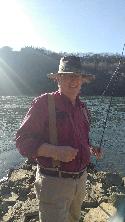

It was about 2004 when my 23 year old son and I took my 16 ft Skeeter bass boat on a deep sea fishing trip to Panama City Beach. I was fairly confident that its deep bows could handle a calm ocean, and I had previously taken boats from Scotty's Boat Rentals offshore. I also owned all the fishing gear needed for the pursuit of king mackerel, which can be caught trolling either live herring or the store-bought cigar minnows. Live bait is best of course! I had borrowed a GPS unit from one of my patients and a two way radio from a friend. Plus, I also had a flip cell phone. The idea was to troll our bait, going dead slow, part of the time and to fish around known, underwater structures which could be located via the GPS unit. With life jackets securely fastened and with the electronic equipment in ziplocks, we launched at a public ramp near the channel leading to the open ocean.
The most dangerous part of the trip occurred almost immediately when a 100+ ft commercial boat passed us going full speed in the opposite direction. The problem was that this boat was creating a continuous 8-10 foot bow wave, which we could not avoid. I slowed to dead slow and tilted the 140 hp engine up in order to raise the bow of the boat as high above the water as possible. I then said some fast prayers and, while warning my son to hold tightly onto our boat, I steered straight into the massive wave, in hope that we could slice through it. I figured our chance of being sent straight to the bottom was 50/50 at best. When we hit the wave, we shifted at least 100 or more gallons of sea water, and the front half of the boat was completely awash. But they apparently built our boat well in Kilgore Texas, as we did not sink, and the bilge pump did its job. We were soon 3-4 miles out in the Gulf of Mexico which was running at 4-5 feet - a big improvement!
I handed the navigation unit to my son, figuring that a young person would be better able to operate it than myself. Our destination was some underwater bridge abutments which had been placed there by the city as fish attractors. According to my depth finder, most of the water out to about 4 miles was 70 ft deep with a smooth bottom. That was why some type of structure was needed to attract the baitfish which, in turn, attracted the larger predatory ones, which attracted us.
Although my son was diligently following the direction indicated on the GPS, I noticed that we were going in a circle with a diameter of about 1/4 of a mile. He kept saying to head to port, which was the left side of the boat, so we were soon lost at sea, so to speak, although we could see the beach a good ways off. That was when I noticed a few fishing boats, all much larger than ours, apparently anchored on our semi-secret destination about a mile away. With it being 70 ft deep, we were unable to secure a good anchorage over the bridge parts, and decided that we would rig up our lines for some trolling, which is really my favorite way to catch mackerel. Trolling for fish anywhere is not as simple as it may sound, as it involves mathematics, physics and a knowledge of fish biology, to provide the correct lure or bait for the targeted species. Trolling is really interesting with plenty of ups and downs; both literally and figuratively.
For example, when you are fishing two lines, one from each side of the boat with each line about 130 ft out, and with the rods extended outward from the hull, if you make a turn to starboard (right), the lure on the inside of the turn will descend in the water column and often trigger an immediate strike, as many fish respond to a falling bait. Meanwhile, the lure on the outside of the turn will not descend as deeply. So you are instantly fishing at two different depths, with the outside lure travelling faster than the one on the inside. This type maneuver is well known to anyone who trolls. And if you see from your depth finder that the water is becoming more shallow, you can speed up and cause your lures to gain height relative to the bottom, so they will not become a permanent artifact on the sea floor. So, there are many tricks of the trade to put food in your ice box.
We then motored about a mile closer to shore and turned off the engine to give us time to rig our trolling rods. That is a spooky thing to do, since it is never a certainty that an engine will restart. Yet, we both had faith that our engine would start. But in a few minutes, with the boat being completely stopped, we started bobbing about 5-6 feet straight up and down, and I became seasick. I told my son we were going to have to head back to the harbor immediately. He suggested that we troll all the way back, which we did, and soon boated an 18 lb king mackerel.
As we neared the harbor entrance, a porpoise almost as long as our boat swam up right beside us hoping for some food. But it is against the law to feed porpoises, so we motored back to the boat ramp. We grilled the mackerel that night back at our cabin, and of course it was excellent.
I have often thought that I have a guardian Angel looking after me and mine, and an ocean of prayers were certainly answered that day.
Recommended Stories
I am an avid Tennessee outdoorsman, practicing dentist, conservationist, environmentalist, boat builder, former whitewater kayaker, first outdoor editor of Versus, a Vanderbilt student newspaper, as well as a father of two and grandfather of three, and a serious Catholic boyfriend and confidante. In respect for our God-given resources, my motto is to always "leave the outdoor environment in better condition than when you first found it" !!



