The Truth Will Set You Free
Sponsored

Catholic365 is sponsored by
Road to Purity




(Written prior to my conversion to the Catholic faith.)
So, let's begin with the definition of baptism according to the Catechism. Baptism is the regeneration by water in word. Basically, when a person is bathed in the holy water, their whole spirit becomes washed and is a new being in Christ. That's what most Christians believe. Baptism is a symbolic washing of the soul for most Protestants, but for Catholics, the soul is literally cleansed during baptism.
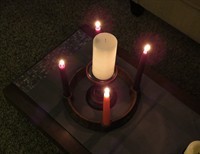
During the baptismal ceremony, the baptize-ee is given a white robe, symbolizing their new purity and their union with the commune of saints. For an adult, the baptize-ee is also annointed with holy oil, signifying their union with the holy priesthood to which all men are called - this is confirmation; infants do not get confirmed. Baptize-ees are also given a candle, representing the Light of Christ now present within them, which they are to take to all corners of the world. It is a candle because it is Light sufficient for where they are presently on the journey. The flame of the candle is lit from the Paschal Candle, the big one in the sanctuary which never goes out, because it is Christ's Light on earth. It's a very pretty ceremony, actually.
Another technicality of the ceremony is water. Any holy water will do, and, since it's in limited supply, the less we can use, the better. Well, kind of. Immersion is always the best baptism. Most typically, holy water is poured, sprinkled, doused, dripped, or dunked on the head (yes, some baptisms just submerge the head.) Some people walk through wading pools. Some people wash their hands. The point is, you're washing your soul. Actually, you're not even washing yourself. Some priest is washing you. You are being washed into the family of Christ.
A big Protestant argument is that Catholics aren't technically baptized because the term means "to dunk" and, more often than not, Catholics don't get dunked. However, Catholics would argue that there are tons of times where people wanted to be baptized in the desert and there was no water to be found, or, what water was to be had was needed for survival, so just a small amount could be used for the ritual. Would we call those people any less Christian just because less water was used? What's the real point of baptism, anyway? Well, it's grace and redemption, yeah? So, what's the big deal about how much water is used?
Furthermore, my investigation into the term "baptismo" means that, yes, while it means to submerge, it is a term used for washing dishes. Actually, that's how it's used all over the New Testament. Remember when Jesus condemned the Pharisees for washing the outside of the dish but not washing the inside? Yeah, that's "baptismo" right there. My guess is that, when people used the term baptized, they didn't mean, "dunked in holy water." I think they meant a ceremonial washing for the purification symbolism, yes, but ceremonial washings all over the world have a variety of structures, from full-on baths to just a specific part. Point is, JUST GET WASHED.
Ain't nobody got time for dirty. Anyway. Moving on.
The biggest Protestant argument against Catholic baptism is that, yes, most Catholics are baptized as babies. "This isn't right," people say, "Babies can't experience the saving grace for themselves nor can they understand what's going on!" Well, not necessarily. A baby doesn't need words to understand that they are loved or that they love someone else. Who's to say a baby doesn't know grace when it is so small and young? Scripture does lean towards a believer's baptism - where the person being baptized is purposefully, consciously, choosing to be baptized and hereafter devote their walk to Christ. However, in Luke 18 and Matthew 19, when Christ calls the little ones to Him, the word He uses is actually the Greek word for infant. Catholics use this and texts mentioning whole households being baptized as validation for their practice (yes, it's basically isogesis.)
I see a historical-cultural reasoning for Scripture having more evidence for a believer's baptism: Christianity was just taking off. The testimonies we see in Scripture are of adults converting to Christianity. This is just the first generation of Christians. There weren't any babies born into Christianity at that time, so Scripture sets no precedents for what should happen when a child is born into this new religion. Actually, if anything, evidence at the time would suggest Judaism still played a heavy role in the newborn Church itself. The comparisons of baptism to circumcision are evidence of this, and, ironically, they're probably where infant baptism got its start. If you tell a Jewish audience that baptism is the new circumcision, logic would follow to not only baptize converts but baptize infants born into the religion. It's an initiation rite. So, yes, infant baptism is never explicitly mentioned in Scripture, but, given the Church Fathers never argued against it, Martin Luther was in support of it, and the evidence from the Jewish community at the time, it's probably been around as long as Christianity itself. Let's just leave it alone for now.
Catholics believe that all human beings are sinful and fallen from the moment they are born. This is called original sin - all humans, once conceived and in existence, have the stain of sin on themselves. Baptism washes that sin away. However, a desire for baptism may yet produce the results of baptism. For example, if a person can't get baptized right away and they die before they can, the Catholic Church maintains that that person is still saved.
Matter of fact, there's few people that proper Catholicism would actually condemn to hell. So long as a person has a tendency towards God, there's probably some kind of searching and relationship there that is of God. Because we are mortals and can't know the deep things of a person's heart, we cant' condemn what's there. Only God can do that. A person with knowledge is then responsible for that knowledge, but otherwise, how can a person truly know to do any better? Some people are just truly lost, and they're doing the best they can. God knows and understands.
This leads me to my conundrum with Catholic baptismal practices. Nope, baptizing of infants isn't found anywhere in Scripture. Yep, the word "baptismo" means to dunk, not sprinkle. So, no, Scripture alone doesn't defend or support Catholic baptismal practices. So are these people really saved? Are these people really Christians?
Well, yes. Totally. 100%.
I'd like to call your attention back to a passage I mentioned earlier, when Jesus condemns the Pharisees for washing the outside but not the inside of the dishes (Matthew 23:25, for reference). The warning of this passage in its context is that the Pharisees have splintered the Law down into bits and pieces and followed them all extremely piously, to the point that they missed the whole message of the Law itself. Oh, they kept the Law in all its entirety, but they still missed the point of it.
I think in this Protestant/Catholic debate, we've missed the point, too.
The point of Jesus coming was to fulfill the Law - to simply love. Love God. Love your neighbor. Love yourself. JUST. LOVE. Jewish Law, when properly examined, was beyond merciful in comparison to other cultures of the day. The whole point was to create a group of people who were merciful and loving to others around them, and, in turn, they would be merciful and redeem more people. Sadly, we humans screwed that up (because that's what humans tend to do.) But still. The point was to love others.
Back to my text.
When we splinter Christianity down to a precise scientific creed (get baptized at this precise date, be confirmed at this age, married by this time, enter into this ministry, pray X amount of hours, do Y amount of events with the youth group, lead a successful Bible study, etc.), we become the Pharisees. We, in turn, make the focus all about following the rules and doing things right instead of love. We become a spiritual legal system as opposed to a spiritual healing center for the broken, the lost, and the ill at heart.
The point of Christianity was never to set up a new Law for people to follow. The point of Christianity was love, setting all men free. We don't have to meticulously keep every single ritual to appease a false god like our lives depend on it. We are free to a loving God that keeps us safe from harm as long as we live within His will. He loves us and wants us to know how much and understand that love. He doesn't care how we get to Him so long as we do. If following Him means getting sprinkled, poured, or dunked, I highly doubt He cares. If He did care so much, why didn't He give more precise instructions on baptism in the New Testament? Seriously, if He can tell the Jews how to handle a zit, I'm pretty sure it wouldn't be too complicated to tell Paul, "Hey, by the way, to initiate new members, have them do X, Y, and Z." God just wants us to know Him! He wants us to find Him, through whatever means He can! If you hear Him calling, answer it. If you're moving towards Him, just keep going. You're doing the best you can. That's all anyone can really hope for. Just keep at it, and eventually, you'll get there.
Sarah is an aspiring writer, artist, businesswoman and teacher from Cornfield, USA. Having studied extensively under evangelical mainstream Protestants and growing up as one of them, Sarah felt something was missing in her faith and found her life was lacking the real presence of Christ. She converted to Catholicism in April 2014 to begin a new chapter. A month later, she began another new chapter in her life by graduating from Lincoln Christian University with a degree in business administration and TESOL certification (Teaching English to Speakers of Other Languages.) While new to the faith, Sarah hopes to use her training and understanding of Protestant and Catholic doctrine to open up more dialogue between the faith communities. Currently, having graduated with her Masters of Arts degree in Composition and Rhetoric, she teaches high school English as well as English as a Second Language in rural Illinois. She married her husband in July 2024.
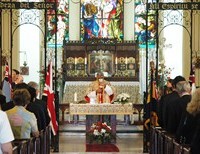
(Photo courtesy of Michael Gowin Photography)