The Church: What Do You See?
Sponsored

Catholic365 is sponsored by
Road to Purity




In this series, I will share my conversations about marriage that occur on our streets everyday. In this first article lets have some background on the Catholic Church and Marriage, shall we?
The two most frequent questions I am greeted with when I share with people that I am Catholic are:
“So you’re against Gay people right?”... "Well no," I reply, "I love all people, just hate the sin."
The next is ”so I’m supposed to stay in a marriage where I am unhappy?"
After a little more questioning, I find out that their assumption was based on their perception of the Catholic view on same-sex marriage and on Divorce. After a lengthy discussion, many of the inquisitors admit they were not sufficiently educated on the Catholic view, although many were not ready to admit they agree with it
Matrimony or marriage is a perpetual and indissoluble bond. God Himself is the Author of marriage, it is not a human institution. “Therefore a man leaves his father and his mother and clings to his wife, and they become one flesh.”(Gn 2:24) Man and woman were created for one another.
Without the help of God’s grace, man and woman cannot achieve the union of their lives, for which God created them. (CCC1608) When I speak of marriage, I only refer to a Christian marriage, which is an efficacious sign: the sacrament of the covenant of Christ and the Church.
Who can be the recipients of a sacramental marriage? Only a baptized man and a baptized woman, who both give consent can be married. Consent must be mutual, declared with words, denoting present time. A Priest (or deacon) assisting at the Celebration receives the consent of the spouses in the name of the Church and gives the blessing of the Church. (1630) Important note here, the Priest or deacon are not the Minsters of the Sacrament, the spouses are the Minsters. The form of the Sacrament is the exchange of vows or promises made to each of the spouses. The matter of the Sacrament is the physical expression of love between the spouses.
Pope Paul VI in his encyclical "Humanae Vitae" (No. 9), offered a beautiful reflection on this conjugal love of marriage. The Holy Father said that marital love is a genuinely Human love, because it embraces the good of the whole person, and is rooted in a freely willed giving of one spouse to the other. This love endures through joy and pain, success and failure, happiness and sorrow, uniting the couple in both body and soul. This love is also total — free of restriction, hesitation or condition.
In the ancient Church there were three stages in Greek and Roman marriage, Negotiations, betrothal or consent, and wedding. Christians agreed with Roman law that “Consent makes a marriage” and so betrothal was the decisive stage. The event was marked by a party, documents, and exchanging of gifts. By the second century, Christian Marriages took place occasionally. By the end of the fourth century the expectation became that Marriages were at least blessed by priests. The Council of Trent aimed at eliminating those marriages contracted in secret:committment must be announced during Mass on three occasions, and is invalid unless contracted in the presence of a priest and at least two Witnesses. The priest must immediately make records of marriages.
The Second Vatican Council (1570-1962) added that the marriage takes place before Mass. Sacrosacntum Consilium (4 December 1963) stated that Matrimony is normally to be celebrated within the Mass, after the reading of the Gospel and the homily. 19 March 1969 Ordo celebrandi matrimonium, issued a revised rite for marriage outside of Mass, for marrying aCatholic and a non-Catholic. Finally on 19 March 1990, the second edition of Ordo celebrandi matrimonium introduced a new rite allowing for the celebrating a marriage in the presence of a layperson.
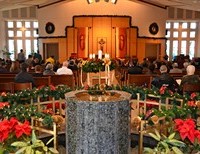
The Rite begins with the Priest greeting the bride and bridegroom at door of Church. If there is a processional, the bride and bridegroom are last to process. The Liturgy of the Word is celebrated according to the rubrics with the Homily speaking about marriage. All present at the Mass stand while the priest asks the couple their intentions. After the statements, the priest will ask the bride and groom about their freedom of choice, their faithfulness to each other, and their acceptance and upbringing of children. Then then consent (vows) will be made ,followed by the blessing and exchange of rings. The Nuptial Blessing follows the Lord’s Prayer. The Blessing of the bride and bridegroom precede the blessing of the people.
Christopher Brown resides in Missouri with his wife of 18 years. He and his wife enjoy their three children and are expecting their first grandchild in October. Christopher is a third year theologian in formation the Permanent Diaconate in the Catholic Church.