The Stages of Faith

Greed, Selfishness and envy: Merry Christmas!


Greed, selfishness and envy, for too many of us those are the attributes we adopt during this time of the year. Every year, sermons are preached and articles written about how Christmas has lost it’s original meaning. We hear this lament and we shake our heads and say how true it is, but we don’t change our behavior at all.
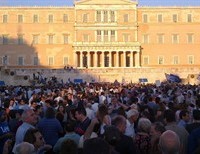
We are caught in a trap, a spider web woven by many forces over which we have no control. How many times do we see news reports of frenzied shoppers rushing through the just-opened doors of some big box stores, sometimes knocking others down and trampling them just to be able to claim some unnecessary item like a giant screen television? And how many times have we seen footage of other shoppers grabbing the item from the hands of someone who got to it first?
This happens each year in the name of celebrating the exceedingly humble birth of the Savior of Humankind, the Prince of Peace? Give me a break! In my opinion, John 11: 35 applies here: “Jesus wept.”
Recently, I saw a television commercial for some product on another. There was a woman who had just returned home from Christmas shopping. She bragged to her neighbor that she had “saved hundreds!” When I saw this I wondered how many hundreds or thousands did she have to spend to “save” what she was bragging about?
This yearly orgy of shopping is supposedly done in the cause of gift-giving, but I believe most of those “bargains” we buy are not meant for others but for ourselves. We become envious and greedy. We want what others have, even better. Our friends have a 50 inch tv, we buy a 60 or 70 inch model. We don’t need such a huge tv, we just have been conditioned by advertising to want one. We see all kinds of marvelous gadgets at low prices and we have to have them, whether we really need them or not.
Our children are learning the same behavior. They are targeted by advertising to want certain toys and gadgets. They compare their possessions with those of their friends, and want even more. We indulge their greed by lavishing them with far too many gifts on Christmas morning. Again, how many toys does a child “need?”
What can be done about it? That selfishness, envy and greed were inculcated in us as children, and we do the same to our offspring. Each year we lavish them with far too many presents. Many of which wind up unused and forgotten on a shelf, or in a closet.
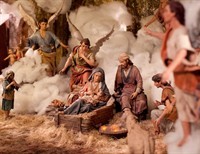
It would be very difficult to retrain our kids from expecting so much stuff at Christmas, but perhaps we can set an example by celebrating a much simpler, holier Christmas. One that more closely mirrors the first one. We can start by not letting ourselves be greedy, we can stop buying those unneeded bargains. We can create a more meaningful Christmas for our children by bringing Christ into our homes, using this holy season to teach them what Christmas really means: that the Savior of the World has been born, and like the angels and the Magi, we celebrate the glad tidings.
We can still give gifts to our children and to each other, but they can be simpler, more meaningful. We can reduce the number of presents we give the kids a little. We can begin to teach them a better way to celebrate Christmas.
Let’s show them how to celebrate Christmas in our hearts, by trying to have our lives reflect the words of the angels. Let’s try to be examples of peace on earth and love and good will towards all humankind. Perhaps we can all live up to that famous wish of Tiny Tim in Dickens’ “A Christmas Carol”: “God bless us, everyone!”
Recommended Stories
About the Author
I live in Lubbock, Texas and have been married for 47 years and counting. We have 5 children, 6 grandchildren, 1 great-grandchild, and 1 due soon. I served 4 years in the Air Force as a Medical Service Specialist during the Vietnam conflict and served 14 months at USAF Hospital, Clark AFB, Phillipines, taking care of Marines and Republic of Korea soldiers who were wounded in Vietnam. I completed undergraduate studies at University of Houston and obtained a Bachelor's Degree from Midwestern State University, graduated cum laude. Following that, I did post-graduate studies at Texas Tech University and Loyola Institute of Ministry,Extension Program. i am a Retired Educator,and have taught History and English at the secondary level. I am also a Retired Permanent Deacon, and for several years I wrote a Q&A column for a diocesan newspaper about the Catholic faith. In addition, I taught Church History for a diocesan Diaconate Formation Program and was director of the RCIA program in my parish for several years.