The Truth about the Origins of the Roman Catholic Church

Religion in the Public Arena
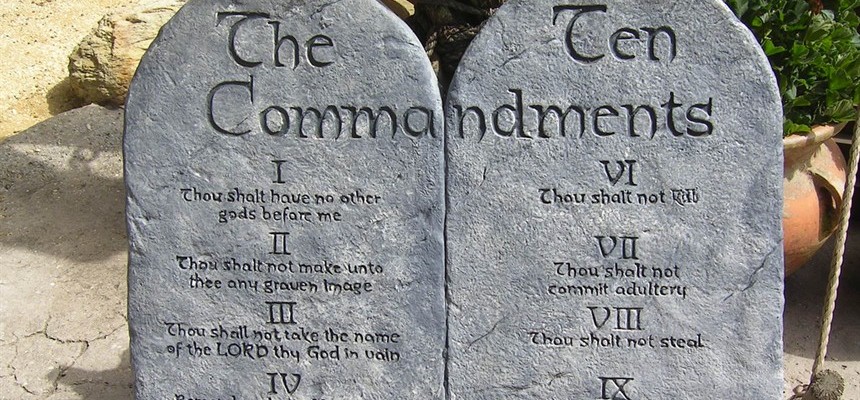
Photo By: Flickr/ imkukie
For years we have heard of the separation of Church and state. The progressive political interpretation of the First Amendment’s establishment clause suggests that we cannot tolerate religion in the public arena in any form whatsoever.
Not only are these progressives wrong but they are completely and irrevocably wrong.
Here’s what the First Amendment to the Constitution states: “Congress shall make no law respecting the establishment of religion or prohibiting the free exercise thereof.”
The Constitution is clear in the establishment clause: “CONGRESS shall make no law.” This means that the government shall not interfere in religious beliefs. Therefore, this is not a separation of Church from state, but it is clear that this clause is meant to be a separation of state from Church, meaning that Congress shall make no law interfering with the free exercise of religion. The only religious restriction is that Congress shall make no law.
On January 1, 1802, then President Thomas Jefferson responded to the elders of the Danbury Baptist Association who had concerns about the Constitution protecting religious liberty. In it, he wrote in part: "I contemplate with sovereign reverence that act of the whole of the American people which declared that their legislature should, "make no law respecting an establishment of religion, or prohibiting the free exercise thereof," thus building a wall of separation between Church and state. Adhering to this expression of the supreme will of the nation in behalf of the rights of the conscience."
Clearly Jefferson's reply to the Danbury Baptist Association was to assure them the separation of Church and state was intended and meant to protect religious expression and not the state except in so far as no particular state religion is ever to be established and allowed to rule the land, thus protecting us all. We should all recall that the immediate tradition of the Founding Fathers is that of religious persecution in parts of Europe, from which they and their ancestors fled to the colonies. Hence, the Establishment Clause.
The Social Doctrine of the Church is clear on this dynamic: "The Second Vatican Council sees the separation of Christian faith (note: Church) and daily life (note: state) as one of the most serious errors of our day" (SDC #554).
This progressive view of the separation of state from Church is a very postmodern one. To separate the two means to secularize the dynamic. Secularization, of course, is one of the key elements and an important principle of postmodern philosophy. It also reflects the reductionist thinking of postmodernism: to reduce religion from its equal status as the state, always ready to substitute relative truths – e.g. religious belief is merely personal, or religious belief must not interfere with civic activities.
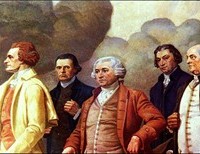
The fact is, postmodern progressives are wrong because many, or possibly most, of the Founding Fathers – whether simply Deist or not – understood the importance of religious belief and moral values in the founding and prospering of a democratic form of government, human nature being what it was – fallen.
Benjamin Franklin was quoted as stating: "[O]nly a virtuous people are capable of freedom. As nations become corrupt and vicious, they have more need of masters."
He also wrote: "whereas true religion and good morals are the only solid foundations of public liberty and happiness . . . it is hereby earnestly recommended to the several States to take the most effectual measures for the encouragement thereof."
John Adams wrote: “We have no government armed with power capable of contending with human passions unbridled by morality and religion . . . Our Constitution was made only for a moral and religious people. It is wholly inadequate to the government of any other."
Noah Webster, though not a Founding Father, was important to the growth of American culture, wrote: "The moral principles and precepts contained in the scriptures ought to form the basis of all our civil constitutions and laws. . . All the miseries and evils which men suffer from vice, crime, ambition, injustice, oppression, slavery, and war, proceed from their despising or neglecting the precepts contained in the Bible."
George Washington wrote: "Religion and morality are the essential pillars of civil society."
None of this is particularly difficult to understand. When we see postmodernism and its principles of relativism, secularization, deliberate irrationality, subjective emotionalism, reductionism, and narcissism, we witness a rapid decline of our culture. Nowhere should we deny a child’s prayer in school, nowhere should we tear down monuments to the Ten Commandments, nowhere should we tear down religious symbols from religious buildings on public college campuses, nowhere should the large cross honoring WWI soldiers – regardless of religion – be brought down, nor should we abandon Nativity scenes because when courts order them, then what is prohibited to Congress is accomplished by another branch and the Establishment Clause is therefore circumvented, denying free religious expression.
All of us need to stand for our freedoms as well as the free religious expression of others, providing that their beliefs never interfere with social order in a free society. As we read from our Founders and see with our own eyes, religious beliefs, as the basis of free government, are absolute.
Recommended Stories
About the Author
I received my BA in English in 1976, and my MFA in Creative Writing in 1996, from Arizona State University. I teach creative writing at Rio Salado College and I have taught at both the University of Phoenix and Chandler-Gilbert Community College. I am also the literary critic for the local Catholic newspaper. Currently, I am the author of 18 books covering an array of subjects from poetry, psychology, religion, fiction, and the process of writing. I co-authored three of these books, and have a new book out. I was the administrator of an international prize in poetry.
I am a life-professed Lay Dominican and two of my books were on the Order of Preachers.
I retired in 2006 from the telecommunications industry after 28 years with Qwest Communications and have extensive, award-winning experience in business and creative writing, and received a national award in journalism from the AFL-CIO.
I enjoy amateur astronomy, woodworking, contemplating quantum mechanics. I am an avid shooter, photographer, a concrete sculptor, and am a voracious reader. I recently bought a motorcycle and tried to learn how to surf.
My writing website is: http://bobcurtis.webs.com/