Paul's discourse on marriage: More relevant now than ever

Somebody else's babies


Photo By: Flickr/r. nial bradshaw
An Iowa congressman recently made headlines when he posted the following "tweet": "We can't restore our civilization with somebody else's babies."
When I read that appalling remark, my mind immediately went to another quotation; but this one was from Disney's The Lion King. The context was Mufasa's ghost gently but powerfully reprimanding his son, Simba: "You have forgotten who you are and so have forgotten me. Look inside yourself...You are more than what you have become".
In my mind, however, it wasn't a Disney lion saying those words, but the Lion of Judah. And he is speaking them to us.
We live in troubling times; and it is tempting to try to find reliable scapegoats to take the blame for all of our problems. The usual candidates for filling this role are people who don't look like us, speak our language, or pray as we do. What we need to remember, though, is that Christian evangelization historically has been carried out by "somebody else's babies". The Apostles traveled to Asia Minor, Greece, and northern Africa; others stayed within their homeland, but ventured into unfamiliar regions. They were the intruders. They were the foreigners in lands to which they did not belong.
Yet, for all of their foreignness, people welcomed them. Certainly the hospitality was not universal: That eleven of twelve Apostles died as martyrs is evidence of that. Nevertheless, many inhabitants of the distant lands to which the Apostles travelled accepted these humble pilgrims and listened to what they had to say. They set aside their biases and fears, and opened themselves up to the possibility that they might share something in common with these strange itinerant preachers.
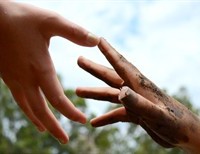
That commonality is love. And those who are enlightened realize that humanity’s universal capacity for love is derived from our being made in the image and likeness of our Father in Heaven. In that respect, there really is no such thing as “somebody else’s babies”.
The tendency to prefer that which is familiar to that which is not is natural to all living beings. However, the inherency of that natural bias does not give us free reign to hate those who are unlike us. If we hate another of God’s creatures, then we hate God himself. We must not forget that all of us are God’s children; if we look deep within our hearts, we will know that this is true. We are better than fear and hatred. If we want to restore our civilization, we must be.
Recommended Stories
About the Author
Denise and her husband Andy are life-long residents of Pittsburgh, PA. Both belong to Assumption Parish in Bellevue, PA, where Denise also serves as a CCD teacher.