The Stations of the Cross: Reflections 1

New Reflections on the Stations

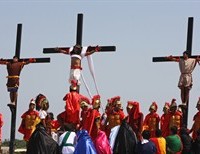
Photo By: Flickr/Kate Dixon -one of 14 crosses on Stations of the Cross trail above Dili, Timor Leste
Last year right around Easter I wrote a two part article on the Stations of the Cross. As I write this, we have just come from doing the Stations with our Parish. Our Stations are set up at homes and businesses around town, so we walk about 2 miles or so by the time we’re done. The first Station is set up at City Hall… try that in the States and see how fast the ACLU screams bloody murder! Unlike last year, my Bisaya (the local dialect) is getting better and I’m actually able to sing some of the songs that are sung between Stations. I also can pray the Our Father, Hail Mary and Glory Be in the language, but I stick to English during the prayer at each stop. I can’t speak as fast as these ladies do.
This article will not duplicate last year’s effort, but rather I want to focus on my personal thoughts that I meditated upon at various points along the way. The Scriptures tell us that the tender love of the Lord is new each morning and, if we are paying good attention to what we are doing in anything we do in the Lord, the Holy Spirit will keep it fresh every time. That’s what I’ve experienced in the Rosary, Divine Mercy Chaplet and especially Mass. The Stations are no exception.
A Slight Difference
Here in the Philippines, they have adopted the list of Stations recommended by Pope Saint John Paul II. Unless your diocese has adopted them as well, these will vary from what you are familiar with. The Stations are:
1. Christ institutes the Last Supper;
2. He prays in Gethsemane;
3. Christ is taken before the Sanhedrin (high court);
4. He is scourged and crowned with thorns;
5. Christ carries the cross to Cavalry;
6. He falls under the weight of the cross;
7. Simon of Cyrene helps Him carry the cross;
8. Christ meets the women of Jerusalem;
9. He is crucified;
10. Christ promises Heaven to Dimas, the repentant thief;
11. He entrusts John, his cousin, and Mary, his mother, to each other;
12. Christ dies on the cross;
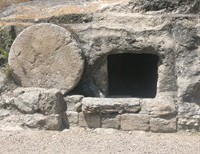
13. His body is laid in the tomb;
14. Christ is resurrected.
The First Two Stations
The first two Stations are, of course, always a blessing to me and speak to me of the gift of the Eucharist , as well as the challenge we face at times “tarrying with Me for one hour” as in the Garden. We, as Catholics, are blessed to have the full teaching on the Real Presence in the Eucharist. As for tarrying one hour, this is the verse that comes to me every time that I think about not getting up at 3 AM to walk the Stations at 4 AM (as if I don’t wake up at that time for no good reason many other days).
The Last Seven
Station 8 shows the love of the Lord. Even on His way to the Cross, He still cared about the people watching and even those who are doing the deed. He warns the women weeping for Him that they should be weeping for themselves because of what will be coming upon them later in 70 AD.
Station 9 is the Crucifixion. I have never been able to watch this scene in any movie, from “King of Kings” to “The Passion of the Christ” without being affected emotionally… in fact, I am as I write these words.
Station 10 is something I’m going to talk about in another article. It is a favorite verse of Protestants to deny Baptism’s importance.
Station 11 is one that always brings joy to my heart. Hanging on the Cross and preparing to die, the Lord gives the Blessed Mother to Saint John… and through him to us.
Station 12 is the centerpiece of our salvation. The Lord quotes Psalm 22 and asks a question that He has never had to ask before or since. He had never been deprived of the fellowship of the Father before. But Scripture tells us that “He Who knew no sin became sin for us, that we might be made the righteousness of God in Christ Jesus” (1 Corinthians 5:21). They also tell us that God cannot look upon sin… and at that moment all the sins of all mankind from ages past to the end of time was poured out upon Jesus there. He fulfilled the Old Testament type and became “the Lamb of God Who takes away the sins of the world” as Saint John the Baptist had said. I can only imagine what that must have been like for the sinless Son of God.
Stations 13 and 14 is the promise of our future, for one day we too will have our physical Resurrection, even as we already have been spiritually resurrected through Baptism, as Saint Peter said in 1 Peter 3:21 and with which Saint Paul agreed in Romans 6… “risen to walk in newness of life”.
Stations 3 through 7
It is in these Stations that I felt that the Spirit spoke to me and upon which the balance of this article will focus. They center on the parts of the Passion where “He was wounded for our transgression, bruised for our iniquity, the chastisement of our peace was upon Him and by His stripes we are healed” of Isiah 53:5 came to fruition. There are two aspects that were impressed upon me.
The first requires a little background in language. The whole Stations is done in Bisaya, which is the local dialect of Filipino. When the Lord is before the Sanhedrin and later at Pilate’s, He is terribly abused, not only physically but also verbally. He is mocked constantly by Jew and Gentile alike. The Bisaya word for mocking is… “bugal” (pronounced boo-gahl) and severe mocking is “bugal-bugal”. Imagine having your name mentioned every time that the Lord is mocked… many times twice. But this spoke to my heart that, at times, a double portion of my sin was laid upon the Lord.
The second spiritual impression that I received was that in Stations 5 through 9, as the Lord Jesus is carrying His Cross, He is bearing even then the terrible weight of our sins. Every time He stumbles and falls, the soldiers are there to beat Him and, of course, “bugal-bugal”. I think about the additional times that the Lord fell, even though it isn’t part of our Stations, because the same thing happened each time. We are commanded to ‘daily take up our cross and follow Me”. So, as we bear our daily cross, we shouldn’t be surprised that when we also stumble and fall the world is right there to mock and abuse us.
The final aspect comes from Station 7. After the Lord has borne this Cross, fallen, been beaten and mocked to where His strength is nearly gone, along comes Simon of Cyrene to help Him carry it (of course, involuntarily on Simon’s part). So too, the Lord sends a Simon of Cyrene or a Barnabas into our lives to help us bear the burdens we carry. That’s why the Scripture commands us to not be Lone Ranger Catholics, but we are to fellowship with one another and “Bear one another's burdens, and so fulfill the law of Christ.” (Galatians 6:2)
Conclusion
This reflection is meant to relate my own experience and insight. This is just one example of how making use of the opportunities that the Church gives us for that purpose, encourages, strengthens and illuminates our personal walk with the Lord. The Rosary, Divine Mercy Chaplet, Eucharistic Adoration can also yield many blessings for us, as well as the Mass. I hope that this Lenten season will bring similar blessing and insights to each of you. God bless you.
Recommended Stories
About the Author
I was a Cradle Catholic from the time that I was born through my teen years. I slowly moved away from the Church and as a young adult I became an Evangelical Christian. I spent nearly 40 years in various types of ministry as a teacher, preacher, pastor or evangelist. But my main area of expertise was Apologetics…what we believe and why we believe it. I am a graduate of Central Christian College of the Bible in Moberly, MO with a Bachelor of Science in Biblical Studies. In November of 2014 I retired to the Philippines, where my wife Rose is from. We live in the mountains of Negros Oriental in the small town of Canlaon City with our many brothers and sisters, nephews and nieces (to whom I am “Daddy Mike”).
Nine years ago I reverted to the Catholic Church. I have try to write articles which inform, instruct and equip our Catholic brothers and sisters while avoiding using jargon. I have also sought to defend the Faith with our several Protestant visitors in as kind a way as possible
My archive here, which now contains nearly 80 articles, is located at http://www.catholic365.com/author/mike-bugal/
I may also be contacted via email at mbugal@yahoo.com