3-dimensional faith in a 2-dimensional world

The Carpenter's hands: A meditation for Lent


Photo By: Flickr/Tony Fischer
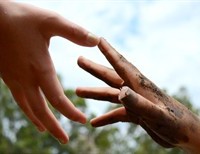
What do you think about during the Consecration? As odd as it may seem, my mind usually focuses on Jesus’ hands as they break the bread and offer the cup. In my imagination, these hands are ruddy and rough from long days spent in hot sun and dry air; and marked by scars and calluses from years of working alongside Joseph. They are human hands, humble carpenter’s hands that betray nothing of the royal priesthood to which they belong. And, on that evening when he broke bread with his disciples for the very last time, I can’t help but wonder whether those hands also might have been trembling, just a bit.
We know from various New Testament passages that Jesus experienced the full range of human emotions. That he experienced fear, in particular, was made evident during his prayer at Gethsemane: “Abba, Father, all things are possible to you. Take this cup away from me, but not what I will but what you will” (Mark 14:36).
As Son of God, Jesus was well aware of his passion long before it occurred. As Son of Mary, the imminence of that final trial probably terrified him. I doubt the fact of his actual death would have contributed importantly to that fear, because in death he would be in the hands of his Father. In the hours leading up to his death, however, he would be in the hands of man—at his cruelest and most brutal.
Because of that brutality, Jesus' accusers were not satisfied with merely putting him to death. His crucifixion thus became more than just an execution; it was a tragic atrocity that was both bitterly ironic and horribly absurd. The irony was that the mode of execution entailed piercing a carpenter’s hands with the very same tools they once used to earn him a living. The absurdity was that a mob of self-righteous fools would attempt to humiliate a man who was completely devoid of pride. He was castigated, ridiculed, and physically tortured; and his only crime was that he loved us.
All of this is the pending burden of the young man with trembling carpenter's hands, whose soul is torn between human frailty and divine resolve. He is about to make the ultimate sacrifice for all humanity—for you, for me, and even for the man who betrayed him and those who would torture him and put him to death. And all he asks of us is that we take up our own crosses and follow him. How can we say no? How can we not accompany him on the journey to our salvation?
By following Jesus on the Way of the Cross, we are both evidence and reassurance that his sacrificial journey was not in vain. We are Simon of Cyrene; Veronica; the women and children; the enlightened criminal; and Joseph of Arimathea. We lessen the weight of Jesus' cross when we shoulder the burden of a brother or a sister; we wipe the blood and sweat from his brow when we dry another's tears; we comfort him when we hold the hand of someone who is hurting; we acknowledge him as our Lord and Savior when we receive him in the Eucharist; and we prepare for him a peaceful resting place when we pray for the souls of those we have lost.
Perhaps the next time you clasp your hands in prayer, when you bow your head at the blessing of the bread, you too will think of the hands of the Carpenter—hands that healed; hands that comforted; hands that were bloodied for our sake; hands that beckon us to follow him. Hands that will receive us when we enter into his glory.
Recommended Stories
About the Author
Denise and her husband Andy are life-long residents of Pittsburgh, PA. Both belong to Assumption Parish in Bellevue, PA, where Denise also serves as a CCD teacher.