Do Protestants Actually Believe Sola Scriptura?

Catholic Triumphalism?

Photo By: Flickr//\ \/\/ /\
Similar to the previous article (Answers to a Non-Catholic) this one will draw up a reply that I made to a responder to the same article on the Facebook group “Catholic Fundamentalism”. This person, whom I will only identify by his first name, Steven, had previously said, “I paid my dues as a Boomer Catholic. Catholic Triumphalism is disgusting...no wonder the masses protest.”
The host of the page asked him for a clarification on the two terms he had coined. It turns out that by “Boomer Catholic” he meant Catholics who grew up in the time period from 1950 to 1965. In reality, of course, the “Baby Boom” generation started in 1945 at the end of World War II. What he really meant by the term was those of us who grew up in the pre-Vatican II era. It was his definition of the second term that drew my response. I’ll mark the beginning and the end of the Facebook portion. I should also note that the verses cited below are all from the King James Version (KJV). Although not recognized by the Church it’s best to discuss doctrine in a translation they readily accept. In this case, except for the 17th Century English, the KJV is dead on target.
BEGIN RESPONSE
Steven, you wrote "Catholic Triumphalism....the twofold fallacy that there is no salvation outside the Catholic Church and the only sense Protestants are "brothers and sisters," albeit "separated," is that they are potential Catholics awaiting union with "the fullness of the true Church."
First, I need to acknowledge that you are quite adept at coining phrases. "Boomer Catholic"? I kind of like that. very descriptive of those of us who grew up in the pre-Vatican Ii Church. I'm going to borrow that sometime.
However, I wouldn't assume that because I was born in a hospital I am a doctor. Many people of our era were poorly catechized and ill equipped to grasp the Faith. My own story is one of cradle Catholic to Evangelical Christian for 45 years (the majority in Apologetics ministry) to revert to the Church. My return is the result of facts/evidence.
Let’s Examine the Evidence
Now, I would contend that something is a "fallacy" only if the available evidence and not personal opinion proves it to be. The evidence in question that I see says:
"Then Jesus said unto them, Verily, verily, I say unto you, Except ye eat the flesh of the Son of man, and drink his blood, ye have no life in you" (John 6:53)
and
"Who so eateth my flesh, and drinketh my blood, hath eternal life; and I will raise him up at the last day". (John 6:54)
and
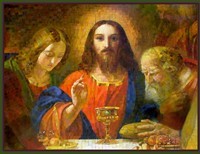
"And as they were eating, Jesus took bread, and blessed it, and brake it, and gave it to the disciples, and said, 'Take, eat; this IS my body'. And he took the cup, and gave thanks, and gave it to them, saying, 'Drink ye all of it; For this IS my blood of the new testament, which is shed for many for the remission of sins.'" (Matthew 26:26-28)
as well as
"And when he had given thanks, he brake it, and said, Take, eat: this is my body, which is broken for you: this do in remembrance of me. After the same manner also he took the cup, when he had supped, saying, This cup is the new testament in my blood: this do ye, as oft as ye drink it, in remembrance of me." (1 Corinthians 11:24-25)
That Saint Paul viewed this as critical is viewed in the verses that follow:
"Wherefore whosoever shall eat this bread, and drink this cup of the Lord, unworthily, shall be guilty of the body and blood of the Lord. But let a man examine himself, and so let him eat of that bread, and drink of that cup. For he that eateth and drinketh unworthily, eateth and drinketh damnation to himself, not discerning the Lord's body." (1 Corinthians 11:27-29)
Summation
Since the clear words of the Lord taken in full context including the full panoply of Scripture on the subject shows that the "flesh" and "blood" spoken of by the Lord in John 6 is indeed the "Body and Blood" (which He identifies as his flesh and His blood) instituted at the Last Supper... known to Catholics as "The Eucharist".
Furthermore, it is also in evidence that the Lord Himself said that those who do not "eat My flesh and drink My blood" have no life in them and will not be part of the First Resurrection. Hence, any claim those who choose not to obey His commands are "heaven bound" is found to be false.
A Challenge
When the Lord had finished telling them the w ords contained in John 6:53-54 the Scripture tells us that many walked away and followed Jesus no more. When asked if they would do the same Saint Peter replied: "Lord, to whom shall we go? thou hast the words of eternal life. And we believe and are sure that thou art that Christ, the Son of the living God." (John 6:68-69)
If you know of any other Church other than the one founded by the Lord Jesus who is faithful to all the words of the Lord and the Apostles in their full meaning please point them out. Otherwise, the contention of "fallacy" is disproved.
I await your counter evidence.
END OF RESPONSE
As of this time no counter evidence to my response has been posted by Steven. The likelihood is that none will be attempted… for in reality none is possible. Steven also misses a point that most Protestants do… and perhaps some Catholics as well. It isn’t that “there will only be Catholics in heaven” because no one is going there just because they ‘are” anything but obedient. Saint Paul makes it quite clear that the Lord Jesus is, “… the author of eternal salvation unto all them that OBEY him;” (Hebrews 5:9). He echoes what the Lord Himself said in Matthew 7:21, “Not everybody that says to me, ‘Lord, Lord’, shall enter into the kingdom of heaven; but he that DOES THE WILL of my Father which is in heaven.”
There will not be only Catholics in Heaven, but there will be only the obedient! That obedience includes all the Scripture discussed with Steven in my response. It can’t be any more clearly stated than the Lord’s words:
” Verily, verily, I say unto you, except you eat the flesh of the Son of man, and drink his blood, you have no life in you. Whoso eats my flesh, and drinks my blood, has eternal life; and I will raise him up at the last day ".
Recommended Stories
About the Author
I was a Cradle Catholic from the time that I was born through my teen years. I slowly moved away from the Church and as a young adult I became an Evangelical Christian. I spent nearly 40 years in various types of ministry as a teacher, preacher, pastor or evangelist. But my main area of expertise was Apologetics…what we believe and why we believe it. I am a graduate of Central Christian College of the Bible in Moberly, MO with a Bachelor of Science in Biblical Studies. In November of 2014 I retired to the Philippines, where my wife Rose is from. We live in the mountains of Negros Oriental in the small town of Canlaon City with our many brothers and sisters, nephews and nieces (to whom I am “Daddy Mike”).
Nine years ago I reverted to the Catholic Church. I have try to write articles which inform, instruct and equip our Catholic brothers and sisters while avoiding using jargon. I have also sought to defend the Faith with our several Protestant visitors in as kind a way as possible
My archive here, which now contains nearly 80 articles, is located at http://www.catholic365.com/author/mike-bugal/
I may also be contacted via email at mbugal@yahoo.com