Sponsored

Catholic365 is sponsored by
Catholic365 Christmas Gift Guide


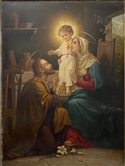

St. Gertrude the Great: The Nun Who Saw the Heart of Christ
By Queen of Heaven
The Girl at the Gate
In the year 1261, a little girl of five arrived at the monastery of Helfta, in Saxony.
Who her parents were and what brought her there remain a mystery. We know the nuns took her in and raised her among them.
Her name was Gertrude.
She grew up inside those walls, and she grew up brilliant. Latin. Literature. Music. She even loved the art of painting tiny illustrations in manuscripts. One of her teachers was St. Mechtilde of Hackeborn.
By twenty-five, Gertrude was a scholar with a quick mind and a strong will. Looking back, she wrote that she had let her learning feed her pride. Her prayers had grown lukewarm.
And then, one winter evening after prayers, Christ came to find her.
This is the story of St. Gertrude the Great.
The Corridor
St.Gertrude tells us when it happened in Book Two of The Herald of Divine Love. The 27th of January, 1281, just after Compline, the last prayer of the day.
She’s standing in the dormitory. An older nun approaches, and Gertrude bows her head, as the rule requires. When she looks up, a young man is standing before her.
Beautiful. Gentle. About sixteen years old. “Soon will come your salvation. Why are you so sad?”
As He speaks, she feels as though she’s in her usual place in the choir. He takes her right hand in His. “Come back to me now,” He says. And then she sees it. A hedge of thorns, stretching so far in both directions that she can’t see where it ends. She stands there, helpless.
In one movement, He lifts her over it and sets her down beside Him. And in the hand that was holding hers, she sees the wound left by a nail.
She recognises Him. It is Jesus.
From that hour, she writes, a new joy came over her. She gave herself to Scripture and prayer with the same energy she had given her studies.
The Heartbeat
St. Gertrude wrote the second book of The Herald herself. A fellow nun at Helfta gathered much of the rest. In Book Four, she tells us what Gertrude saw on the feast of St. John the Evangelist.
Gertrude is praying at Matins when St.John appears. He leads her to Jesus and places her at His right. John rests at His left. And as Gertrude leans against Christ, she hears it. His Heart is beating.
She asks St.John if he heard it at the Last Supper. He says he did. Then why, she asks, did he leave it out of his Gospel?
John says the sound of those heartbeats was kept for a later age, so that a world grown cold in the love of God could be warmed again.
Pope Francis returns to that exchange in Dilexit Nos, his encyclical on the Heart of Jesus. He remembers St. Gertrude and her teacher, St. Mechtilde, among those who found rest in the Heart of Christ.
Nearly four hundred years would pass before St. Margaret Mary Alacoque had her visions at Paray-le-Monial. And here, in a convent in Saxony, St. Gertrude was already close enough to hear His Heart.
He still invites us to come near.
The Souls in Purgatory
That love led St. Gertrude to pray for the souls in purgatory. Book Five of The Herald tells of two sisters who were both preparing to become nuns at Helfta. They died a month apart.
One day at Mass, as the priest raised the Host, St. Gertrude asked God to receive the offering for the sister who had died second. In her vision, the young nun told Gertrude how much relief the Mass brought her. And Gertrude saw her rising little by little towards heaven, carried by the prayers of the Church.
If you’ve ever buried someone you love, stay with that image for a moment.
The prayer we’ll say at the end is traditionally attributed to St. Gertrude. You may have heard that saying it once frees a thousand souls. That promise was attached to the prayer later, and its origin is uncertain.
Here is what the Catholic Catechism teaches. We can help the dead by praying for them, above all through the offering of the Mass. So when you bring someone you love to God in prayer, you can do so with confidence in His mercy.
The Thorns
St. Gertrude died at Helfta on the 17th of November, around 1302. In her Spiritual Exercises, she prayed, “O Jesus, you who are immensely dear to me, be with me always.”
In 1677, Rome entered her name in the Roman Martyrology. In 1738, Pope Clement the Twelfth extended her feast to the whole Church. Today we remember her on the sixteenth of November.
Pope Benedict XVI called her the only German woman known as “the Great.” He saw her friendship with Jesus at the centre of her life.
Think back to those thorns. She stood there helpless, and He took her hand. That’s the picture of holiness she leaves us.
It is letting Him lift you over the thorns.
Pray With Me
Please join me now in the prayer that bears St. Gertrude's name.
Bring to mind someone you have lost. If you like, say their name quietly before we begin.
Eternal Father, I offer Thee the Most Precious Blood of Thy Divine Son, Jesus, in union with the Masses said throughout the world today, for all the Holy Souls in Purgatory, for sinners everywhere, for sinners in the universal Church, those in my own home, and within my family. Amen.
God bless you. St. Gertrude, pray for us — and for the souls in purgatory.
Queen of Heaven is a Catholic channel devoted to Our Lady, the lives of the saints, and everything Catholic. For videos on the Rosary, the saints, and the Catholic faith, find Queen of Heaven here:
Instagram: https://www.instagram.com/queenofheaven_25/
YouTube: https://www.youtube.com/@Queenofheaven_25
Facebook: https://www.facebook.com/masia.pinto





