



Damien High School Students Build Notre Dame Cathedral Replica
Sponsored

Catholic365 is sponsored by
Catholic365 Christmas Gift Guide




"Even a poor tailor is entitled to some happiness." - Motel Kamzoil to Tevye in the classic musical and film Fiddler on the Roof
This memorable line from Fiddler reflects traditional Jewish and Catholic theology regarding human dignity. In God’s eyes, we are equal in human dignity and we are all made in His image, the rich and the poor alike. We are all entitled to some happiness.
Sometimes, when people want to take a jab at the Catholic Church, they bring up the fact that the Church is rich in real estate holdings and in treasures stored in the Vatican Museums. "Why doesn’t the Catholic Church liquidate its wealth, sell her treasures, and give the money to the poor?"
Of course, they fail to remember that this is the same Church that gave us the mendicant religious orders, like the Franciscans, whose charism is centered on poverty and begging. We recognize that there is a place for living out the Gospel to the extreme by "selling all you have" and following Jesus. Furthermore, every religious takes three core vows called the evangelical counsels, one of which is the vow of poverty.
Those Vatican treasures were never meant to be sold, to be hoarded by the rich, but rather to belong to the people of God so that they can be seen and enjoyed as one’s Catholic heritage.
They stand as material and visible signs that speak of our status as God’s chosen people, sons and daughters claimed through the grace of Baptism, set apart as a chosen race and a royal priesthood. Once they were no people at all, but now they are God's own.
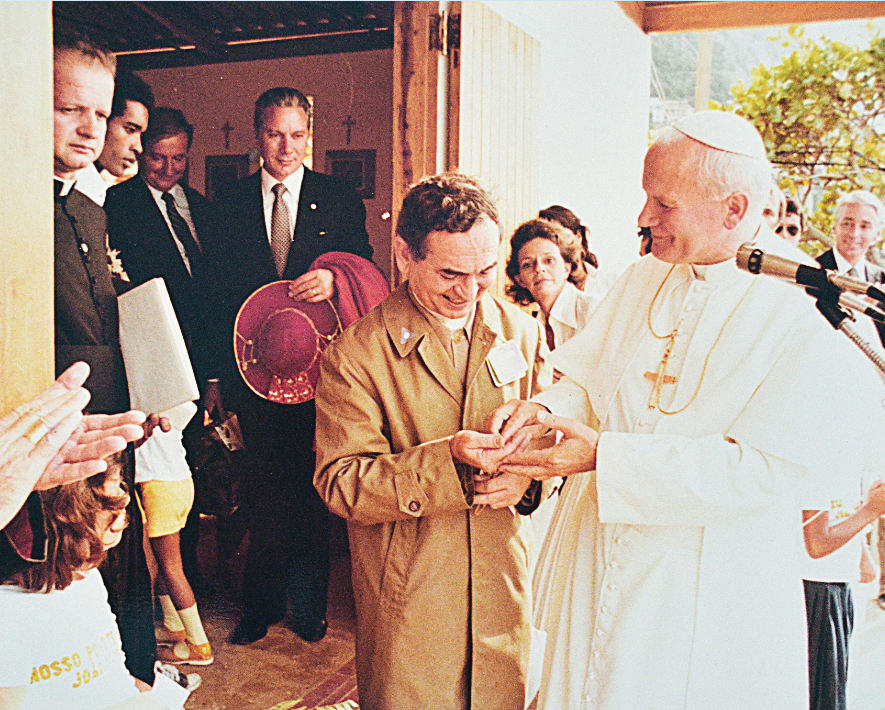
Above: Pope John Paul II gives his gold ring to the people of Vidigal.
In 1980, Pope John Paul II visited the poorest of the poor in Brazil. He went out of his way, climbing steep dirt roads to reach the Vidigal Favela, a shantytown in Rio de Janeiro whose dirt-poor residents were targeted by authorities with threats of eviction. So moved by their welcome, when he reached the little church, John Paul removed the gold ring that Pope Paul VI had given him when he was named a cardinal. Then he handed it to a local priest as a donation to the parish. From then on, Vidigal became known as "The Pope’s Favela."
The ring, originally given to him by Pope Paul VI when he was made a cardinal, sparked a local debate over whether or not it should be sold so that the money could be distributed to the desperate residents.
The parish community collectively decided not to sell it, but to keep it as a shared treasure. It would do them no good financially, but it was, for them, a status symbol - not the kind that brags about economic power over others, not the kind that provides exclusive access to the best parties or social clubs, and not even the kind that speaks of prestige. They had none of that, but as Catholics, they knew they were beloved children of God and that the Vicar of Christ came out of his way—all the way from Rome - to remind them. The ring became a material and visible sign that speaks of our status as God’s chosen people, sons and daughters claimed through the grace of Baptism, set apart as a chosen race and a royal priesthood.
The ring says, "Once they were no people at all, but now they are God's own."
Servant of God Dorothy Day knew about this kind of status symbol as well. When a donor to the Catholic Worker gave her a diamond ring, instead of cashing it in to buy more food for the poor, she handed it over as a gift to a poverty-stricken widow who frequented the house of hospitality. Many scoffed and questioned her judgment.
We are reminded here of the Gospel story about Mary of Bethany. When she poured an expensive alabaster jar of pure nard perfume over Jesus, some of the disciples and onlookers were upset because they viewed it as a massive waste of money.
But Jesus said, “Leave her alone; why are you bothering her? She has done a beautiful deed to Me. The poor you will always have with you, and you can help them whenever you want. But you will not always have Me. She has done what she could to anoint My body in advance of My burial. And truly I tell you, wherever the gospel is preached in all the world, what she has done will also be told in memory of her” (Mk 14:6–9).
Those who saw the gesture of Dorothy Day were likewise indignant. “Why are you giving her that? This diamond could pay for her rent!”
Dorothy quipped, “Do you suppose… that God created diamonds only for the rich?”
By letting the woman decide whether to sell it or simply enjoy wearing it as a child-of-God status symbol, she, like Pope John Paul II, gave back to the poor what is owed to them, which is their dignity - the greatest treasure of all.


