



Finding Nemo (in the Sacrament of Baptism)
Sponsored

Catholic365 is sponsored by
Catholic365 Christmas Gift Guide




As Christians, we usually identify Jesus with two animals: the Lion of Judah and the Lamb of God. The Lion represents Christ's royal power, while the Lamb emphasizes His redemptive sacrifice.
The donkey is different. It is not an established Christological title assigned to Jesus by the divinely inspired writers of Scripture. Instead, its inspiration likely came from the mind of Satan, whispered into the ears of one of his deviant, worldly bullies - a Roman youth who graffitied a blasphemous message portraying Jesus with the head of a donkey. See below...
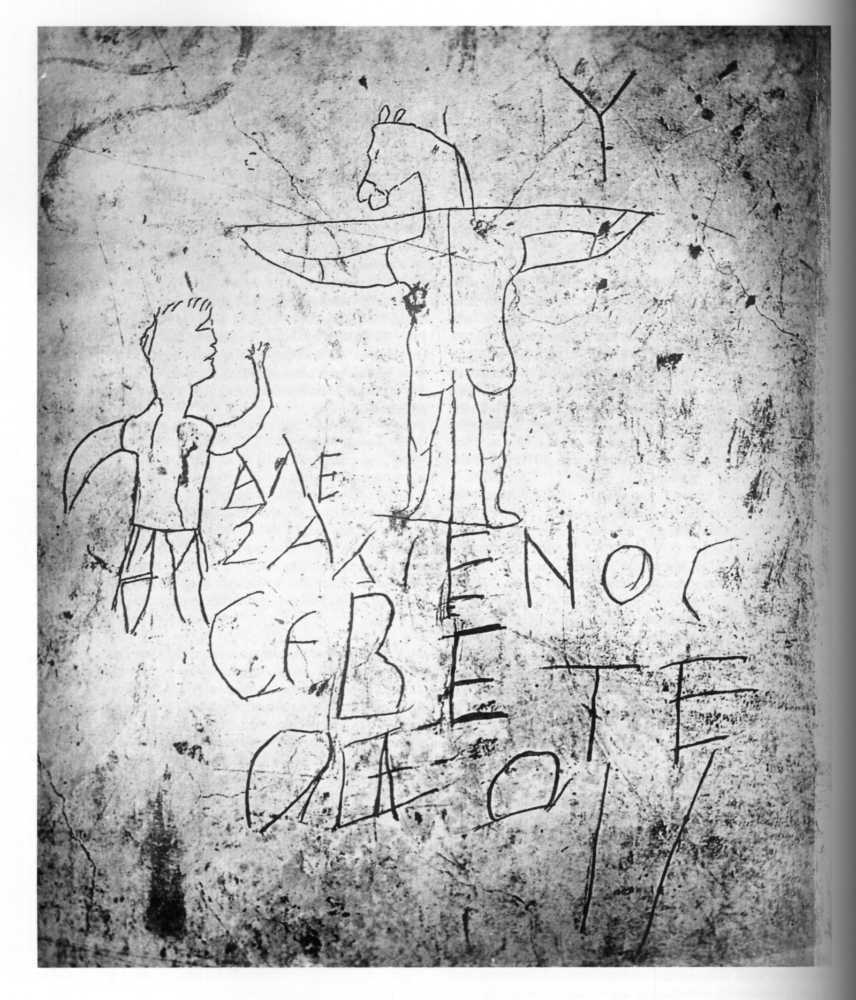
The pagan tagger left his mark on Rome's Palatine Hill. Ironically, it is one of the earliest surviving images apparently depicting Jesus crucified. Archaeologists call it the Alexamenos Graffito (c. AD 200).
The drawing depicts a human figure crucified with a donkey's head, while another figure stands nearby, hand extended, apparently worshipping him. Beneath it, an inscription in Greek reads, "Alexamenos worships his god." (See above).
This anonymous Christian, Alexamenos, was apparently a victim of teenage bullying. This was the ancient world's version of social media. Someone even posted a reply etched into a nearby plaster wall: "Alexamenos is faithful."
Did poor Alexamenos see this taunt? Was he forced to watch it scrawled on the wall? Was he beaten and spat upon? Did he feel shame, anger, embarrassment? Did he retaliate?
Did he understand the Devil's strategy of mocking and inverting the Faith? Did he understand the paradox at the heart of Christianity?
Did he turn the other cheek? Love his enemies? Laugh, knowing the joke was ultimately on the prideful Roman tagger? Was it Alexamenos himself who declared, "Alexamenos is faithful"? Was he eventually martyred? Was he an unknown, uncanonized saint?
The Palatine Hill, where this graffiti was discovered, is only a short walk from the Colosseum, an enduring symbol of Roman persecution and spectacle. It's where St. Ignatius of Antioch was brought to be devoured by beasts in the early second century. Alexamenos lived in a world where Christians could face humiliation, imprisonment, and death for their faith.
Perhaps the courage and mule-like stubbornness of the martyrs inspired Alexamenos to withstand peer pressure. Perhaps his own family members were killed.
Who was he? He was emblematic of me and you, the fool for Christ. He represents Catholics today who are shamed, teased, mocked, berated, ignored, canceled, and silenced.
"It is worth noting that the first Christians hesitated to use the symbol of the cross as the logo for their new religion, and for good reason too. For people in Roman-occupied territories, the predominant meaning of the cross was terror and dread, for it was the instrument of 'unsurpassable punishment,' in the words of Cicero." — Bishop Barron
By AD 200, however, the image of God hanging on a cross was apparently no longer enough to shame His disciples. Christians were transforming an instrument of torture into a sign of redemption and victory.
What once represented humanity's greatest defeat became the greatest symbol of victory and the surest sign of God's crowning characteristic: agape love.
Saint Paul wrote, "The message of the cross is foolishness to those who are perishing, but to us who are being saved it is the power of God" (1 Corinthians 1:18).
Eventually, the cross became Christianity's most recognizable symbol.
"From being a sign of malediction, the Cross was transformed into a sign of blessing, from a symbol of death into a symbol par excellence of the love that overcomes hatred and violence and generates immortal life." — Pope Benedict XVI
By using the cross as an instrument of mockery, the Adversary sought to make devotion to God look foolish. Yet Christ's paradoxical teachings inoculated His followers against shame, freeing them to recognize a hidden truth.
"When I am weak, then I am strong" (2 Corinthians 12:10).
"Whoever loses their life for my sake will find it" (Matthew 16:25).
The cross was losing its power to intimidate Christians. To salvage its value as an insult, the next step was to portray Jesus crucified with the head of a donkey.
The message was unmistakable: "Your God is an ass, and so are you for worshipping him."
The donkey-headed Christ was meant to be deeply offensive, absurd, and contrary to worldly logic. It was a psychological weapon designed to shame, belittle, and isolate believers, causing them to lose courage, patience, and interior peace.
Yet, upon deeper reflection, even this insult reveals a hidden truth. Through the New Testament principle of paradox, we can see the strange, crucified Christ-donkey as a kind of triumphal epiphany. It requires the peculiar illumination of faith that only paradox can provide.
"Those who humble themselves will be exalted" (Luke 18:14).
"The greatest among you will be your servant" (Matthew 23:11).
"The last shall be first, and the first last" (Matthew 20:16).
Drawing upon this spiritual superpower to embrace insult and invert mockery, when we hear the words "Christ is a donkey," we ought to think of humility, obedience, patience, endurance, and the willingness to carry burdens.
We are free to turn this graffiti insult into a meditation on Christ, who carries the burden of humanity's sins from the cross.
Christ as donkey offers rest to those who labor (Matthew 11:28). He is the One who takes the form of a servant to carry humanity on His back toward salvation.
On that first Palm Sunday, the donkey carried Jesus. On Good Friday, Jesus carried the cross- the sin-laden burden of the worlld. He humbly became our Donkey.
"Surely he has borne our griefs and carried our sorrows" (Isaiah 53:4).
The early Church Father St. Irenaeus offered a similar comparison between Christ and a donkey:
"The ass was the type of the body of Christ, upon whom all men, resting from their labours, are borne as in a chariot. For the Saviour has taken up the burden of our sins."
Jesus the Lion conquers sin, death, and Satan. Jesus the merciful Lamb offers Himself at the Last Supper, on the Cross, and at every Mass out of love.
Jesus the Donkey carries humanity's burdens with steadfast endurance, demonstrating that insults need not defeat us. Instead, they can make us more resilient, patient, and humble.
Through this paradox, may we become like the faithful Alexamenos—more Christ-like and, dare I say, more donkey-like.


