Sponsored

Catholic365 is sponsored by
Catholic365 Christmas Gift Guide



At the opening of St. Raymond's new school building in 1951 [in the Bronx, New York], my father, Peter A. Quinn, was the main speaker … he spoke about the church's role in providing spiritual sustenance and material support to generations of immigrants who had struggled to make a place for themselves in a city that regarded them as incurably poor, ignorant and foreign.1
Well, my immigrant family was not incurably poor or ignorant. But we were definitely foreign.
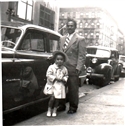
When I was three years old, my family immigrated from South America to New York City in the early 1950s. We lived in the Manhattan neighborhood known as Little Spain (Pequeña España). Spaniards before us settled the area located between Chelsea and Greenwich Village. No doubt my family found comfort living in an enclave where they could speak their native tongue.
Even more comforting was being able to worship in the neighborhood Catholic Church named for a beloved Mother: Nuestra Señora de Guadalupe (Our Lady of Guadalupe). Founded 50 years prior to our arrival by Augustinians of the Assumption (Assumptionists), the parish was the heart of the Spanish-American community, the first in Manhattan to celebrate Mass in Latin and Spanish. The church building started as a 1850s brownstone rowhouse. The immense Spanish Colonial façade as well as the language of its services expressed its Iberian ancestry.2
Our Lady of Guadalupe attracted many who were not Spaniards or Spanish speakers. Notably this included social anarchist-later-Servant of God Dorothy Day and writer-later Trappist monk Thomas Merton.
“The Communist Party cared about the welfare of the poor but was unequivocal in its opposition to religion…[Dorothy Day] asked the elderly Spanish priest at the small church that she attended during the winter months in Manhattan, Our Lady of Guadalupe on West 14th Street, about this troubling dichotomy. Father Zachary Saint-Martin’s counsel was reassuring. ‘Keep your job,’ he told her. [Day was employed as (sic) a communist paper at one time.] ‘You have a child to support. That must be your priority, and if your faith is strong enough, there is no need to worry about anything else.’”3
In his famous autobiography, The Seven Storey Mountain, Thomas Merton speaks of the Church of Our Lady of Guadalupe on 14th Street in describing his early life as a young Catholic convert living in the city. He visited the church to pray for an unpublished early manuscript. Merton describes kneeling to pray intensely for the publication, a request he later realized arose from spiritual blindness. He also recalls the immense, quiet joy he felt on winter mornings, leaving after Mass and Communion and walking down Seventh Avenue, experiencing a deep happiness he was scarcely aware of at the time.4
It would be many decades later that I would know of these two worthy Catholics and read their works. In the meantime, I attended public school where I learned English by immersion, as formal bilingual education was unknown in the 1950s. I credit Mrs Smith, my first grade teacher originally from New England, with my love of reading and with speaking English with a Boston accent.
Because of a landmark Supreme Court case5 I was able to participate in released-time religious instruction. Along with approximately 100,000 other NYC public school students, I left class an hour early every week to attend St Bernard Catholic Church where I was prepared for First Communion. The church was built in the late 19th century in the French-English revival style. St Bernard parish served a population of predominantly Irish immigrants and their ancestors. At the time my family arrived in New York, we were part of an enormous demographic change. The Irish and others from Europe who came before us were climbing the ladder of success, leaving the city for the suburbs. We from Latin and central America moved in to take their place.6
In 2003 these two parishes that served the Irish and Spanish immigrant populations were merged and became the Parish of Our Lady of Guadalupe and St Bernard. The combined parish continues to minister to immigrants. The Spanish and English speaking parishioners gather to celebrate Masses conducted in both languages. Parish ministries serve the neighborhood in both languages as well.
However, by the time of the merger, my family had long left Manhattan, doing what many immigrants did: climbed the ladder of success and moved, in our case not to the suburbs but to another New York borough, and found a new parish. It was named for a beloved Mother: Immaculate Conception.
We felt totally at home.
__________________________
1 “New York's Catholic Century,” Peter Quinn, New York Times, June 4, 2006, Accessed October 8, 2026, https://www.nytimes.com/2006/06/04/nyregion/thecity/new-yorks-catholic-century.html
2 “Who are we? / Quienes somos?” Accessed October 8, 2026, https://guadalupestbernard.org/oracion-a-la-virgen-de-guadalupe
3 Dorothy Day: Dissenting Voice of the American Century, by John Loughery and Blythe Randolph, quoted in https://www.thecollector.com/dorothy-day-catholic-anarchist-radical-life/)
4 The Seven Storey Mountain by Thomas Merton, available at https://www.fisheaters.com/srpdf/xThomasMertonTheSevenStoryMountain.pdf
5 Zorach v Clauson, 1952, https://supreme.justia.com/cases/federal/us/343/306/
6 For a history of Catholics in New York City, see https://virtualny.ashp.cuny.edu/EncyNYC/catholics.html





