Klaus Schwab's Promise of Eternal Life and the Tower of Babel
Sponsored

Catholic365 is sponsored by
Catholic365 Christmas Gift Guide


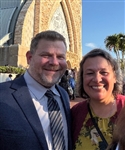

I recently viewed a video made by an evangelical Protestant YouTuber named Matt. He visited a Catholic cathedral and was given a tour by a Catholic priest.
As they approached the altar, the priest (Fr. Diaz) tried to explain that at every Mass we are experiencing the Last Supper, Calvary, the present moment and the Wedding Feast of the Lamb in heaven. Father Diaz said that each event happened at different points in time yet in the sacrament they are all intersecting in one celebration. Matt’s response was great. He seemed to get the Catholic concept of time for the first time when he responded, “So the Mass is 'an atemporal version of that (Calvary) event?!'”.
It dawned on me that many of the core disagreements between Catholics and Protestants often boils down to how each side views time and eternity. Apologists on both sides would save a lot of time if they would start out by clarifying that the two views of time are what cause so much division downstream.
Many people fail to realize that they have unwittingly inherited a concept of time. It is taken for granted as an unexamined presupposition that shapes their worldview and their theology.
Father Diaz: You're entering sacred space which is where you, even though we're grounded on earth, are touching heaven. So for us, the Eucharist is three events in one. So it's the last supper, so every mass is the last supper, every mass is in the present moment, and every mass is the banquet in heaven.
Matt: Now you're saying that word ‘is’, with tremendous emphasis.
Father Diaz: So it ‘is’, there's only one event, there's only one sacrifice.
Matt: So it's not a repetition of that event,
Father Diaz: It's not a recollection, it's not,
Matt: It's an atemporal version of that event.
Father Diaz: Right, it is the last supper. There's only one sacrifice.
Matt: Okay.
Father Diaz: It's it's Jesus...
Matt: Do you see my protestant brain trying to wrap it,
Father Diaz: Right, so it's the cross. He only died once for all, once for all. And the last supper is the unbloody sacrifice of the cross, okay.
Matt: Fascinating, okay, all right.
Father Diaz: So this is my body, this is my blood which is offered on the cross, it's his body and blood that redeems us. His death, and so every time we have mass, heaven and earth come together. Whether you're in the Cathedral of the Madeleine or you know, in a,
Matt: So it's all one Mass.
Father Diaz: It's all one Mass.
Matt: Okay.
Father Diaz: All one event, but it's outside of our, so we left the world behind, we left time and space outside. We left our world outside, we're in a world, and whether we're in this space or we're in a village someplace in Cambodia or Africa or whatever country that would be you know, it's the same heaven and earth coming together. And so our architecture and art help to depict that.
Matt: Yeah, I wanna go all the way down the rabbit hole with you on like the mechanics of that. Maybe when we sit down I can pick your brain more about how that happens.
____________________________________
While Protestants like Matt tend to view time as strictly linear and chronological, Catholics often view time as dynamic, mysterious and sacramental...
In the Protestant imagination time is stuck on a train track always making progress. It can’t speed up or slow down. It can’t break into eternity and eternity can’t penetrate its walls. On the other hand, the Catholic imagination is that Chronos time and Kairos eternity are intertwined allowing eternity to break into the present moment.
Here are three examples of how these two different views of time shape key doctrinal disputes:
The Protestant objection to the Catholic Mass as a sacrifice is based on their reading of Hebrews Ch 10:14, “For by one sacrifice he has made perfect forever those who are being made holy.” They say, ‘It was a once and for all sacrifice yet you Catholics are ‘re-sacrificing Jesus at your Mass’.
Of course Catholics do not believe the priest re-sacrifices Jesus every Sunday. Instead, they believe the Mass transcends time. Through the Holy Spirit, the one-time sacrifice of Calvary on Good Friday is made present because eternity breaks into time. The once and for all sacrifice of Christ "re-presented" as eternity intersects with the present moment.
For Protestants the communion service is an act of remembrance ("do this in memory of me") looking back across history to the Last Supper as a finished event stuck in the past.
So this is really a dispute about how we see the relationship between time and eternity.
Mary, the Immaculate One, was conceived without original sin. Because God acts outside of time, Catholics believe that God applied the merits of Christ's future death on the cross to Mary at the exact moment of her conception. Christ’s saving work was applied retroactively. She needed a Savior too but her salvation was preemptive as a special favor since she is Jesus’ mom and the pure Ark of the New Covenant.
Protestants hold that redemption is bound to a linear, chronological order. A person enters necessary steps and stages. She hears the gospel, places faith in Christ, and is saved. Since Mary lived before the crucifixion and resurrection they see the Immaculate Conception as an unbiblical distortion of historical cause and effect.
Once again, this is fundamentally a dispute about the relationship between time and eternity.
Time and death do not separate the body of Christ and the saints in heaven are trapped in the past. Catholics view the transition from earth to heaven as a process that exists outside of time.Those in purgatory, those in heaven and those on earth are all connected to Christ as a living body is to a head. This is why asking a saint like Padre Pio or the Virgin Mary to pray for you is no different than asking a friend sitting next to you.
Christians on earth can offer prayers and sacrifices that help those undergoing purification right now. Saints constantly intercede on our behalf from their place in heaven. Our prayers for each other in the Communion of Saints transcend space and time.
Protestants view physical death as a strict, irreversible boundary on the historical timeline. The moment a person dies, their eternal destination is completely fixed. Because time moves strictly forward and the dead are entirely separated from the living timeline, praying for the deceased is viewed as ineffective and unbiblical. Asking them for prayers is often viewed as crossing a forbidden boundary between the living and the dead (necromancy). They believe that those in the afterlife cannot hear or interact with our present timeline until the final resurrection.
Once again, this is fundamentally a dispute about the relationship between time and eternity.
Too bad the Counter-Reformation and the Council of Trent failed to clarify, emphasize or double-down on the Catholic theology of time. Many of these theological disputes could have been avoided. Catholic apologists ought start every debate by making a convincing artgument about the Catholic understanding of the dynsmic relationship between time and eternity. For a more indepth look at the Catholic theology of time see my article called CatholicTime Travel.
As St. Elizabeth Ann Seton said, "We must often draw the comparison between time and eternity. This is the remedy of all of our troubles. How small will the present moment appear when we enter that great ocean."