



40 Crosses for 40 Days: 30th Cross -The Carpenter's Cross
Sponsored

Catholic365 is sponsored by
Catholic365 Christmas Gift Guide




Those of you who have followed me for a while may remember the series of crosses I wrote a couple of years back - 40 Crosses for 40 Days: A Lenten Journey. I took a photo and posted a reflection on 40 different crosses, one for each day of Lent, as a way to foster the habit of pondering, of seeing and apprehending.
‘Pondering’ is an interesting word. It’s easy to gloss over it and assume we know what it means. But St. John Henry Newman had something to say about the act of ‘pondering.’ He said, essentially, that the Virgin Mary embodies this word as an action which changes her, and we should follow her example. He writes that Mary:
…is our pattern of faith, both in the reception and in the study of Divine Truth. She does not think it enough to accept, she dwells upon it, not enough to possess, she uses it; not enough to assent, she develops it…And thus she symbolizes to us, not only the faith of the unlearned, but of the doctors of the Church also, who have to investigate, and weigh, define, as well as to profess the Gospel; to draw the line between truth and heresy; to anticipate or remedy the various aberrations of wrong reason.(1)
This is what it means to ponder. Newman scholar, Robert Andrews, expands on this understanding in his article “Our Pattern of Faith: The Virgin Mary in John Henry Newman’s Theory of Religious Development.” He writes that:
When the Virgin Mary ‘pondered’ and ‘developed’ her impressions of what had occurred in bearing and giving birth to the incarnate Christ, she was exhibiting the same process the Church goes through in formulating its doctrines. Thus, though the Virgin Mary herself may not have been able to pass a test on the Christological decrees of the fifth-century Council of Chaldean, this does not mean that the development of Chalcedonian orthodoxy was not a part of the original deposit of divine truth (which was the whole mystery of the Incarnation) that God had given to her. The Church, through reason, contemplation and deliberation, had explained in a more defined and detailed way the same idea that had been initially impressed upon the mind of a young Jewish woman named Mary. The process was the same with the Apostles and with the whole of development of Catholic orthodoxy. Christianity, in the nineteenth century was, for Newman, nothing but the development or expansion of ‘a few words, uttered, as if casually, by the fishermen of Galilee.’ The original deposit of faith that was given to the Apostles and that they, in turn preached to the ends of the earth, was not in any way a complete and exhaustive summary of the faith, yet it nonetheless contained the seeds of further development within it- as the subsequent centuries of the Christian era would demonstrate. (2)
Pondering the workings of God, with the assistance of the Holy Spirit, changes us. We are moved by an experience or an image, or in this case, something made - a cross. In pondering, we see something we had not seen before. There is a deep apprehension, something that becomes part of our soul. Faith becomes more real, more tangible to us, when we imitate Mary’s attitude of pondering these things “in her heart.” (Luke 2:19)
September 14 was the celebration of the Feast of the Exaltation of the Holy Cross. In honor of this day, therefore, it’s appropriate to ponder the cross, to look upon it and let it change us. Crosses come in all shapes and sizes, just as they do in our lives, and if we let them, they also participate in the Cross of Christ. The cross I chose to ponder is the “God is Love” cross, from the 2026 line of Hallmark ornaments.
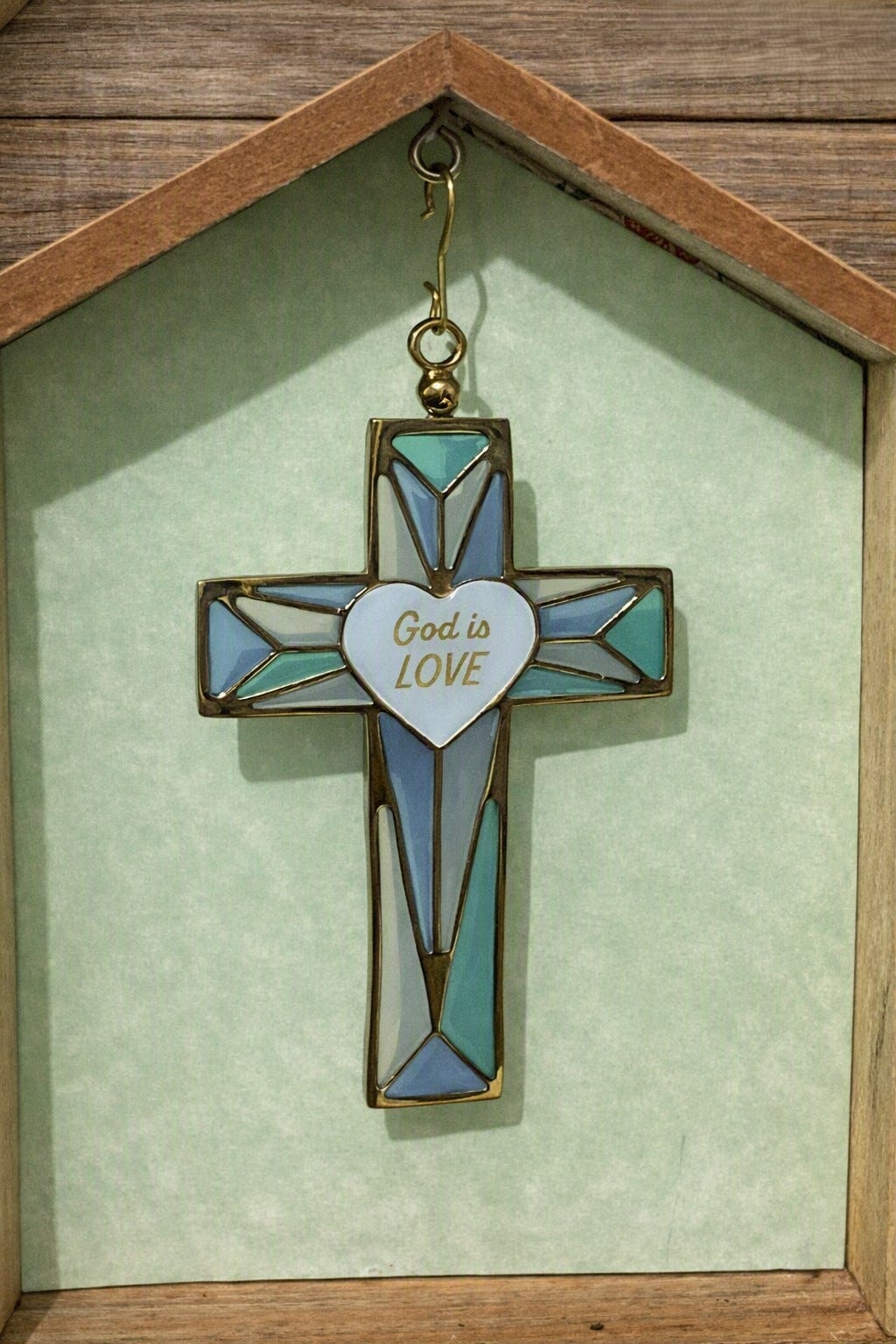
What can we see and understand about this cross? Here’re some of my thoughts:
The arms of the cross are stained glass, always a reminder of the transparency of love. We see the colored glass because of the light that flows through the glass. We don’t see the light itself that illuminates, even though we are subconsciously aware that it must be there. If the light is absent, we would not notice much at all. It’s the light that animates.
And what do we see when the light shines through? The colors blue, green and purple. Blue and green bring to mind the sky and the earth, and purple usually signifies seriousness, the solemnity of suffering. Purple is the color of Lent and Advent, times of preparation and repentance. These three colors together signify that there is no place where God’s love is not. Not only is He above and over us (the sky), He’s also down here, in creation (the earth). As the old saying goes, “God is in everything, but not everything is God.” (3)
But not only is God over and around us, He’s also with us. That’s what the purple signifies. That’s the color of sorrow, of suffering. God is with us in our sufferings. There is no place where God is not.
And tying the glass and the colors together are those pieces of gold joinery. Usually, stained glass is fused together by heavy, dark lead. But in this cross, the lines connecting everything, holding it all together, are gold. What might these gold lines signify, if we ponder with the heart of Mary?
It brings to my mind the Japanese art of kintsugi - the art of embracing brokenness and finding beauty in imperfection. You may have seen examples of it.
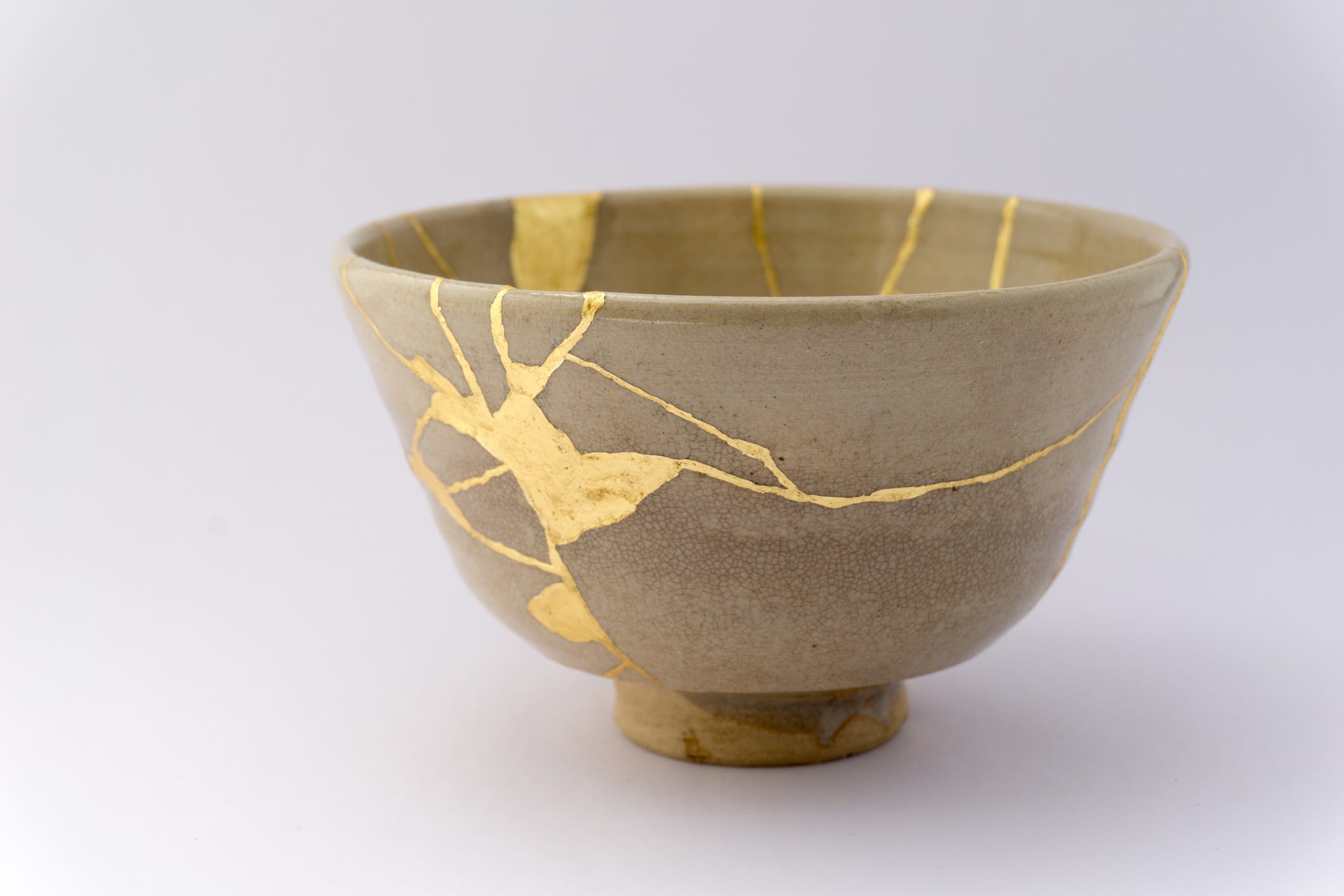
In the kintsugi art form, the bowl is considered more beautiful with the gold cracks than it was in its original state.
That something is more valuable after it is broken and repaired - that’s a statement worth sitting with. We know that after Jesus resurrected, His wounds did not disappear. On the contrary, His wounds made him even more glorious. They shone forth, like the gold lines in the bowl. Henri Houwen’s classic The Wounded Healer dives into this idea - that we are all patients suffering with some sort of illness, but it is what we have learned about grace, presence, hospitality and compassion that enables us to connect with each other. Healing can happen through our wounds, even because of our wounds. As Scripture teaches, it is by the wounds of Christ that we are healed. (1 Peter 2:24)
That’s a surprising and enormously comforting thought. If the wounds of Jesus the Christ stay with Him on His resurrected body and are not seen as something shameful but as signs of deep love, then that will most certainly be true for us, as well. One day, our deepest sufferings, the things that truly broke us, will be seen as precious. They will not detract from who we are. Rather, they add to our value. Our broken bits and pieces will be carefully, lovingly repaired and made into something new, just like the kintsugi bowl. But because God loves us and is with us, because of His incarnation, we don’t have to wait until the next life to begin reassembling ourselves. We can start that process now.
And that brings us to the heart - literally - of this cross. The silver heart situated in the crossroads of the vertical and horizontal arms cries out “God is Love.” This itself is a reference to the Scripture passage of 1 John 4:16, which says “We have come to know and to believe in the love God has for us. God is love, and whoever remains in love remains in God and God in him.” In his encyclical Deus Caritas Est, (God Is Love), Pope Benedict XVI unpacks this understanding. God’s very nature is love; it’s not just an attribute or an occasional disposition. Christianity is not, therefore, simply a philosophical or ethical system designed to make us better people, or the world a better place. Rather, it’s how we respond to the invitation to be part of that love, to let our hearts become one with His heart.
More recently, Pope Francis has made that love of God deeply personal in his 2024 encyclical Dilexit Nos (He Loved Us), by reflecting on the divine and human love in the heart of Jesus Christ. He writes that Christ’s “open heart has gone before us and waits for us, unconditionally, for he loved us first.” Just as this cross does, Pope Francis emphasizes the “need to rediscover the importance of the heart…In the heart we encounter the radical source of our strengths, convictions, passions and decisions.”(4) (5) Being formed by the heart of Christ, the God who is Love, is about interiority, contemplation, and resisting the “liquid world” Pope Francis describes.
To ponder this cross is to remember that Christianity begins in the heart — in the place where divine love meets human longing. Pope Benedict names that love as God’s very nature; Pope Francis calls us back to the interior space where that love is received. As St. John Henry Newman so eloquently proclaimed, the heart is the meeting point where God speaks to us and we speak to God.(6) And perhaps that is why this cross speaks so clearly: it reveals, in simple glass and metal, the truth that has always been at the center of our faith — God is Love, and He loved us first.
That’s what I see when I look at this cross. But as with all things of God, there is always more to notice, to discover, to apprehend. As you ponder this cross, what do you see and understand? How are you changed?
Footnotes:
1. John Henry Newman, Fifteen Sermons Preached Before the University of Oxford, Sermon XV - The Theory of Developments in Religious Doctrine
2. Robert Andrews, “Our Pattern of Faith: The Virgin Mary in John Henry Newman’s Theory of Religious Development,” www.academia.com
3. Matthew Shadle of Window Light wrote recently about this in his article “The Trinity is Imprinted on all of Creation.”
4. We should note that the Biblical understanding of the heart has little to do with feelings. Instead, it is “the seat of memory and judgment, rather than emotions.” footnote in the NAB https://usccb.org/bible/genesis/6
5. Dilexit Nos (24 October 2024) paragraphs 1, 2, and 9
6. In 1879, when he was named a Cardinal of the Catholic Church, Newman chose the motto Cor ad cor loquitur - ‘Heart speaks to heart’. For Newman, the heart symbolizes the whole person. It is the core of one’s personhood.


