The Shadow of God's Plan Part 2

Our Catholic Life

Image provided by Mike Bugal
As I write this it is Sunday, January 15th and we have just returned from first Mass (5 AM). The Church was brightly decorated as this is a special day here in the Philippines as a whole. Today celebrates the arrival of the Catholic faith in the country. In 1521, Ferdinand Magellan arrived and met with local chieftains on the island of Cebu. He presented them with an image of the Christ Child which is still preserved today. It’s on display in the Basilica named in its honor, Basilica Minore de Santo Niño, in Cebu City. There is also a cross that was planted at Magellan request by the first Catholic priests that arrived with him. It is also preserved and stands in a memorial close to the basilica.
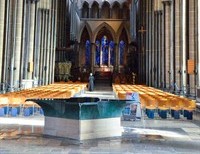
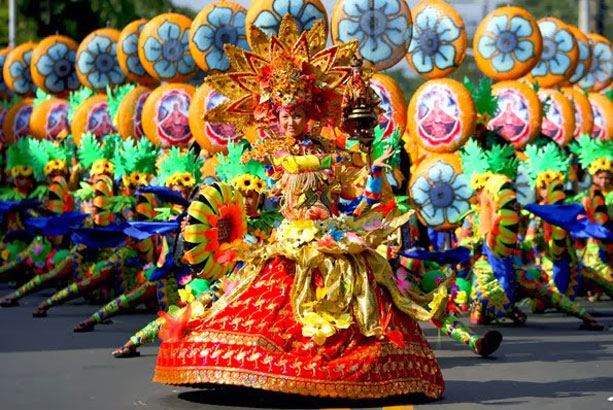
Although this day is celebrated throughout the nation, no place more so than Cebu City. There is a fiesta called “Sinulog” that takes place every year to honor the Santo Niño and to thank the Lord for his protection and guidance down through the years. There is a series of Novenas leading to this weekend and the picture of the Basilica that I linked to above was taken during one such Mass. The attendance at each Mass is no different than the attendance today… massive! The crowd spills out into the streets on both sides.
At the beginning of the actual fiesta there is a procession that is made up of many hundreds of thousands of worshipers (some estimates go as high as 1 million). This picture focuses on the portion where the Image is at the head of the crowd. That same volume of people comes behind them pretty much for as far as the eye can see. Then the people from the various communities around the islands of the Visayas (the part of the country where we live) dress in colorful costumes and parade… performing street dances as they go.
Nearly every Catholic home here has a Señor Santo Niño image. The picture that accompanies this article shows the altar in the living room of our house. One of the Santo Niño belongs to our sister Samara and the one on the right is ours. During the Sinulog we have a small celebration in our parish. Everyone brings their Santo Niño and carries them in the procession. Of course, in a couple months we have our own fiesta on the Feast of Saint Joseph (March 19th).
A Way of Life
Catholicism here is not just a religion, but a way of life. It is part and parcel of family life. No meal begins without prayer. The same is true of special occasions as well, such as birthdays, weddings and so on. No day begins or ends without blessing ourselves with the Sign of the Cross. No journey by any means of transportation starts without the same. Novenas Masses of Advent that begin at 4 AM are packed to overflowing even in a fairly small town like Canlaon… all 9 days. Christmas Eve begins with the Misa de Gallo at 10 PM and then meals are eaten with friends and family. This is called “Noche Buena” and is usually the time when gifts are exchanged. The same is true of New Year’s Eve.
Every day at 3 PM the Divine Mercy Chaplet prayer is played on ABS-CBN Network (one of two major TV networks). Every Sunday morning Mass is telecast on both networks in Tagalog, Bisaya or English. Sinulog is not the only huge celebration. The popular Feast of the Black Nazarene at the Quiapo Church in Manila draws well over a million people to the “Traslacion” procession on January 9th. Pope Francis’ visit 2 years ago drew pretty much the same size crowd.
Strength
This ingrained Catholic experience is one of the sources of strength for the people. Believe me, they need strength. These islands are wracked by earthquakes, typhoons, floods, tsunamis, and volcanos (such as our own Mount Canlaon which has had minor eruptions as recently as last year). There have been times when those things came one after another in fairly short order. For instance, Typhoon Yolanda hit Leyte and Samar to our east with devastating impact. Cities such as Tacloban were pretty much wiped off the map. Not long after that a major earthquake hit the same region.
The people of the Philippines are, for the most part, a very poor people. Poverty if a way of life and then they lose what little they have in these disasters. Yet they never give up and their spirit is never broken. They pull together, share what they can with one another and help each other start again. The heart of the Filipino is a singing heart and a smiling heart. That inner strength and peace in the face of these things flows from their shared experience of their Catholic Life and the strength of family and friends that naturally flows from it.
Our Example
I’ve written this article not just to laud the Filipino people and culture, though laudable they are. But the time is probably coming when being a Catholic in the rest of the world will not be as easy as it has been the last 200 years or so. Possibly persecutions may even begin. But the Lord has provided us the example of the Church in the Philippines (and Africa as well) that no matter what happens, no matter how much or how little we have that if we will draw close to Him and Mama Mary as well as each other we will overcome and thrive. After all, the blessed family starts with the Blessed Family.
Recommended Stories
About the Author
I was a Cradle Catholic from the time that I was born through my teen years. I slowly moved away from the Church and as a young adult I became an Evangelical Christian. I spent nearly 40 years in various types of ministry as a teacher, preacher, pastor or evangelist. But my main area of expertise was Apologetics…what we believe and why we believe it. I am a graduate of Central Christian College of the Bible in Moberly, MO with a Bachelor of Science in Biblical Studies. In November of 2014 I retired to the Philippines, where my wife Rose is from. We live in the mountains of Negros Oriental in the small town of Canlaon City with our many brothers and sisters, nephews and nieces (to whom I am “Daddy Mike”).
Nine years ago I reverted to the Catholic Church. I have try to write articles which inform, instruct and equip our Catholic brothers and sisters while avoiding using jargon. I have also sought to defend the Faith with our several Protestant visitors in as kind a way as possible
My archive here, which now contains nearly 80 articles, is located at http://www.catholic365.com/author/mike-bugal/
I may also be contacted via email at mbugal@yahoo.com