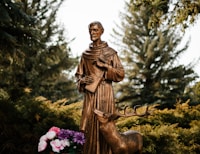
Saint Francis of Assisi: A Beacon of Humility in a Culture of Excess
Sponsored

Catholic365 is sponsored by
Road to Purity




Blessed are those who mourn, for they shall be comforted.
I have read these words many times, but never have they carried their proper weight. Just last week, they were ink on a page. They were familiar, yet distant. But now, as I read them again, they seem to shimmer with something living, as though traced in gold by a hand unseen.
In my mourning, I find myself in awe of God.
It is here, in this sacred ache, that I watch Him mend what we could never mend on our own. I see Him gently tending to familial wounds long left open, wounds we learned to live around but never knew how to heal. I see His strength filling the hollow places where ours gives way. I see the Holy Spirit moving, alive and active like at Pentecost, setting tongues on fire to speak words that restore life. Bridges that once seemed permanently broken are quietly rebuilt, not by human effort, but by a love that is whole, divine, and without limit.
In mourning, I’ve learned that God is not distant; He is visible and radiant in mercy.
And in this time of sorrow, I am drawn again to a truth that has long lingered in my heart: memento mori—the quiet knowledge that even at our most beautiful and alive, death is already near.
For me, this remembrance has always belonged to autumn. It comes when the air turns crisp, when green gives way to amber and rust, when the fullness of summer bows gently into decline. It is then that my soul shifts almost instinctively toward the awareness that I am dust, and to dust I shall return (Genesis 3:19). I dress in black. I pray for the souls in purgatory. I intentionally begin to order my life around that sobering and fruitful truth: that time is fleeting, and every moment is a gift entrusted to us.
But now it’s spring.
Spring, with her fresh green leaves and happy dandelions all brilliant in her warmth, her light, her quiet promise of life renewed. Spring, so perfectly aligned with the joy of Christ risen.
And it is here, in this season of beauty, that I am most unexpectedly confronted.
Because even now with the sunshining and the flowers blooming, death lingers just beyond the Magnolias.
And with that realization, something within me awakens more sharply than before. Having seen the nearness of death set against the loveliest of days, I find myself consumed with a holy urgency:
What have I taken for granted?
The use of my hands for my work, my craft, my service. The ability to exercise the gifts God has entrusted to me. The chance to speak what rests quietly within my heart. A moment to say, “I love you,” without hesitation or regret. The grace of a proper goodbye. The gift of sight to truly behold the faces of those I love, to study their smiles, to notice the joy, or even the sorrow, in their eyes.
Am I loving well today?
Am I caring for my neighbor with intention, or just drifting through these moments as though I’m certain they will return to me later?
And what will I do with this moment, knowing the next is not promised, only hoped for?
In mourning, My thoughts have turn inward, toward my own soul. I begin to examine the path behind me, the road ahead, and all the quiet ways I might draw closer to the Lord who reveals Himself so clearly in both joy and sorrow.
And in the midst of all this, surrounded by blooming flowers and wide blue skies, I find myself still in mourning.
A deep, profound mourning that settles not just in one part of me, but across my whole being, mind, body, and soul.
And yet… they are not in conflict.
They are in agreement.
Because here, in this place of deep sorrow, I remember something I’ve learned before: that when I am weak, then I am strong. That in this deep, piercing, sanctifying mourning, I am not broken, I am comforted and I am seeing God.
I see Him in the man who suddenly finds the words he never had, the words that heal, that reconcile, that bring life. And I am reminded of Pentecost, of the disciples who longed to speak truth but did not know how, until the Holy Spirit moved and gave them voice.
I see Him in the eyes of the hardened heart, softened in an instant, made willing—freely willing—to forgive.
I see Him in the gentle words of strangers, in quiet kindnesses that could easily go unnoticed, in subtle mercies that pass before others but stop me in my tracks.
And in those moments, I find myself whispering,
“God… I know that was You.
I see You, Lord.”
And though my heart remains heavy, “My soul magnifies the Lord, and my spirit rejoices in God my Savior” (Luke 1:46).
— Ophelia
I am a catholic writer who shares exegetical essays and letters based on Scripture, Magisterium and the wisdom of the Saints. If you like my work, please consider reading more on my Substack opheliamolina.substack.com.