Bind Their Kings in Chains

St. Paul is Praying for You


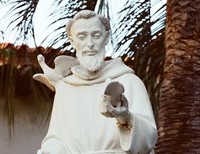
Photo By: Flickr/QuartierLatin1968
“Therefore, from the day we heard [of your faith], we do not cease praying for you and asking that you may be filled with the knowledge of his will through all spiritual wisdom and understanding to live in a manner worthy of the Lord, so as to be fully pleasing, in every good work bearing fruit and growing in the knowledge of God, strengthened with every power, in accord with his glorious might, for all endurance and patience, with joy giving thanks to the Father, who has made you fit to share in the inheritance of the holy ones in light.” (Colossians 1: 9-12)
I ran across this passage last week after a particularly frustrating day and it really struck a chord with me. I'll explain why in just a minute.
First off, I admit I know less about the background to specific epistles than I probably should, so I flipped to the handy introduction page on the USCCB's online Bible. It turns out that this Letter was written to the Church at Colossae in Asia Minor (modern-day Turkey) by St. Paul at the request of Epaphras, the missionary who apparently founded the Church at Colossae. As with many of the Churches St. Paul wrote to, the Church of Colossae had gotten a bit derailed by the preaching of some folks who didn't quite understand the Gospel. Epaphras wrote to St. Paul asking him to weigh in on the subject and set the Church in Colossae on the straight and narrow. St. Paul had never visited Colossae (and couldn't at the time, since he was in prison), but he did not hesitate to pray for the Church there. He rejoiced at the faith of people he had never met, and prayed for their discernment of God's will and the courage to follow through with it. So why does it matter to me if almost 2000 years ago, St. Paul was praying for some wayward congregation members in Asia Minor?
As Catholics, we understand that those who have come before us and passed away are as much alive today as they were back then (in fact, some might say even more so, as they're no longer bound by the limitations of time and space). So, when I read St. Paul all those years ago praying for people he's never even seen or met, it really felt as though he was speaking to me. Of course, “it's like the author was speaking right to me” has become a literary cliché. But unlike when I read the poetry of Emily Dickinson and feel like I've just had a soothing chat with a friend, when I read the writings of the Saints and/or Scripture, the authors are actually speaking right to me.
Do you think St. Paul rejoices any less over us embracing the faith than he did over the Colossians?
Do you think he prays any less for our discernment of God's will than he did for theirs?
I guess it's kind of funny that St. Paul wrote in another one of his Epistles that we are “surrounded by so great a cloud of witnesses” (Hebrews 12:1). Turns out he's one of them now.
Recommended Stories
About the Author
Nick Modelski is a permanently professed Secular Franciscan, an ordained Reader in the Ukrainan Catholic Church, and a loving husband and father. Graduating from Madonna University in 2008 with a major in Psychology and a minor in English (with some healthy doses of theology and philosophy), Nick completed a year of National Service through the Americorps*VISTA program at his alma mater. He then worked for 3 and a half years in Southern Illinois with the USDA, Forest Service’s Job Corps program, all the while discerning his vocation. After considering the Franciscan Order for some time, Nick felt most called to the married life with long-time friend, Maria (they first met at daily Mass during college).
Their little family lives liturgically in southern Minnesota on "Pisanki Farms" (named after traditionally decorated Polish easter eggs). Nick also teaches history online for a Catholic homeschooling program.
His other interests include nature, history, literature, film, music, prayer, theology, philosophy, the Internet, and service.