Saint Bernardine of Siena
Sponsored

Catholic365 is sponsored by
Road to Purity




In an age overflowing with noise and distraction, the radiant witness of Saint Rafael Arnáiz Barón shines as a quiet beacon for every soul longing for God’s presence in stillness and simplicity. Born into wealth in early twentieth-century Spain, Saint Rafael Arnáiz Barón surrendered the world’s restless pursuits for a life veiled in humble silence—embracing the Cross with a love that was wholly Marian and Eucharistic. His journey, marked by suffering and deep spiritual joy, speaks not just to monks behind monastery walls, but to Catholic families, pilgrims, and spiritual seekers everywhere who yearn for deeper intimacy with Jesus and Mary.
At Bob and Penny Lord Store | Journeys of Faith, we have always cherished the luminous path of the saints—those faithful souls who invite us, through word and witness, to discover God’s love anew. Saint Rafael Arnáiz Barón is especially dear to our mission. Through his devotion to the Eucharist, ardent love for the Blessed Mother, and silent offering of his trials, he lived the message at the heart of our apostolate: that holiness is possible, even in the ordinary, when our hearts are consecrated to Christ and Mary.
As you journey with us through the life and message of Saint Rafael Arnáiz Barón, may his testimony encourage you to find God’s voice in silence, to trust Divine Providence, and to bring the treasures of the Faith—straight from the monastery to your home, and from your home back to the heart of the Church.

Born in 1911 in the scenic town of Burgos, Spain, Saint Rafael Arnáiz Barón lived in a world filled with tradition and gentle faith. His family was blessed with material comforts, but what truly distinguished young Rafael was the profound Catholic atmosphere that imbued every moment of his youth. From a tender age, he was surrounded by the practice of daily Mass, family rosaries, and loving conversations about the Blessed Mother and the Holy Eucharist.
As a boy, Rafael displayed a quiet, contemplative nature that stood out even among devout families of Spain’s heartland. Friends and relatives later described him as sensitive, intelligent, and drawn instinctively to silence and presence over noise and distraction. The seeds of his spiritual destiny were planted early—in the sacred rhythms of home prayer, the reverence for sacramentals, and a filial love for the Virgin Mary that would become the guiding star of his interior life.
In these formative years, Rafael’s longing for meaning and depth intensified. He yearned for moments alone in prayer, drawn by an almost magnetic call to be close to Jesus in the Eucharist. This devotion—nourished by countless hours before the tabernacle—became the central axis of his days. The Spanish landscape around him, marked by stone chapels and fields of wheat, whispered of God’s presence and spoke to Rafael’s soul of mysteries beyond the visible world.
Suffering entered his life at an early age with bouts of illness, yet these sorrows only deepened his sense that each hardship could draw him closer to Christ. Family stories tell of the boy quietly offering his discomfort for the intentions of Our Lady, uniting his pain to the sufferings of the Sacred Heart. Even amid youthful dreams and ambitions, one thing was clear: Rafael’s heart had been claimed, set apart for a unique path—a path of surrender, silence, and unparalleled love for the Lord.
Bring the Legacy of Saint Rafael Arnáiz Barón Into Your HomeAre you inspired by the life and devotion of Saint Rafael Arnáiz Barón? You’re not alone. So many Catholic families and pilgrims yearn to draw closer to God through the silence and surrender that marked Saint Rafael’s path to holiness—but sometimes we need help to begin or sustain that journey. At Bob and Penny Lord Store | Journeys of Faith, we invite you to:
Let us help you walk in the footsteps of Saint Rafael Arnáiz Barón. Visit our store today, and discover resources and relics that can enrich your journey to Jesus in the Eucharist and Mary, His Mother. |
From the outside, Rafael Arnáiz Barón seemed to live a storybook life. Born into a loving, affluent Spanish family in 1911, he was blessed with intelligence, refinement, and every opportunity a young man of his era could desire. He excelled in his studies, his artistry, and his friendships. Those who knew him remember a polite, joyful spirit—the kind of son any Catholic family would be proud to call their own.
Yet, even amid this abundance, Rafael felt a restless stirring in his soul. While many of his peers chased pleasure or worldly success, Rafael’s heart recognized an emptiness that neither accolades nor comfort could fill. From an early age, his deepest joys came not from social gatherings or achievements, but within moments of quiet contemplation—lost in prayer before the Blessed Sacrament, or meditating on the mysteries of the Rosary at his mother’s side.
This hunger for something greater grew steadily, quietly overtaking the attractions of youth. It was not that Rafael scorned the good things of the world—far from it. He cherished his family and friends. But God, ever gentle and patient, was drawing him to something deeper: to the silence of the Carthusian cloister, where he would learn to love Christ in the Eucharist above all else.
Painfully aware of his own frailty, Rafael answered the Lord’s subtle call with humility. He would later write, “To possess God is everything.” His journey—a journey marked by obedience, sacrifice, and a burning Eucharistic love—offers us a powerful witness: even those blessed with every earthly gift are made for something higher, something eternal.

Saint Rafael Arnáiz Barón, so sensitive to the noise and distractions of his age, discerned a radical invitation from Christ—to leave all behind and pursue silence in the heart of the Cistercian Trappist order. In his early twenties, Rafael abandoned promising studies in architecture, the comfort of family wealth, and the dizzying pace of life in Burgos for the spare hiddenness of the Abbey of San Isidro de Dueñas. Here, he entered the novitiate, exchanging worldly ambitions for the white habit of the monks and the rigorous silence of Trappist life.
It was a surrender not only of career and comfort, but of his personal plans—embracing daily labor, the Psalms prayed in choir, nights punctuated by the bell for Matins, and days drawn out in adoration before the Eucharistic Lord. The silence Rafael so hungered for was more than an absence of noise; it was the arena where God’s voice could reach his heart. Saying yes to monastic life, Rafael testified that only in leaving the world behind could he find “the sweetness of lost time recovered with God.”
For Rafael, the cloister was a school of the Cross—a place where human weakness is confronted and transformed by grace. Chronic illness often sent him back outside the monastery walls, yet obedience and humility anchored him through trials. He wrote: “I seek nothing but to love God… whether in bed of pain or at the altar, every moment is an eternal gain if it is spent with Jesus.” His fidelity did not waver in suffering, but seemed only to deepen, especially in his devotion to the Blessed Virgin and his longing for Holy Communion. In the abandonment of the world for the Trappist life, Rafael Arnáiz became a luminous witness of surrender—a saint for restless souls yearning for silence and God.

Tucked away in the Castilian plains, the Monastery of San Isidro de Dueñas became the sacred refuge where Saint Rafael Arnáiz Barón discovered the soul’s true silence—a silence that thrummed with the Real Presence of Christ. The Trappist enclosure, ancient stone cloisters, and echoing Gregorian chant called out to a generation hungry for something beyond the clamor of modernity. Rafael, a young man burning with love for Mary and the Eucharist, found in these quiet walls the peace his heart craved.
Inside the gates, daily life was woven with the Liturgy of the Hours, adoration before the Blessed Sacrament, and humble work. Rafael’s letters brim with the warmth of brotherhood, the simple joys of carving wood, and above all, the grace he found at the altar. “To live hidden with Christ in God, to lose oneself for love of Him,” he wrote—here, every Mass was an encounter with the living Jesus, and every Rosary an embrace of Mary’s maternal care.
Yet the path was not without suffering. Rafael’s illness forced him, again and again, to leave the cloister for long periods of painful recuperation. Each time, he returned to San Isidro not with bitterness, but with deeper trust in Divine Providence. His humility, detachment, and love for the Eucharist became a witness to his fellow monks—and, eventually, to Catholics around the world—reminding all of us that true holiness finds its home where silence, suffering, and sacrament meet.
For those yearning to draw closer to Christ, the story of San Isidro de Dueñas is more than history; it is an invitation. It is a place—and a way—where ordinary life is transfigured by grace. Through Rafael’s example, the monastery’s humble walls echo with a promise: God still calls souls to Himself, in silence, sacrament, and surrender.
Saint Rafael Arnáiz Barón’s life bore the unmistakable mark of suffering—a suffering sanctified by his unwavering faith. Diagnosed with severe diabetes at a young age, Rafael’s earthly journey was riddled with exhaustion, physical pain, and the humbling limitations of chronic illness. This was not merely a medical trial, but a spiritual crucible in which God refined one of His hidden gems.
What sets Saint Rafael apart is not just that he suffered, but how he suffered. From within the walls of the Trappist monastery of San Isidro de Dueñas, he embraced his illness in union with Christ Crucified. Every injection, every moment of weakness, every return to his family home because of failing health became an offering—an oblation woven together with countless Rosaries and hours before the Blessed Sacrament.
For Rafael, diabetes was a call to deeper surrender, not despair. His journal, radiant with trust and tinged with the solitude of his struggles, reveals a soul that sought solace in Mary and in humble, hidden prayer. The walls of his cell became a sanctuary where suffering was not wasted, but transformed—a holy school where the Eucharist and the Virgin Mother were his strength and consolation.
In a world distracted by activity and noise, Rafael teaches that illness is not exile from God’s plan, but a privileged invitation to intimacy with the Suffering Lord and his Mother. His witness is a beacon for families and individuals alike who carry hidden crosses: even in weakness, you can become a fiery soul, loving Jesus in the silence and offering everything for the world’s salvation.
Saint Rafael Arnáiz Barón’s journey is not a tale of effortless sanctity, but one marked by persistent, humble surrender—one “yes” echoing into the next, every day, in hiddenness and simplicity. Born into a loving Spanish family, Rafael tasted the world’s gifts: talent, good looks, academic promise, and strong friendships. Yet, as he listened in prayerful silence, a gentle but persistent invitation from God grew clearer within his heart: Leave all, come follow Me.
Rafael’s vocation blossomed in the cloistered silence of the Trappist monastery at San Isidro de Dueñas. There, his days unfolded in the rhythm of liturgical prayer, labor, and—perhaps most heroically—acceptance of suffering. He was forced to leave the monastery multiple times because of debilitating diabetes, enduring each departure with the docility of Mary’s fiat: “Let it be done to me according to Thy word.” The world outside beckoned, promising relief or distraction; Rafael responded not with grand gestures, but with daily acts of consent to God’s mysterious plan.
Instead of bitterness, Rafael embraced his limitations as a way to unite more intimately to Jesus in the Eucharist. In his letters and spiritual writings, he returns again and again to the theme of abandonment—trusting that each moment, even the most sorrowful, is willed or allowed by the loving Heart of God. Rafael’s story reminds us that holiness is not about bearing all things in our own strength, but about trusting, as Our Lady did, that God can sanctify every circumstance if we keep saying “yes.” Even in his physical absence from the monastic choir, Rafael offered his sufferings as a hidden sacrificial oblation, united to Christ’s love poured out in every Mass.
For Catholic families, pilgrims, and all souls longing for silence in a noisy world, Rafael Arnáiz Barón stands as a luminous witness: Sainthood is a path of small, persevering fiats—a thousand quiet “yeses”—woven through ordinary days into an extraordinary testimony of faith.
To encounter the life of Saint Rafael Arnáiz Barón is to be invited into the holy paradox of loving what is unseen and cherishing what is unspoken. In a modern world pulsing with distractions and noise, Saint Rafael stands out as a beacon for all souls who thirst for silence—not the emptiness of isolation, but the fullness of a heart devoted to God in secret. His journey, marked by humility and withdrawal from the world’s acclaim, reflects a deeply Marian spirituality: hidden, contemplative, always seeking the quiet where God whispers.
Saint Rafael’s choice to enter the Trappist monastery, to embrace a life removed from the clamor of ordinary ambitions, teaches us that holiness is often found not in doing, but in being—with God, for God, and in God. He understood, with the wisdom of the saints, that the most profound encounters with Christ often happen in the silence of the Eucharist, where all words fail and love alone remains. His devotion was saturated with Eucharistic longing: in hours spent before the Blessed Sacrament, he discovered the secret of surrender, offering every suffering and joy to Jesus truly present.
In the hidden cloisters, away from the gaze of the world, Rafael’s soul blossomed under the gaze of Mary. He entrusted his purity, his difficulties, and his very vocation to Our Lady, confident that she would draw him ever closer to her Son. The rosary was his refuge, a chain binding him to the mysteries of Christ’s life lived quietly at Nazareth and united at the foot of the Cross. His silence was the soil in which his Marian and Eucharistic loves grew strong—unseen by most, but known by God.
For families and seekers drawn to the tradition and beauty of the Catholic faith, Saint Rafael beckons: step back from the clamor, shelter your heart in silence, and discover the hidden presence of God. In following his example, we learn that the path to holiness is often paved with unseen sacrifices, quiet prayers, and the gentle, persistent love that blooms in the silence where Christ dwells.
For Saint Rafael Arnáiz Barón, the heart of his spiritual journey was simple, surpassing every earthly joy or sorrow: to love Jesus in the Eucharist above all else. While the world outside his Trappist monastery was restless and noisy, within its walls, Rafael found an oasis—the Blessed Sacrament enthroned and adored, radiating silent strength to all who would approach with faith. Time after time, Rafael's reflections, preserved with childlike sincerity in his writings, reveal it was at the feet of Jesus in the tabernacle where he found his truest home.
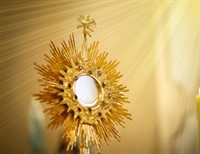
This young saint’s devotion was not an abstract theology, but something lived intimately in daily Adoration and in receiving Holy Communion. He wrote, “What happiness to be near Jesus, to see Him so close, to tell Him everything!” It was this Eucharistic presence that became Rafael’s anchor, especially as his fragile health interrupted his monastic routine, forcing him to spend long periods in the infirmary. Even away from the altar, his heart remained knelt at the foot of the monstrance, longing for union with the Living God veiled beneath the appearance of bread.
Saint Rafael understood what so many saints throughout the ages have proclaimed: the Eucharist is the very center of Christian life. It is the Lord Himself—Body, Blood, Soul, and Divinity—breaking into the solitude of our lives with transforming grace. In an era marked by distractions and endless activity, Rafael’s testimony whispers to every restless soul: “Come, let your heart rest in the gentle silence beside Jesus in the Blessed Sacrament. Everything you seek is here.”
Saint Rafael Arnáiz Barón’s journey to sanctity is intertwined with his unwavering, almost childlike devotion to the Blessed Virgin Mary. For Rafael, Mary was not simply a distant ideal—she was a loving Mother to be trusted with a son’s every worry, joy, and suffering. In his tender letters and journals, he described a relationship with Our Lady marked by boundless confidence, surrender, and simplicity. He turned to Mary in times of struggle, especially during the physical hardships of his illness, invoking her intercession with the pure confidence of a trusting child.
Rafael’s Marian devotion did not spring from grand theology or complex arguments. Rather, it blossomed in quiet moments of prayer: the gentle rhythm of his daily Rosary, the silent presence before her statue in the Trappist monastery, and humble appeals for strength when his body failed him. For him, Mary was the surest path to Jesus. He called her “the avenue to Heaven,” echoing the wisdom of the saints who taught that to come to Mary is to come to Christ.
His example speaks powerfully to Catholic families today. In a world of noise and fleeting distractions, Saint Rafael’s reliance on the maternal heart of Mary is a luminous invitation: “Be little. Be simple. Trust the Mother God has given you.” His legacy calls us back to the Rosary, to Marian consecration, and to the intimate conviction that, as Saint Rafael wrote, “if I abandon myself to her, she will bring me straight to Jesus.”

Saint Rafael Arnáiz Barón’s sanctity did not arise from grand gestures or the world’s applause, but from his unwavering devotion to God in the smallest corners of daily life. After illness interrupted his monastic aspirations, Rafael returned again and again to the Trappist Abbey of San Isidro de Dueñas, not as a fully professed monk, but as an oblate—one called to serve in the background, often assigned to the most menial work. It was here, in sweeping floors, peeling potatoes, and washing dishes, that Saint Rafael’s soul soared.
Far from resenting these chores or seeking a spotlight, Rafael saw each act as a sacramental encounter, an offering to Jesus truly present in the Eucharist. Each humble duty became a silent hymn of love, his way of reverencing Christ in the ordinary. For Rafael, the monastery kitchen became an altar, and the rhythm of daily labor formed a liturgy as pleasing to God as formal prayer. In his letters, he wrote movingly of finding “the presence of God in each small thing lovingly done,” echoing the Blessed Virgin Mary’s own fiat to the hidden, everyday will of God.
This Eucharistic vision transforms even the most routine tasks. When Rafael polished brass candlesticks for the chapel or mopped chilly hallways, he united his fatigue with Christ’s sacrifice, finding closeness to Mary, who herself lived and sanctified ordinary family life at Nazareth. Rafael teaches families and all who labor in obscurity that holiness is not distant, but accessible through the devotion, patience, and self-offering we pour into every quiet moment. In a world clamoring for attention and noise, Saint Rafael reminds all who seek God that He waits for us in the stillness, in the ordinary, and in the humble tasks of each day.
Saint Rafael Arnáiz Barón stands as a radiant beacon for our noisy, restless times—a modern saint whose life gently calls Catholic families and pilgrims back to the heart of the Gospel: silence, surrender, and Eucharistic love. In the witness of “Fray Rafael,” we discover anew the invitation to make space for the Lord in the midst of daily life. Here, amid ordinary tasks and hidden sacrifices, he teaches us to let Our Lady lead us, to find renewal before the Blessed Sacrament, and to rest in God’s presence even when the world presses in.
At Bob and Penny Lord Store | Journeys of Faith, we believe the lives of saints like Saint Rafael Arnáiz Barón are not distant relics, but living guides—companions on our own journey of faith. Through his Marian devotion, his love for the Eucharist, and his joyful embracing of suffering, he invites each of us to return to what matters most: Jesus in the Eucharist and the still, small voice of God within. May we follow Saint Rafael’s example, deepening our devotion and finding God’s peace in the silence, trusting that even our hidden prayers and sacrifices echo in eternity.
Saint Rafael Arnáiz Barón was a Spanish Trappist oblate, known for his profound love of God, deep Eucharistic devotion, and his witness to silence and humility in modern times. Born into a devout Catholic family in 1911, his life stands as a shining testimony of faith and trust in Divine Providence.
Saint Rafael Arnáiz Barón is recognized for his commitment to silence, contemplation, and prayer as essential pathways to God. His spiritual writings reveal a soul in love with Jesus in the Eucharist and deeply trusting in Mary’s maternal care. His life and legacy offer encouragement to all who seek an intimate relationship with Christ, especially in the midst of the noise of today’s world.
Saint Rafael Arnáiz Barón was born on April 9, 1911, and died on April 26, 1938. Despite his short life, his impact endures through his spiritual diaries and the powerful witness of his joyful surrender to God’s will.
Saint Rafael’s life addresses the ache of the modern heart for stillness and authentic relationship with God. In an age filled with distractions, his example of silence, adoration, and simplicity gently challenges Catholics—and all Christians—to rediscover the beauty of contemplative prayer and to root their lives more deeply in the Eucharist and Marian devotion.
Saint Rafael embraced the Trappist monastic rhythm, steeped in silence, manual work, and hidden prayer. Even as illness forced him to live much of his monastic life as an oblate rather than a full religious, he offered his sufferings in union with Christ and found God in the quiet, humble daily round of monastic life.
Rafael’s writings center on abandonment to God’s will, the beauty of silence, the centrality of the Eucharist, devotion to Our Lady, and the redeeming value of suffering. Time and again, he returns to the message that authentic Christian joy is born in surrender and simplicity.
Saint Rafael entered the Trappist monastery of San Isidro de Dueñas in Spain, embracing the Cistercian call to contemplative life. Though illness prevented him from taking final vows, he remained a beloved oblate, faithfully living the Trappist spirit until his death.
Silence, for Saint Rafael, is not emptiness but fullness. It is where God speaks to the heart, where distractions fade, and where true communion with Jesus in the Eucharist is fostered. Saint Rafael’s teachings invite families, individuals, and all Catholics to carve out daily moments of prayerful quietude, trusting that in stillness, God’s voice becomes clear