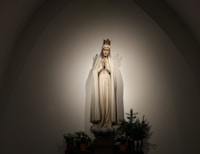
Our Mother Mary
Sponsored

Catholic365 is sponsored by
Road to Purity




Dear women,
Did you know that even a love that feels deep, warm, and sincere can be disordered?
I am not speaking of something cold or obvious. I am speaking of that kind of love that feels almost beautiful in its intensity—the kind that settles into you, that softens you, that begins, slowly, to shape the way you move through your days.
Have you ever felt as though your world begins to orbit him?
As though his presence steadies you, and his absence unsettles something deeper than it should?
We speak of love this way, almost poetically.
We say he is the sun, and we are the moon.
But Scripture is quieter—and more exacting.
“You shall not make for yourself a carved idol… you shall not bow down to them or serve them; for I the Lord your God am a jealous God.” — Exodus 20:4–5
This does not mean God is insecure.
It means He does not permit His place in your heart to be given to another.
And yet… the heart is capable of carving.
Not from wood or stone, but from affection, longing, and desire.
It can take a man—real, limited, unable to bear the weight of worship—and quietly shape him into something central, something necessary… something more than he is.
So every woman should pause, gently but honestly, and ask:
Have I made him into a carved idol?
Look closely. You will recognize it here.
You seek from him the security that belongs to God alone.
→ “God is our refuge and strength.” — Psalm 46:1
You feel safe only when he is present or responsive. When he pulls away, your sense of stability collapses.
Your heart clings to him in a way that competes with your love for God.
→ “You shall love the Lord your God with all your heart.” — Matthew 22:37
You think of him more than you turn to God. Your first instinct is to run to him, not to prayer.
You fear losing him more than you fear losing your state of grace.
→ “Do not fear those who kill the body… rather fear Him…” — Matthew 10:28
You tolerate what distances you from God because the thought of losing him feels worse.
You allow his approval to matter more than obedience to truth.
→ “If I were still pleasing men, I would not be a servant of Christ.” — Galatians 1:10
You adjust your values, your words, or your boundaries so that he will not pull away.
You remain in near occasions of sin to preserve the relationship.
→ “Flee from sexual immorality.” — 1 Corinthians 6:18
You keep placing yourself in situations you know weaken your self-control, telling yourself it’s “not that serious.”
You justify disordered behavior because of your attachment to him.
→ “Woe to those who call evil good and good evil.” — Isaiah 5:20
You explain away what you know is wrong, softening it so you don’t have to confront it.
You neglect prayer or the sacraments when the relationship consumes you.
→ “Pray without ceasing.” — 1 Thessalonians 5:17
Your spiritual life becomes inconsistent, but you remain attentive and available to him.
You place your hope for happiness primarily in him rather than in God.
→ “Cursed is the man who trusts in man…” — Jeremiah 17:5
You believe that if he finally chooses you fully, everything in you will feel at peace.
You ignore moral clarity to avoid the suffering of detachment.
→ “Take up your cross and follow me.” — Luke 9:23
You see what needs to be done, but you delay it because letting go feels too painful.
You allow emotional dependency to replace trust in Divine Providence.
→ “Cast all your anxieties on Him…” — 1 Peter 5:7
Instead of bringing your anxiety to God, you wait for him to soothe it.
Did you recognize yourself in more than 2 of those?
And if the answer, even faintly, is yes… do not be afraid of what that reveals.
The heart can be reordered.
Love does not need to be extinguished—it needs to be placed rightly.
A man was never meant to carry the weight of your peace, your identity, or your hope. He cannot hold it without it breaking in your hands—or in his.
Only God remains steady beneath the full weight of your love.
So release him, not in rejection, but in truth.
Let him be what he is—finite, human, capable of love, but not the source of it.
And return your heart to its proper center.
This is the quiet work of a woman who desires to love well—
not less deeply, but more truthfully.
Not disordered… but rightly placed.
I am a catholic writer who shares exegetical essays and letters based on Scripture, Magisterium and the wisdom of the Saints. If you like my work, please consider reading more on my Substack opheliamolina.substack.com.