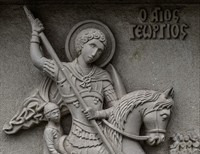
On Dragons, Roses and Books. Catalonia celebrates Sant Jordi

The New Berlin Wall

Photo By: Flickr/Seth Frantzman
Berlin is facing its most serious threat since the rise of the Berlin Wall in 1961: the division of society by an invisible wall built with the bricks of "religious fundamentalism" and "cultural segregation." That is, by the existence of an Islamic parallel society, run by its own rules and manners. This parallel society is growing fast due to migration and a high birthrate among foreign residents.
Approximately 300,000 Muslims live in Berlin - nearly as much as members of the Roman Catholic Church (about 330,000). Around half of them are of Turkish or Arab origin. The community is growing at a rate far above average through migration and births. To discuss this in an open way is not easy for politicians, as they do not want to be seen in the bad light of right-wing radicalism. But that does not change the arithmetical certainty.
Religion is becoming more and more important for Muslims in Germany. Researchers have noted that religion is important to only 17 percent of Christian students in Germany but to 73 percent of Muslim students. Furthermore, there is a close connection between Muslim religiousness and social isolation. The researchers' conclusion: the more distinctive the religiousness, the worse the language skills and social integration of the children and teenagers.
If it is true that religiousness and segregation go hand in hand, the result is an isolated parallel society, organized according to religious moral principles and values - in this case, Islamic ones. Further, this Islamic parallel society in the future will increase quantitatively because of its high fertility rate, especially with regard to women with a radical Muslim background due to their restricted role of "mothers" under the circumstances and influences of Islamic extremism.
The Islamic parallel society is a community structured and organized by families and clans, occupied with both legal and illegal business and applying its own rules, not only in the sense of customs and habits but also in terms of jurisdiction. Tribunals in which civil law disputes are settled in front of a religious committee are part of this outlaw "regulation system" as well as punitive measures according to Islamic principles.
Studies which misjudge these circumstances and attribute the segregation to disastrous social conditions or even the macroeconomic framework do not get the point, because they ignore the close connection between radical Muslim religiousness, tending to a political Islamic fundamentalism, on the one hand, and unemployment and poverty on the other.
According to authorities in Berlin, about 6,000 of the 300,000 Muslims in the German capital can be considered extremists. But even if one takes into consideration that this only represents 2 percent of the Muslim community, one cannot ignore the problem, particularly since one terrorist attack can destroy more confidence than thousand remarks of regret can build back up.
The number of extremists seems to be increasing and, furthermore, one gains the impression that they rule within their municipalities. Nevertheless, everyone in the democratic civilian society should promote peaceful dialogue, at least with the 98 percent who are moderates in the Muslim community.
Politicians, representatives of the Christian churches and those who are responsible in business, culture and sports should try to stay or get in contact with that parallel society in order to tear down this new Berlin Wall before its construction is completed.
Recommended Stories
About the Author
Josef Bordat, who was born in 1972 and lives in Berlin, began his academic career in Industrial Engineering (DI, 2000) and Philosophy (MA, 2004). He took his PhD in Philosophy (Dr. phil., 2006) at the Technical University of Berlin. He has lectured in Berlin and in Arequipa, Peru. He is published in different areas of philosophical and sociological research, especially on Bartolomé de Las Casas, Ethics, Globalisation, Human Rights and International Public Law. In his Weblog Jobo72 he publishes frequently different kinds of articles (Essays, Reviews, Reports, Satires, Poems) on several topics (Religion, Christianity, Ethics, Theology, Politics, Football, Catholic Church). Josef Bordat is Catholic, Pro Life, married and deeply engaged in Social Media
My blog: https://jobo72.wordpress.com/
English articles in my blog: https://jobo72.wordpress.com/category/articles-in-english/
My Facebook: https://www.facebook.com/josef.bordat
The blog's Facebook: https://www.facebook.com/joboistjobo72
My Twitter: https://twitter.com/JosefBordat