When the Bell Still Rings
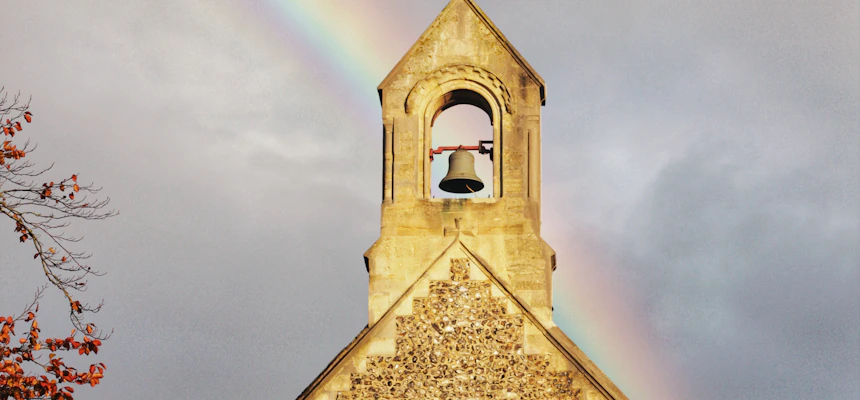
I begin not with theology, but with the sound that takes me back. It echoes differently here in the wide open spaces of Montana. It rings wider, slower. Yet, it stirs the same memory as the hymns of my Appalachian childhood. Sundays flood back to me in bits and pieces. Waves of wooden pews worn smooth by generations. Waves of those altar calls heavy with urgency. Waves of Scripture marked thick with red ink. Faith was something you could feel, and it was genuine. It was a place where I felt at home. In that sound, a question surfaced quietly: When did I stop belonging to where I began?
I am writing this for the people who may feel the same way I use to. I am writing for those who love Jesus but live between belonging and belief. I write for those whose hearts were raised on Scripture, but who feel history tugging at their sleeve. Whispering gently that there is more, not apart from what they know, but beneath it. Deeper than words. Older than argument.
I have always been drawn to the Church, not as just a place of worship but also a piece of history. For most of my adult life, I have studied the Church as one might study a distant ancestor. I have studied it with curiosity, reverence, but without any expectation of resemblance. I have analyzed her fractures, her reforms, her endurance. All the while, assuming always, that I stood outside her story. What I did not yet understand was that history is not simply the past. It is a living memory that is carried, transmitted, and embodied across time. It is a thread that weaves through time and we are tangled within it.
That bell, steady and unbroken, was my first hint of this truth. Its sound crossed fields and centuries alike, collapsing distance between what had been and what still is. It did not call me to abandon what I had believed. It called me to remember why belief endures and survives division without losing its shape. The bell was not telling me to give up what I believe in, but to think about why I believed in it in the first place.
Faith, I came to see, is not sustained by argument alone, nor by nostalgia for what once felt certain. It is sustained by continuity, by a living tradition that remembers what it believes, even when generations forget. The Church’s endurance is not rooted in human perfection, but in the quiet persistence of memory: prayer handed down, Scripture preserved, sacraments repeated, truth guarded and given again.
For those who feel unsettled by questions, I offer this reassurance. Questioning is not the enemy of faith. Forgetting is. The danger is not in asking where we belong, but in assuming that we must choose between sincerity and history, devotion and depth. Sometimes the work of faith is not to construct something new, but to listen long enough to hear what has been calling us all along.
That bell did not demand an answer. It asked me to listen.
And in listening, I began to recognize a belonging older, and more generous, than I had ever imagined.
So then, brothers and sisters, stand firm and hold fast to the traditions that you were taught.”
—2 Thessalonians 2:15
Recommended Stories