St. Joseph Invoked to Overcome Coronavirus
Sponsored

Catholic365 is sponsored by
Road to Purity




Picture an elderly Jesuit priest who looks out solemnly over his black-rimmed glasses at thirty or so Catholic laity gathered before him. The group busies themselves finding their seats, chatting with friends and shuffling papers. And yet John A. Hardon waits patiently to begin.
Presentations on the Catholic faith usually don’t start out like this. Many teachers would call people to attention, but the diminutive Fr. Hardon, hunched over from years of priestly duties, quietly waits until the group settles down to silence.
“Let us begin,” he says, as he intones the Sign of the Cross in his reverent Latin, “In nomine Patris, et Filii, et Spiritus Sancti…”
This was Fr. Hardon’s tried and true method of commanding attention in a quiet, unobtrusive way. He did not seize the room; he gathered it. In those first measured moments, he seemed to sense the mood of his listeners and gently led them into stillness. Minds that moments before had been scattered became focused; hearts that had been distracted grew attentive. Before long, the room was wholly absorbed in the truths he unfolded.
When they came to his class, whether laity, religious sisters, or priests, they were plunged into a world of devotion centered firmly on God. The effect was not merely intellectual engagement but interior awakening. What began as a lecture became an encounter — a summons to deeper faith. A quiet fire was kindled in the hearts of his students, one fed not by rhetoric, but by conviction.
In all those years, Fr. Hardon never wavered in his orthodoxy or his loyalty to the teaching authority of the Church. As he reflected in his Spiritual Autobiography:
“All these years of remaining faithful to the Catholic Church in spite of widespread opposition to what I believed, these were the years when I learned clearly and deeply that to remain a bonafide Catholic teacher of Catholic doctrine was, honestly, the most demanding enterprise of my whole life.”
That fidelity shaped everything about him — his tone, his method, his patience, and even his silence. He understood that teaching the faith was not merely a profession, but a participation in the Church’s mission to hand on divine truth intact.
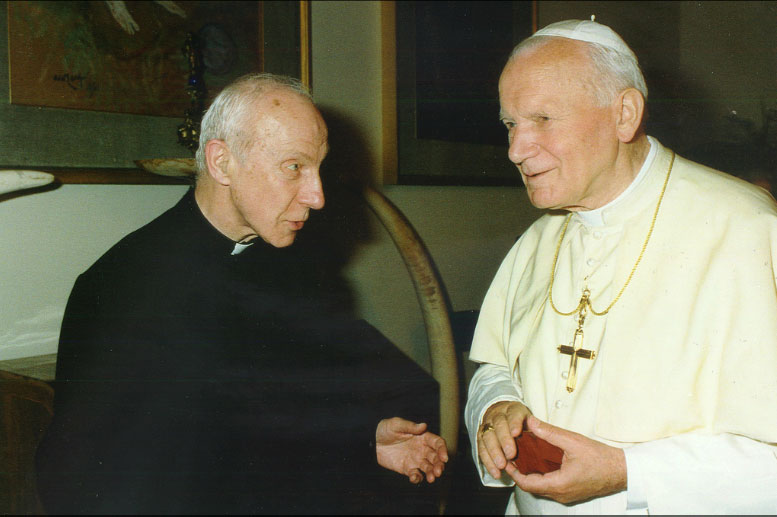
To meet the growing need for solid catechesis, Fr. Hardon gradually turned from teaching in seminaries to lecturing widely among the laity and religious communities. He formed at least five apostolates to carry forward the Church’s mission of evangelization. Among the most active of these is the Marian Catechist Apostolate (MCA), established at the request of Pope John Paul II as a concrete response to the catechetical crisis gripping the Church.
At the time, the Catechism of the Catholic Church was still nearly a decade from publication. Pope St. John Paul II asked Mother Teresa to ensure sound catechesis for her sisters so that the Missionaries of Charity could offer not only material assistance, but the full spiritual riches of Christ’s teaching to the poorest of the poor. From that seed grew an apostolate that would expand to serve bishops, priests, religious, and lay faithful around the world.
Before Fr. Hardon’s death in 2000, leadership of the Marian Catechist Apostolate was entrusted to His Eminence Raymond Leo Cardinal Burke, who continues as its episcopal moderator and international director. The apostolate has been placed under the patronage of Our Lady of Guadalupe, Patroness of all America and Star of both the first and the new evangelizations.
“The key work in the apostolate of the Marian Catechists,” Father Hardon said, “is to make God known through Christ so that knowing God, people might love Him, and loving Him might serve Him, and serving Him might save their souls.”
Fr. Hardon is now a Servant of God, and his followers, both then and now, are hoping that his path to canonization will be swift.
For more than forty years, the members of the Marian Catechist Apostolate — a public association of faithful Catholics — have sought to draw others closer to Christ through disciplined prayer and careful study. Their purpose is simple and demanding: to know the faith deeply, live it faithfully, and share it confidently.
Now headquartered at the Shrine of Our Lady of Guadalupe in La Crosse, Wisconsin, the MCA trains OCIA instructors, homeschoolers, parish catechists, and other groups across the globe. Through structured formation, doctrinal clarity, and devotion to Our Lady, the apostolate continues the quiet, steady work that characterized its founder.
In this way, the spirit of Fr. Hardon’s classroom lives on. The silence before the Sign of the Cross, the careful fidelity to doctrine, the patient gathering of minds and hearts — all remain at the heart of an apostolate devoted to making Christ known in a world hungry for truth.
Look up these articles, videos and books by Fr. Hardon:
Marian Catechist Apostolate — Become a student, grow in your faith, seek consecration, and join as a member to help with our mission.
Fr. Hardon Archive & Guild — Read hundreds of articles by Fr. John John Hardon, S.J.
Real Presence Association — Articles, videos, and audio presentations by Servant of God Fr. John Hardon and Raymond Leo Cardinal Burke.
Fr. John Hardon Archives (YouTube) — Watch an ever-growing list of videos of Fr. John Hardon, S.J.
Eternal Life — Purchase many books by Fr. John Hardon, S.J.
Marian Catechist Bookstore — Purchase books by Servant of God Fr. John Hardon, Cardinal Burke, and many other Catholic authors.
Kevin J. Banet is a journalist and publicist. He provides marketing for religious communities, non-profits and healthcare services. Kevin and his family live in the Chicago area. His website is VocationPromotion.com.