

Confirmation: How to Confront and Smite Smaug
Sponsored

Catholic365 is sponsored by
Road to Purity




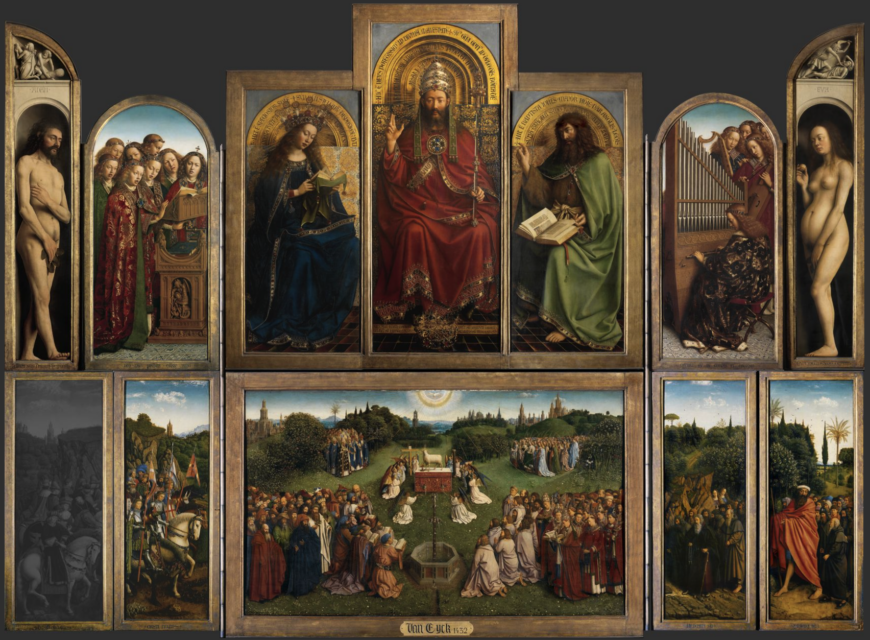
The Ghent altarpiece is about the 'Christus Totus'. According to the catechism, liturgy is an "action" of the whole Christ (Christus totus). Those who even now celebrate it without signs are already in the heavenly liturgy, where celebration is wholly communion and feast.
Nowhere do the celebrants of the heavenly liturgy appear in such great detail as in the Ghent Altarpiece. The whole altarpiece is a catechesis on the Eucharist, the Mass and the heavenly liturgy as revealed in the book of Revelation.
Created in 1432 by Jan van Eyck (and possibly his brother Hubert), this massive polyptych resides in St. Bavo’s Cathedral in Ghent, Belgium. It tells the story of heaven and earth coming together in an eternal and perpetual sacrifice of the Lamb of God.

God the Father, who offers his own Son out of love sits in the sanctuary of heaven, on his throne, in priestly vestments. Like his priests do on earth, he extends his right hand in blessing of those who come to participate in the sacrifice of his Son, the Lamb. Behind him, stamped into his chair, is a pattern of the eucharistic image of the pelican feeding her young with her own flesh and blood.
Mary is called the ‘Bread giver’ by the church fathers. Eve gave us the fruit of death and Mary gave us the fruit of her womb, Jesus - ‘the bread of life’. Behind her stamped into her chair is a pattern of unicorns which symbolize the Incarnation. In every Mass we have a type of Incarnation since Christ, the Word, becomes flesh and blood on the altar. This is fitting since Mary's yes opened the door to the Incarnation. In Bethlehem (which means 'house of bread') Mary laid the infant, the Bread of Life, in a manger (a feeding trough).

When he saw Jesus coming to be baptized he said the priestly words, “Behold, the Lamb of God who takes away the sins of the world” (Jn 1:29). As a Levite, he wears a sacred vestment - a priestly cope.
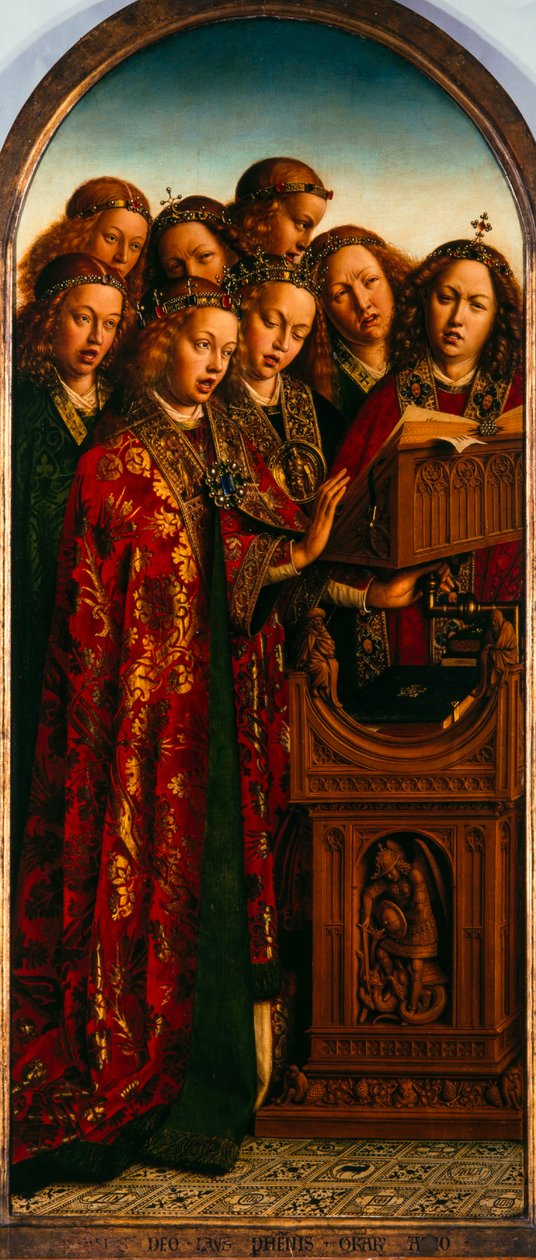
In the Book of Revelation the angels are constantly singing to God in the heavenly liturgy, ‘Holy, Holy, Holy Lord…” Priest at Mass: ‘And so, in company with the choirs of Angels, we praise you, and with joy we proclaim: It is truly right and just, our duty and our salvation, always and ..’

Jesus is the New Adam who gives himself as food (Redemption) to undo the food taken and eaten by Adam (Original Sin). In the Garden of Gethsemane he obeys the Father rather than disobeys as Adam did in the Garden of Eden.
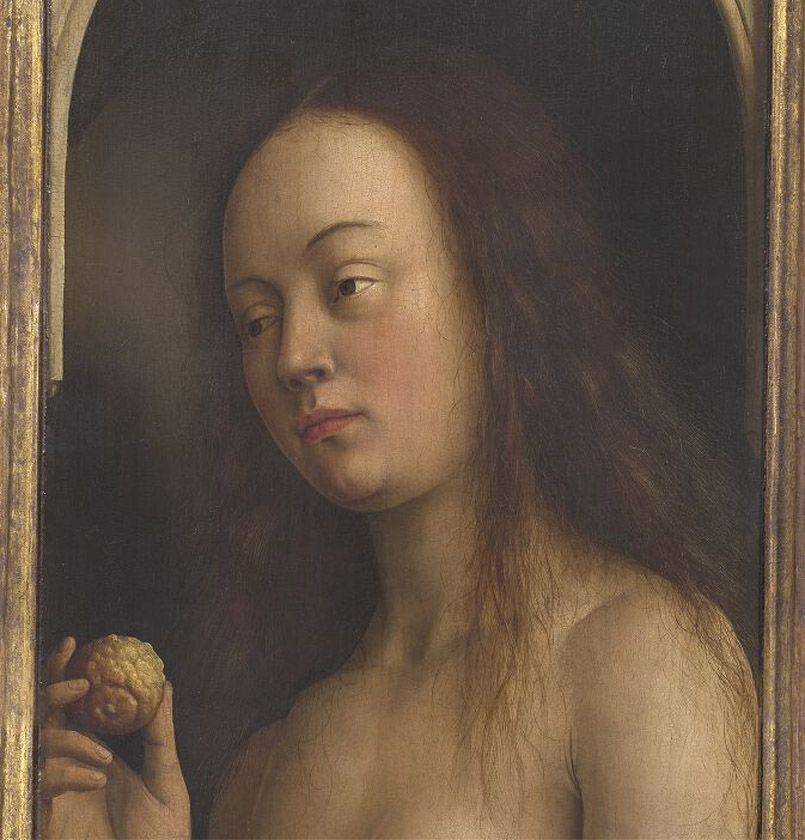
Eve fed us death and separation from God through the poisonous fruit. There is a poetic justice in reversing the fall through consuming perfect food, the bread of angels, the Eucharist. Where it all began is where it all ends.
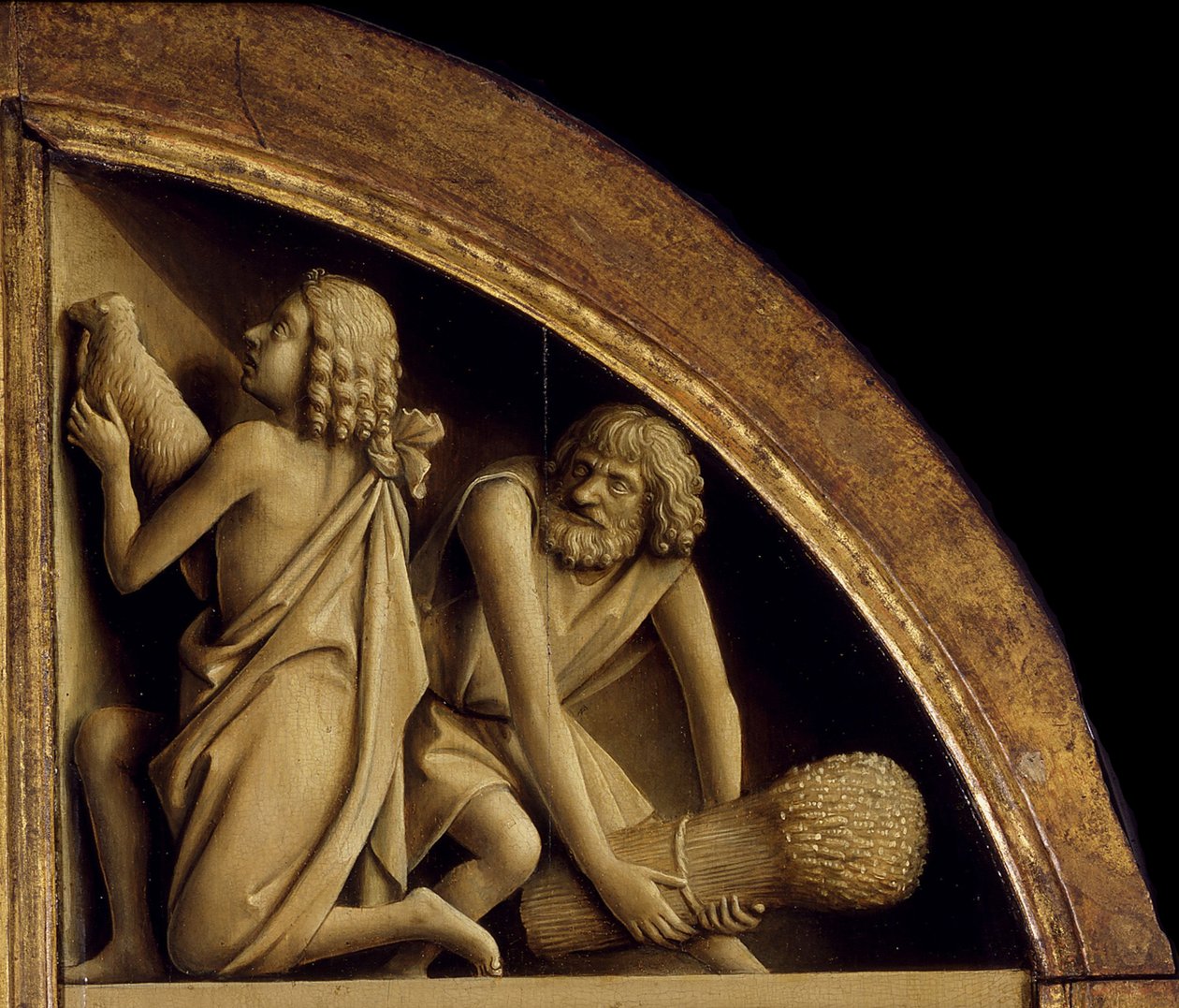
Abel was the first priest. He performed the sacrifice of a lamb on an altar as an offering of thanksgiving to God. His sacrifice was acceptable because he offered his sacrifice out of love. Just as at Mass, 'We lift up our hearts to the Lord'.
Abel himself ultimately gave his whole life in conjunction with the offering of the lamb. An innocent victim of vengeance, hate, anger, jealousy and satanic pride. His blood had a living, eucharistic quality and survived death by crying out to God for justice.

The knights of Christ (including various sovereigns and probably leaders of the Crusades) and the Just Judges, i.e. administrators and politicians come to pay homage and adoration to the King of kings. Every socio-economic class is called to the Feast of Feasts. Even those who held military or political power recognized and payed homage to the King of Kings under the appearance of bread and wine.
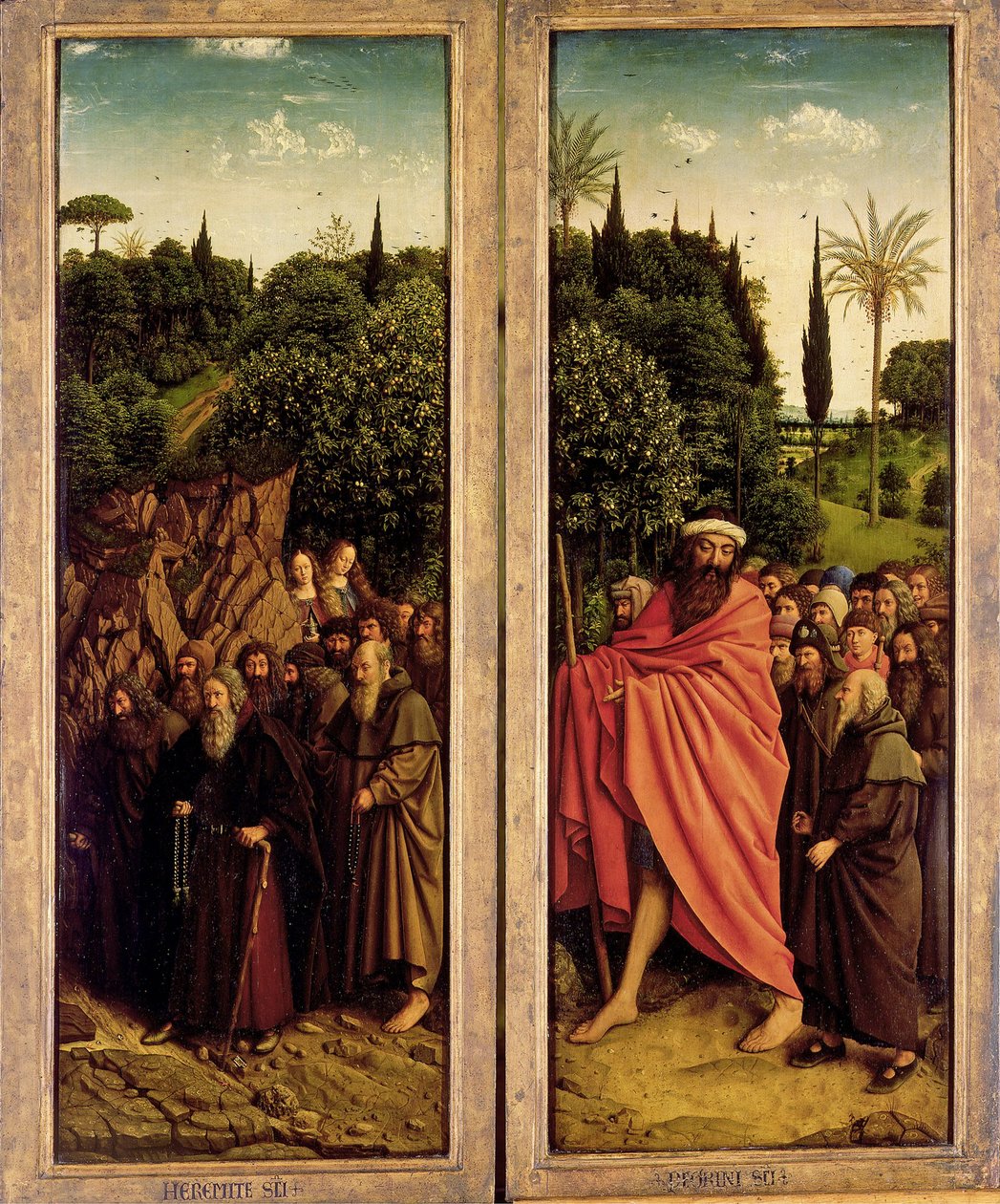
The hermits (including Mary Magdalene at the back, with her vase of unguents) and the pilgrims, led by a giant Saint Christopher arrive for the Mass which links heaven and earth. Like a magnet, Christ in the Eucharist draws everyone in to himself. Pilgrims who make a long trek and hermits too must come into the community to celebrate a deeper unity brought about by the Eucharist as one Body of Christ.

In the Mass heaven and earth meet and time and eternity become one. We participate in the New Heaven and New Earth as a foretaste of our own sanctification from the Eucharist, Jesus the Lamb of God. “These are the ones who have survived the time of great distress; they have washed their robes and made them white in the blood of the Lamb” (Revelation 7:14).

The main prophets of the Old Testament (Isaiah, Jeremiah, Ezekiel and Daniel) kneeling in the front row with books in their hands. It was Isaiah who wrote about the Lamb, "He was oppressed and afflicted, yet he did not open his mouth; he was led like a lamb to the slaughter, and as a sheep before its shearers is silent, so he did not open his mouth" (Is 53:7). Tthe twelve minor prophets stand behind with the multitudes of all nations including people who had not known Christ. Among these, the figure crowned with laurel leaves is thought to represent Virgil.
The twelve apostles, as the first priests and bishops, kneel in the front row. They were the first to receive the Eucharist and they were the first to offer it. Behind them are the Christian martyrs identifiable by their red robes. Saint Stephen can be recognized by the stones he is carrying in his surplice and Saint Livinus, one of the patron saints of the city of Ghent, has his tongue held in the grip of the tongs which were used to tear it out. All gave their lives in witness to the saving power of Christ in the Eucharist.

The clergy, ministers of the Eucharist, stand in the order of hierarchy. They are carrying palms but are not dressed in red (which shows they did not die a martyr’s death): popes, cardinals, bishops, and priests all stand in the sanctuary ready to consecrate the gifts.
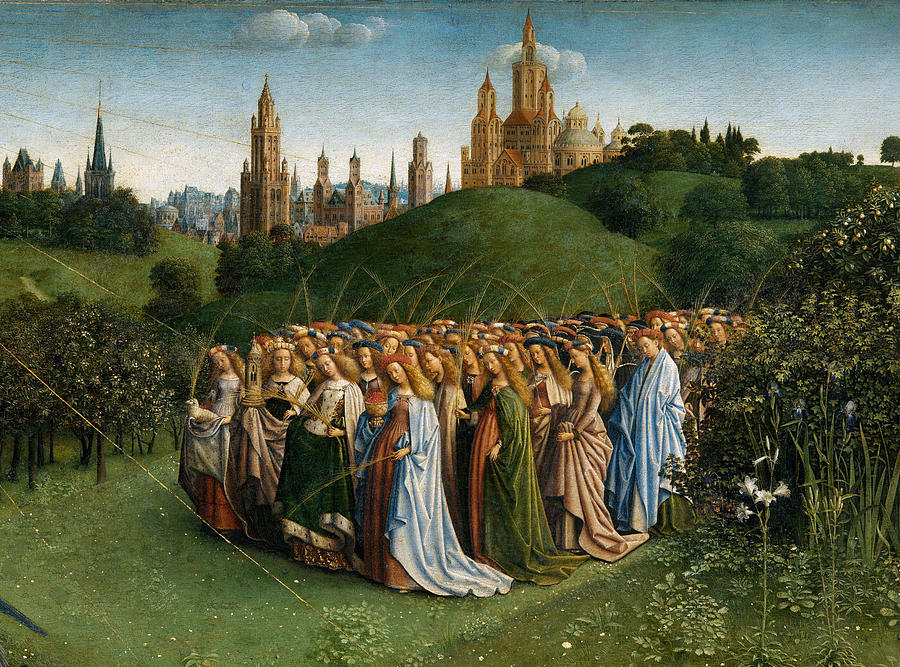
The women saints (both martyred and not), carrying the palm of victory and wearing flowers in their hair, along with other anonymous women (both religious and not). Among the saints we can recognize Agnes with her lamb, Barbara with the tower, Dorothy with the basket of flowers and Ursula with the arrow. All come to worship the Lamb with palms in hand, singing, "Blessed is he who comes in the name of the Lord, Hosanna in the highest."

Through baptism we receive divine life which is fed through the reception of the Bread of Angels, the Eucharist. This octagonal fountain (eight is the number of the day of the resurrection, understood as a new beginning, or new creation) with its twelve spouts, just as there are twelve apostle (twelve is the number of fullness) flows into the foreground of the painting, almost towards the observer like the blood and water from Christ's side.

The dove representing the Holy Spirit is depicted in the centre of the scene high above the altar with its wings spread, surrounded by a halo of light. During the celebration of the liturgy, the Spirit is invoked in the epiclesis for the blessing and transformation of bread and wine into the body and blood of Christ.
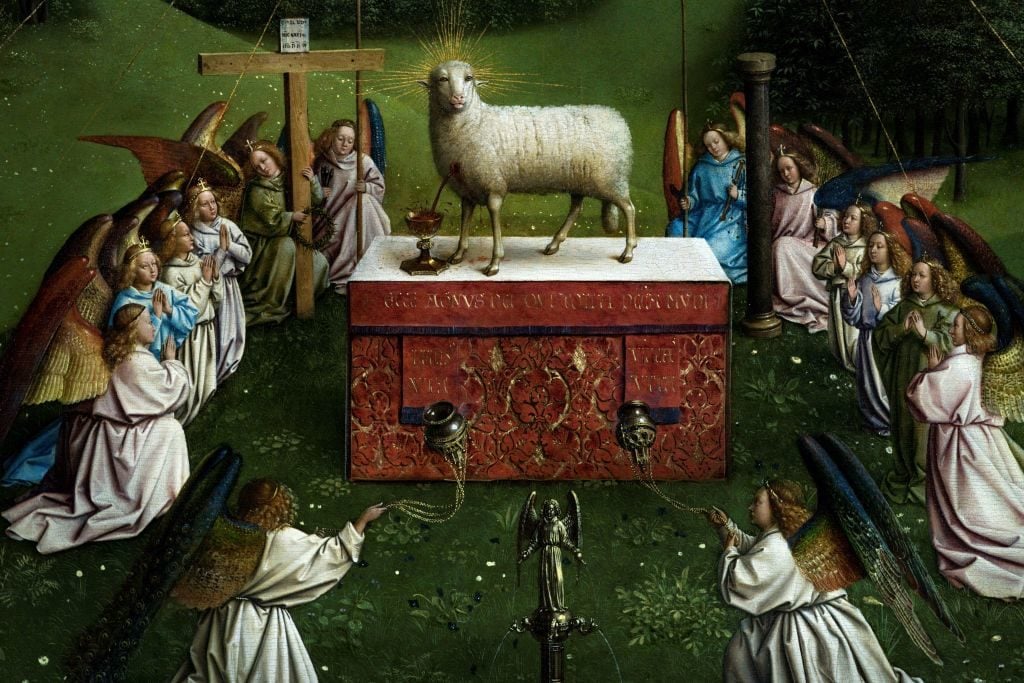
The instruments of Christ’s passion are held by four angels behind the altar: a cross with a crown of thorns, a spear, a scourge and a sponge, a column and a rod. all remind us that Jesus is a sacrificial Lamb who suffered greatly for us.
The angels offer incense before the Lamb as an act of worship and as a sign of our prayers being accepted by God.
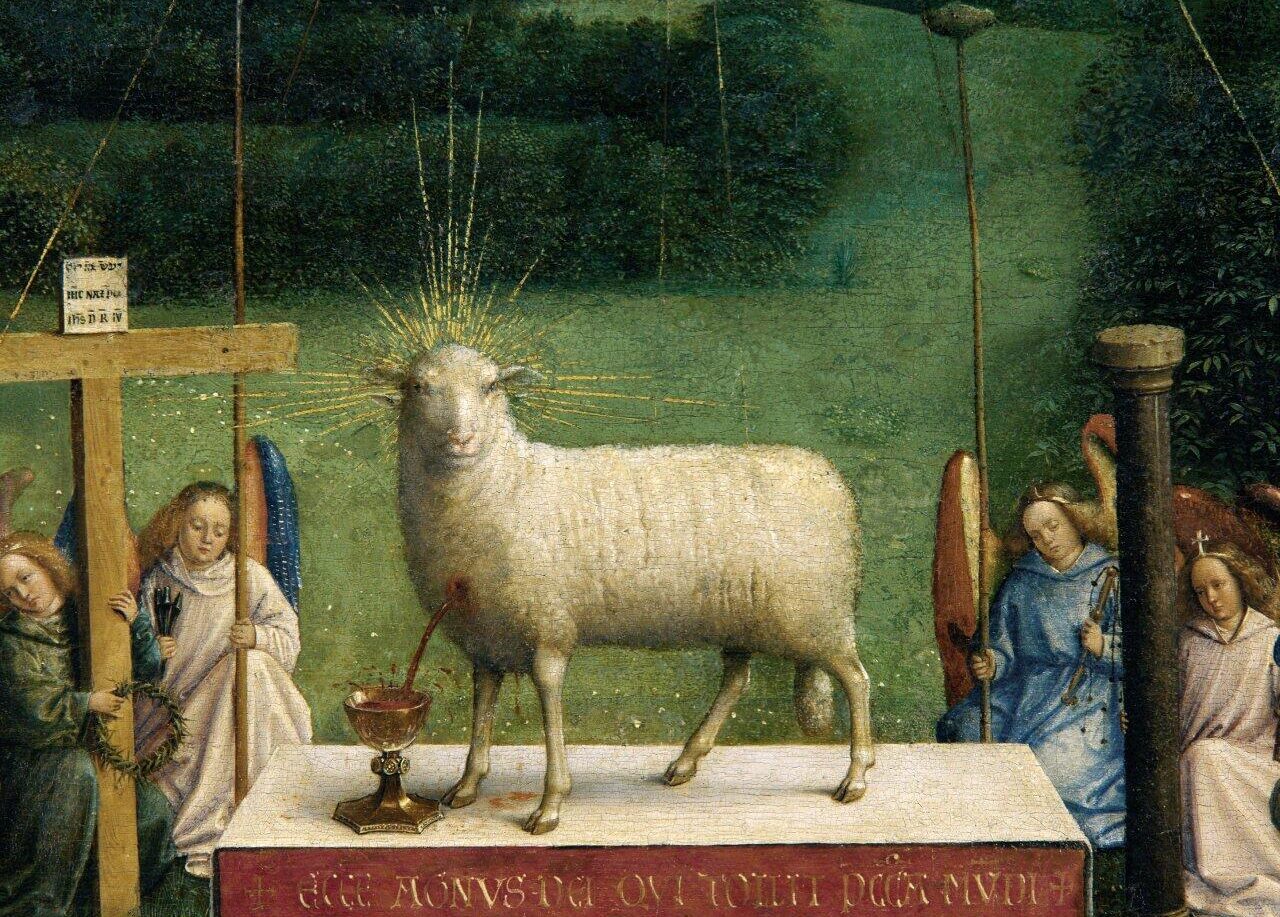
The redemptive power of Christ’s blood is shown when Christ himself says: “Whoever eats my flesh and drinks my blood has eternal life, and I will raise him on the last day” and “This is my blood of the covenant, which will be shed for many.” The life giving blood once in the holy grail is the same we consume at Mass.
I am a life-long Catholic, husband, dad, teacher and former football coach. I've been teaching the Catholic Faith to young men, religious educators and catechists since 1998. My academic background, MA is in Theology and Catechetics. Email: gary@apexcatechetics.com



