AN ADVENT "CHRISTMAS CAROL" RETREAT - XVI
Sponsored

Catholic365 is sponsored by
Road to Purity




Sunday's Gospel (Lk 18:9-14) featured the Parable of the Pharisee and the Publican. The parable speaks of two men going up to the Temple to pray: a Pharisee and a Publican. The Pharisee takes "his place" and prays to himself, enumerating his virtues while venting his spleen on his fellow man. The Publican takes the lowest place and prays to God, simply asking for mercy. Our Lord succinctly summarizes the outcome: the Publican went home justified, the Pharisee not.
The Gospels have long been themes for great artists, from antiquity through the present day. The Dutch painter Fabritius captured Our Lord's judgment in his 17th century triptych depicting the scene: the Publican exits the Temple accompanied by an angel, the Pharisee followed by a devil.
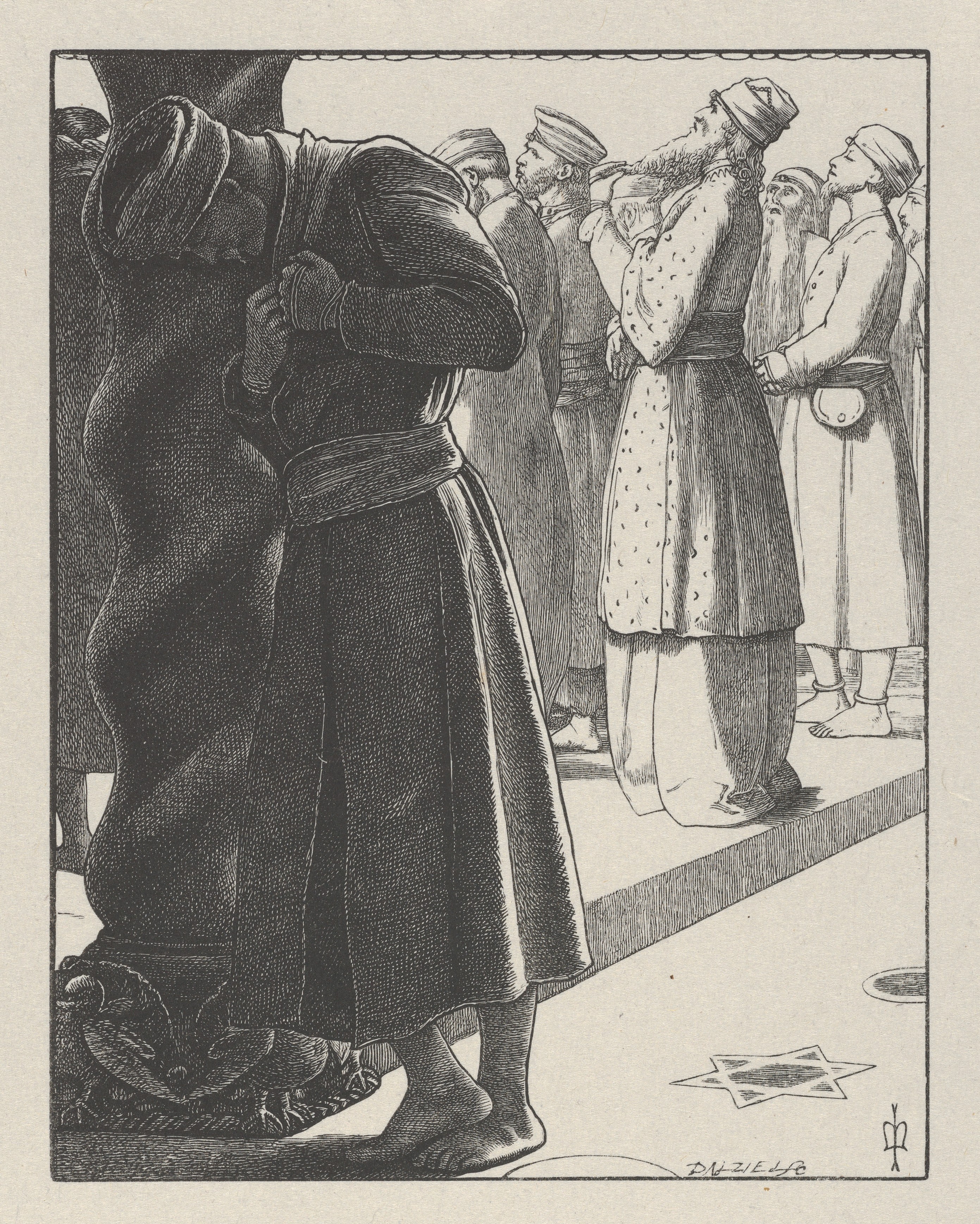
I prefer to turn my attention to the representation of this scene by the 19th century British painter, Sir John Everett Millais. Primarily known as a painter, Millais also distinguished himself as an engraver. In the 1860s, he illustrated a collection of the Gospel parables, including this scene. Millais's engraving is here: https://images.metmuseum.org/CRDImages/dp/original/DP835786.jpg
Millais's Pharisee and Publican respects the Christian message of humility, which inverts worldly standards. If "the first shall be last and the last first," Millais captures that idea by showcasing the Publican. The Publican stands prominently and alone in the foreground of the illustration, albeit in shadows. The Pharisee stands in the background, in profile, amidst a crowd. The Publican's head is cast down as he strikes his breast; the Pharisee's head is lifted up. The Publican dares not look up towards God; the Pharisee who, as an observant Jew knew that one cannot look upon the face of God and live (as Moses and Isaiah remind us) nevertheless dares raise his eyes to God.
We are all sinners. The difference is the Publican is a sinner who knows he is a sinner. The Pharisee is a sinner who thinks he is a saint. There is Christian truth in Socrates' injunction: "Know thyself."
St. Faustyna Kowalska was the "secretary of Divine Mercy," recording the private revelations God gave her in 1930s Poland about the centrality of mercy in the spiritual life. Through her we came to know the "Chaplet of Divine Mercy." Its essence, however, was known millennia earlier by a repentant Jew who struck his breast pleading, "O God, be merciful to me, a sinner!"
We are called to accompany each other in our journey to the Lord, but that accompaniment must be rooted in truth -- the truth that we are all sinners, all falling short of the mark, all in need of God's mercy. Mercy does not pretend that sin does not exist: it acknowledges it and seeks to repent from it. Accompaniment and conversion are indivisible.
Millais's work itself exhibits the greatness of smallness, not just in how he portrays the parable's dramatis personae, but in its sheer reality: the engraving, quite intricately detailed, measures but 5-1/2 by 4-1/2 inches. And while Millais's wood engravings were black-and-white, they were beautifully colorized in the "Millais Window" of the Kinnoull Church (Church of Scotland) in Perth. The window is depicted here:
John Grondelski (PhD Fordham) was former associate dean of the School of Theology, Seton Hall University in New Jersey. He is a Catholic theologian with special interests in moral theology and the thought of St. John Paul II. All views are his own.