Conisbrough Castle
Sponsored

Catholic365 is sponsored by
Road to Purity



(Inspired from the readings for the 32nd Sunday in Ordinary Time, Cycle C)
You are middle-aged or older if you can remember when the film "Seven Brides for Seven Brothers" was first released. While we may not wish to be reminded of our age, we will remember with pleasure this exuberant, fast-paced, big-screen musical extravaganza. Now for you younger members, who may not know what a musical is, just think of it as a two-hour MTV song special and you will get the general idea. Anyway, the story was about seven brothers on the frontier of the United States who were all looking for brides. Such "commodities" were rare in their part of the world, but, of course, in the end each brother got his bride.
Do you remember who starred in the film? That's right: Howard Keel and Jane Powell. So, some of you are that old after all!
The story in our gospel reading for today is about one bride for seven brothers, but the end of this story is not as happy and upbeat as was the film. This account is part of a "knock-down, drag-out" debate or argument between Jesus and some of his most powerful opponents. Chronologically, the encounter takes place in the temple court in Jerusalem during the last week of Jesus' earthly life. Although Jesus is immensely popular with a great many people, his opponents have dogged his steps almost from the beginning of his public ministry.
The opposition comes to a head and moves towards a climax as Jesus approaches Jerusalem, boldly riding a donkey and being greeted with shouts of "Blessed is the king who comes in the name of the Lord." Then Jesus heads straight for the Temple and takes it over as the central arena of his activity in Jerusalem. One can imagine that the religious authorities are not too pleased with this turn of events. As Jesus teaches every day in the Temple, the tension between him and the authorities continues to mount.
This is how Luke describes the situation: "He taught in the Temple every day. The chief priests and the scribes, in company with the leading citizens, tried to do away with him, but they could not find a way to carry this out because the whole people hung on his words." In such an atmosphere, conflict is inevitable. There is attack and counterattack.
The representatives of the establishment question Jesus' authority to rearrange the furniture of the Temple or to teach in its confines. He counters with a question they cannot answer and a story which makes them extremely uncomfortable.
The authorities call in reinforcements. They send spies to listen to Jesus' teaching in the hope that they will hear some heretical or treasonous word by which they can accuse him to the Roman governor. These spies seek to bait Jesus with fawning compliments. Then they ask him a trick question about whether it is lawful to pay taxes to the government.
Such a question can raise strong differences of opinion in almost any age or country. It is an especially sensitive issue in the time of Jesus. If he says an unadorned "Yes," many of the common people who are on his side will be offended. If he replies "No," the Roman IRS will go into action against him. Jesus' clever counterattack involves a Roman coin and the admonition, "Give to Caesar what Caesar's, and to God what is God's."
And so the tension mounts. "Let's bring in the heavy artillery," they say, "Let's trap this travelling teacher with a complicated theological question based on scripture. Let's watch him squirm as he tries to get out of this one." And so the Sadducees enter the fray.
Many of the Sadducees are aristocratic, arrogant, and wealthy. They accept as scripture only the first five books of the Bible, which they attribute to Moses, called the Pentateuch. We call them Genesis, Exodus, Leviticus, Numbers, and Deuteronomy. We can almost see them snickering behind their hands as they pose their question in the form of an absurd hypothetical story about one bride for seven brothers.
The Sadducees are using an old trick: their question is an attack question. It's a question designed to destroy the other person's viewpoint so that one's own viewpoint wins without ever having to be defended. The Sadducees weren't really interested in what Jesus believed about the possibility of resurrection from the dead. Their question about one bride for seven brothers was not a question which they hoped would bring them some new knowledge or understanding. They already knew that the law which obligated a man to marry his brother's widow and raise up children by her—which would legally be his dead brother's children—was a compassionate social custom designed to provide for people who had no voice or standing in that culture: the widows, and to ensure the continuity of a family's line. They didn't need to be instructed on the meaning and significance of levirate marriage. Their question wasn't serious, except that it was seriously designed to entrap Jesus into taking a position that would alienate people while making themselves look good at his expense.
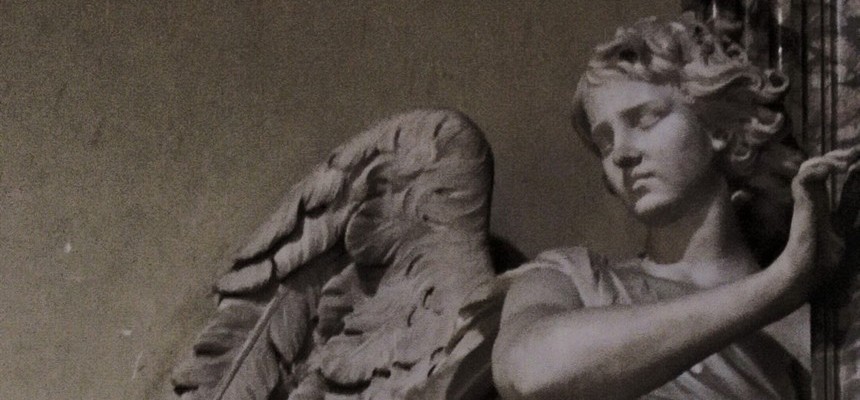
Basically it was a silly question. But Jesus gave it a serious answer. The Sadducees had no idea what resurrection was all about. They were unable to look beyond this present world and time into the possibility of a new dynamic future. They thought resurrection meant a simple extension of how things are here and now in this world. But Jesus assured them (and us) that the resurrection belongs to a new life and a radically different existence. An existence in which marriage is unnecessary and where we shall be like angels, he said.
Notice that Jesus does not say we become angels but are the same as angels inasmuch as we will not die any more. Those who make it will be in the presence of God forever and Jesus calls them "sons of God".
In our day and age, we have seen a resurgence of interest in angels and books on the subject fill the shelves of bookstores everywhere. Even Hollywood has shown a fascination with angels. And not to be outdone, the super-stores have released the latest flood of Hallmark cards festooned with angels of all sorts, shapes and sizes as we begin the countdown to Christmas. But it does raise some rather interesting questions.
The term "angel" comes from the Greek "angelos" meaning "messenger". The Church teaches that angels are pure created spirits without bodies or gender who have keen intellects and resolute wills. Angels were created good by God. Some, now called devils, disobeyed God and they make their home in hell; they tempt humans to commit sin. The good angels continue to serve God and to act as his messengers to humankind.
As an aside, did you know that angels are traditionally ranked in a so-called celestial hierarchy of nine orders or choirs of angels? We have seraphim, cherubim, thrones, dominions, virtues, powers, principalities, archangels, and angels. Surprised?
Well, let's think about this for a moment and put it all together to see where it leads us. After all, it may be of some passing interest for us to learn what life could be like in the hereafter—especially for those of us who are planning on going there.
The first thing we know is that there is no more marrying—no more need for procreation—since we will be immortal. In this life, one generation passes away like the grass of the field, so for another generation to arise, there must be families in which children are born. To that end God created us male and female for the purposes of procreation: to preserve the human race and thus ensure its continuity. But in the resurrection, marriage is no longer necessary because there is no more death. Life is not interrupted by the passing of one generation to make room for the next.
And the next thing we learn is that our bodies will be different and transformed as Paul said in his Letter to the Philippians: "He will change our lowly body to conform with his glorified body by the power that enables him also to bring all things into subjection to himself." And if we will be just like the angels—and angels are without gender—then it follows that we will be without gender. Remember, gender and marriage are requirements for procreation, and if marriage and procreation are no longer necessary in heaven, neither will gender be required.
So, what will we look like? Will I have more hair, be several pounds lighter and look many years younger? I have no idea! But I don't think we can count on Hallmark cards to give us the true answer either!
As an aside, the change in resurrection appearance may be a clue to understanding why the risen Christ was not initially recognised by even his closest friends following his death on the cross.
Anyway, back to the Sadducees: are they convinced by Jesus' interpretation of scripture that God is not God of the dead but of the living? Do the Sadducees change their minds about the resurrection? The story does not tell us, but I doubt it. Their feet are set in the long-since hardened concrete of their system. They are trapped in a rigid and unbending stance from which they choose not to escape.
We no longer have a group of people called Sadducees. That religious sect and political party has long since passed off the scene. But their relatives are still alive and well and very much with us. Even in the Church there are those individuals and groups whose practises and beliefs would deny a true understanding of the resurrection. Some of these groups have politicised themselves into a rigid, unyielding position: a position they say the Church must recognise and accept. They demand that the Church change to embrace their own narrow thinking.
These groups go by many names and titles but prominent among them are: "Catholics for a Free Choice"; "Future Church"; "Dignity" (an organisation of gay, lesbian, bisexual, and trans-gender Catholics); "WATER" (Women's Alliance for Theology, Ethics & Ritual); "Call to Action" (CTA) and "We Are Church".
Take for instance the "Call to Action" (CTA) group. This is a group of militant feminists who have made it their life's work to conduct intense gender wars. Specifically, they are less interested in being women or mothers and more interested in wanting to be priests. Many chancery offices have been infiltrated by CTA and their supporters in order to further this agenda.
I remember all too vividly finding myself in a women's monastery in the hills of Kentucky as a supply priest. I was setting up the Lectionary for Mass when I noticed the number of crossed-out words and heavy use of "white out" on every single page. A closer look revealed that every reference to "he" or "him" had been substituted with "she" or "her": all, that is, except references to Satan or the devil which were left with male pronouns! The Missal had been similarly "corrected" according to somebody's idea of "gender inclusivity". I also quickly learned that they no longer referred to God as "God" or "Lord" but preferred the titles: "Mother Sofia" or "Wisdom Sofia" instead.
What I had found myself in was a so-called Catholic community of women religious who were angry that they had been born female instead of male. And for them, a "male dominated" Church represented the direct object of their anger. Frustrated and angry that they would never be ordained, several had simply taken to vesting themselves as priests for Mass and doing it themselves.
The point of relating all of this (which is more common than you might imagine) is simply this: gender is not a matter of power or control or supremacy but a matter of role. Yes, I understand that this is not the Politically Correct view of today, but truth is truth. God made us male and female so we could marry and carry on the human race until the day of resurrection when there would be no more need to marry—no more need for procreation—and thus no more need for gender. Gender is for this world, not the next. No one controls his or her gender at birth. Gender, like life itself, is a gift from God to be used according to God's plan—not ours.
You can well imagine that this does not sit well with the homosexual agenda and their loud demands that we Catholics recognise their so-called "marriages". Nor does it fit well with the current politically-promoted gender ideologies.
Do those who support gender ideology like to hear this? No! Are the militant feminists of "Call to Action" convinced of this? Not at all! If any of them believe in the resurrection at all, they tend to think of it as a simple extension of how things are now and here—just like the Sadducees. This is what their "New Age Spirituality" and so-called "feminine theology" (or gender ideology) tells them and which explains why they want to change the present world. They want a heaven populated exclusively by women and creatures just like themselves. Like the Sadducees, their feet are set in the long-since hardened concrete of their cause. They are trapped in a rigid and unbending stance from which they choose not to escape.
So, do some of us have concepts of the resurrection life which need clarifying by Jesus' interpretation of scripture? Jesus' word that God is the God of the living may not satisfy our curiosity about such things as gender and political exclusivity in heaven, but it does give us strong assurance that God does not abandon us at death. It may not make entirely clear what our relationship will be to those whom we loved dearly on earth but who have gone before us into new life, but it does confirm that our relationship with God is forever.
And that is what honest religion is all about. We don't have to find all the answers or force everything around us to change just to fit our own personal ideas and politics. But we do have to practise the truth we already know: to love the people that God loves and in a real and practical way, to share our life with them. Finally, like Paul suggests, we should never cease to pray that we "may be delivered from perverse and wicked people, for not all have faith." And as we listen to all the political nonsense coming out of our respective governments, we certainly know the truth of that statement!
The person who really knows the mind of God will also know what life in the resurrection will be like. For Luke then, and now for us, Jesus' resurrection is our hope. During every Eucharistic Prayer, we recall Jesus' death and resurrection and we remember God's promise: what he did for Jesus, he will do for us!
Now that's a promise no politician can make.
God bless you.
I am a retired priest who lives quietly in his native England. I have a YouTube channel at:http://www.youtube.com/user/