Toward a Consistent Ethic of Life

Rethinking what it Means to be Pro-life


Photo By: Flickr/Patrick Sweeney
Honest Reflections during a Tough Presidential Election
I’m a Pro-life Catholic. I’ve voted in four presidential elections in my lifetime – I voted for George W. Bush in 2000 and in 2004. I voted for John McCain in 2008. I voted for Mitt Romney in 2012. But I will not be voting for Donald Trump in 2016.
This election season has been trying for Americans across the political spectrum, as both major parties have managed to nominate individuals with – How do I put this charitably? – significant flaws. Instead of asking which candidate will be good for the country, many of us find ourselves wondering which will do the least harm. As difficult as this election has been, I really think it’s a God-given opportunity for Catholics and other Christians to reexamine more honestly than before what it means to be “pro-life.”
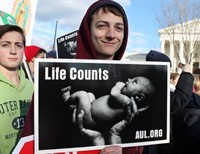
Abortion is one of the greatest evils of our day.
As a college freshman preparing for the 2000 presidential election, I confidently registered to vote as a Republican. Although I’ve been Catholic all of my life, I had recently experienced a deeper conversion to the Catholic faith and made the decision to be Republican in large part because of it. The deciding factor for me, like many other Catholics, was the party’s stance against abortion.
After all, if our laws do not prohibit the killing of innocent people, even if those people are still in the womb, then what good are laws anyway? The use of euphemisms often prevents us from considering the seriousness of this issue, but is it really so tough to see that the murder of one million unborn babies a year is a serious evil that should not be permitted by law?
Catholics have a moral obligation to resist abortion.
The leaders of the Catholic Church have been pretty forceful in explaining that Catholics have an obligation to oppose abortion not only in their private lives, but in the voting booth. For example, Cardinal Ratzinger (later Pope Benedict XVI) wrote in 2004:
A Catholic would be guilty of formal cooperation in evil, and so unworthy to present himself for Holy Communion, if he were to deliberately vote for a candidate precisely because of the candidate’s permissive stand on abortion and/or euthanasia. When a Catholic does not share a candidate’s stand in favour of abortion and/or euthanasia, but votes for that candidate for other reasons, it is considered remote material cooperation, which can be permitted in the presence of proportionate reasons.
In other words, a Catholic should never vote for a political candidate because that candidate is pro-choice. It has to be admitted, though, that a Catholic may morally vote for someone in spite of their pro-choice stance, but only if there are “proportionate reasons.” The U.S. Bishops offer an even fuller explanation in Forming Consciences for Faithful Citizenship 34 – 37.
Abortion is an intrinsic evil, but not the only one.
Part of what makes abortion unique is that it is an “intrinsic evil,” i.e., it is an act that is not morally permissible under any circumstances. War is an evil, but it is sometimes necessary and morally permissible to go to war. That’s because it’s morally acceptable, when absolutely necessary, to kill persons who intend to do you harm, but it is never morally acceptable to kill an innocent human person.
While the pro-life movement tends to focus on abortion and related threats to innocent human life, the Catholic Church outlines a number of intrinsic evils that have no place in a just society. Pope St. John Paul II, who pioneered the idea of building a “culture of life,” offered the following partial list in Veritatis Splendor, quoting the Second Vatican Council:
Whatever is hostile to life itself, such as any kind of homicide, genocide, abortion, euthanasia and voluntary suicide; whatever violates the integrity of the human person, such as mutilation, physical and mental torture and attempts to coerce the spirit; whatever is offensive to human dignity, such as subhuman living conditions, arbitrary imprisonment, deportation, slavery, prostitution and trafficking in women and children; degrading conditions of work which treat labourers as mere instruments of profit, and not as free responsible persons: all these and the like are a disgrace, and so long as they infect human civilization they contaminate those who inflict them more than those who suffer injustice, and they are a negation of the honour due to the Creator.
We shouldn’t ignore other important issues because of party politics.
It’s obvious that some of these issues are more clear-cut than others. No politician says, for example, “I support subhuman living conditions and degrading conditions of work!” Some may think the Democratic Party prevents such conditions more effectively, and others may think that the Republican Party does. There’s a wide spectrum of legitimate opinions on these types of issues.
Issues like abortion and euthanasia are much less ambiguous – someone either intentionally chooses to end another innocent life or chooses not to. There’s no middle ground. Because the Democratic Party does unambiguously support clear-cut evils like abortion and euthanasia, it has been easy to say “Catholics must vote Republican!”
Still, it’s time for us as pro-life Catholics to admit that we’ve ignored a lot of other evils in our efforts to end abortion. To politically support any of the issues mentioned above is contrary to Catholic teaching and basic human decency, but some in the pro-life movement have done so. When Republicans began supporting torture of detainees, an unambiguous intrinsic evil listed above, many Catholics chose to defend the Republican Party over Catholic teaching. When Republicans began supporting deportation of immigrants and the targeting of non-combatants in war, some again sided with the Republican Party. When Catholic Republicans place their party platform over the clear moral teachings of the Church and the demands of charity, are we really that different from Catholic Democrats who support abortion because their party does?
When we put either party’s platform over the teaching of the Church and non-partisan respect for all people, we tend at the very least to downplay a whole host of important issues. In an election season a few years ago, for example, I realized that I often got frustrated when I heard bishops or priests speaking out about issues like poverty, because they were political priorities of Democrats, not of “our” party. I began to see that the words “social justice,” which are an essential part of Catholic teaching, had actually become trigger words for me and many on the Right. St. Vincent de Paul, patron saint of charities, was my Confirmation name in eighth grade, for Heaven’s sake, but partisan politics had made me callous toward poverty! Thanks be to God, I realized that this was a fault within me, not within the leaders of the Church, and I began to read and reflect more on the parts of Catholic social teaching that I had been downplaying. The US Bishops warn precisely of this danger of politics in Forming Consciences for Faithful Citizenship:
As citizens, we should be guided more by our moral convictions than by our attachment to a political party or interest group. When necessary, our participation should help transform the party to which we belong; we should not let the party transform us in such a way that we neglect or deny fundamental moral truths or approve intrinsically evil acts. We are called to bring together our principles and our political choices, our values and our votes, to help build a civilization of truth and love.
It’s time to view the world through non-partisan lenses.
It’s more important than ever that pro-life Catholics today widen our vision to see how the politics of the Right has affected us. The Republican Party itself has changed dramatically over the past few years in ways that we can’t ignore. Anger, fear, resentment and even hatred now seem to characterize a sizable portion of the Right - though many on the Left are just as guilty in this area – and far too many Christians have been swept up by these sentiments.
Yes, it’s spiritually dangerous to be pro-choice, but re-read Jesus’ Sermon on the Mount if the political attitudes we see among many today don’t concern you. These attitudes are the tools for building a culture of death, not a culture of life: “We know that we have passed from death to life because we love our brothers. Whoever does not love remains in death. Everyone who hates his brother is a murderer, and you know that no murderer has eternal life remaining in him” (1 John 3:14 – 15).
The 2016 Republican nominee, Donald Trump, unfortunately exhibits these types of behavior more than any Republican candidate I’ve seen. I share the desire to defeat Hillary Clinton and don’t need to be reminded of her faults, but the uncompromising support of Trump that I see from some Catholics greatly concerns me. If we shout Hillary Clinton’s character flaws and policy failures from the rooftop while remaining silent about Donald Trump, our double standard implies – or proves – that we don’t care about many important moral issues, or that our allegiance to the Republican Party overrides all other considerations.
Back in the 2004 presidential elections, my late Uncle Lenny and I had an ongoing debate about whether Catholics should support Obama for President. Uncle Lenny didn’t support abortion, but he frequently reminded me, “We shouldn’t be single-issue voters.” I voted against Obama for more than one reason and stand by that decision, but I have to admit that he had a concern that is even more valid today: Are we really willing to support any Republican candidate because they are not Hillary Clinton and can mouth the words, “I will appoint Supreme Court judges who will be pro-life”?
At the very least, it’s time for us to admit that the “moral choice” isn’t as clear this time around. There is not and never has been a Catholic obligation to vote Republican, nor to view abortion and related issues as the only evils that we are bound to oppose. In this election we must more openly acknowledge that there are things that we can’t morally support on both side of the political aisle.
If, after careful consideration, you find proportional reasons to vote for Donald Trump in order to defeat Hillary Clinton, you are within the parameters of Catholic teaching only if you do so without sharing support of the intrinsic evils that he proposes, such as torture of detainees and the targeting of non-combatants. At a time when animosity between political parties seems to be at an all-time high, it’s also important to acknowledge that those who find proportional reason to vote for Hillary Clinton or Gary Johnson without sharing support of the intrinsic evils that they permit or promote are also within the boundaries of Catholic teaching, even if we disagree with their weighing of the issues or their assessment of the candidates.
There’s always a silver lining.
One silver lining in our current political predicament is this: Pro-life Catholics have an opportunity to step back from the Republican Party for a moment and honestly ask ourselves some tough questions. Is my primary allegiance to the GOP, or to non-partisan moral reasoning? Am I guided more by the Gospel and the whole of Catholic social teaching or by my favorite media pundits? Am I motivated by sincere love of human life or disdain for the Democratic Party? Perhaps now we can all be more forthcoming in admitting that the Republican answer isn’t always the right answer and start talking about other issues that many pro-life Catholics have downplayed because of political allegiances.
This is what we should have been doing all along. Do we really think that we can reduce abortions among the poor without encouraging more honest, unbiased discussions about the causes of poverty? Do we think that we can change the abortion statistics in black communities without listening to the concerns about racial injustice that are causing many to feel hopeless today? How can we impact immigrant communities when we unquestioningly align ourselves with those who demonize them? It’s only in honestly examining these types of questions without the polarization of party politics that we can be fully “pro-life” Catholics and not just “anti-abortion” Catholics. It’s time to prove the stereotypes about us wrong once and for all by making a more obvious, intentional effort to love all, as the Gospel has always taught.
Anticipating the objections of many readers, I will reemphasize that I don’t think Hillary Clinton should be President, both because of her character and her zealous promotion of abortion-on-demand. At the same time, I’m personally not willing to overlook Trump’s policy and character flaws in order to cast my vote for him. I, for one, plan to write-in a third party candidate, but I don’t fault you if you disagree with my own personal judgment in this very difficult presidential election. Michael Maturen from the American Solidarity Party, for example, seems to be a choice who reflects the whole spectrum of Catholic social teaching, even though he has no chance of winning anywhere, and I would hope to see individuals of such conviction with more political experience in the future. My intention in this article is to share some principles for discernment in this tough election rather than my endorsement of a particular candidate.
The final silver lining in this election is the opportunity to remember that our nation’s culture is shaped far more by our interactions with each other than by our votes. I don’t see an obvious opportunity for us to build a “culture of life” by our vote in this presidential election, but there is always an opportunity to create a culture of life by choosing to love others unconditionally in our homes, in our workplaces, in society, and – believe it or not – even in our political conversations.
Recommended Stories
About the Author
Leonard Wathen is the Director of Religious Education at St. Aloysius Church in Leonardtown, Maryland. He holds a master's degree in theology from Christendom College and is in formation as a Secular Carmelite. He and his wife Nicole live in rural St. Mary's County, Maryland, with their four children. For more information or to receive email updates, visit www.LeonardWathen.com.
Leonard is the author of two books - Follow Me: Scriptural Reflections on Living as a Disciple of Jesus, which contains thirty-one daily meditations on Jesus’ Sermon on the Mount, and Remain in Me: Scriptural Reflections on Growing as a Disciple of Jesus, which contains thirty-one daily meditations on Jesus' Last Supper Discourses. The books are available as a paperback or Kindle eBook at https://www.amazon.com/author/leonardwathen.
More Stories By :