On Frequent Confession

The New Eve


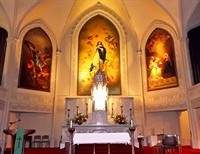
Photo By: Flickr/Fr Lawrence Lew, O.P.
Despite the fact that the early Reformers themselves showed a great devotion to Mary, one of the unfortunate fallouts of the Protestant Reformation was a loss of Marian devotion for many Christians. They came to view it as an unnecessary add-on of the Church of the Middle Ages, at best, and an insidious form of idolatry at worst. If we look at the writings of the Church fathers however, we find a great devotion to her, especially under the title of the New Eve.
“For Eve, being a virgin and undefiled, conceiving the word that was from the serpent, brought forth disobedience and death; but the Virgin Mary, taking faith and joy, when the Angel told her the good tidings…answered, ‘Be it to me according to Thy word.’” Justin Martyr (c. 140)
“And so the knot of Eye's disobedience received its unloosing through the obedience of Mary; for what Eve, a virgin, bound by incredulity, that Mary, a virgin, unloosed by faith.” (Irenaeus c160)
Where did Irenaeus get this idea? If we look at Irenaeus’ personal history, we see that he was ordained by Polycarp who was a disciple of John the Apostle. The Gospel of the Beloved Disciple then is a good place to start.
To be fair, we should expect any mention of her to be rather subtle, especially in the earlier Gospels and letters. She likely lived for some time after the death of Our Lord and there was an ever-present danger of a distorted cult arising around her. That is why when we turn to St. John’s Gospel, we must use an important biblical interpretation tool called typology.
Typology is such an important tool because it makes use of a very important principle. Scripture is not just a bunch of disconnected books or stories—it tells a single story.
And what is that story? It is the story of God’s revealing of Himself to man so as to enter into a relationship with him. And not just any relationship but a family relationship where we are adopted into His life forever. This does not happen all at once but instead God does it gradually, using not just words but also events and people.
In essence, we can say that God uses people and events in salvation history (called types) to foreshadow greater persons and events that are to come (called archetypes). We do this not merely to play a Scriptural version of the Six Degrees of Kevin Bacon, but because the types always help us to more fully understand the archetypes. What we find in the type can be applied to the archetype, even if the archetype is greater.
St. Paul himself is a master at drawing out the type—archetype connection. For example he calls Christ “a Priest forever in the order of Melchezidek” in the letter to the Hebrews to show that He is a Priest who forever offers the sacrifice of bread and wine in the Eucharist.
Perhaps the most common type-archetype that he uses is between Adam and Christ, the new Adam. We will see why this one is relevant to the discussion in a moment.
Returning to Our Lady, by calling Mary the New Eve what we really mean is that Eve is a type of Mary.
If we return to “the beginning”, after the fall of man, we find God telling the Serpent that because he tempted Adam and Eve He “will put enmity between you and the woman, and between your seed and her seed; he shall bruise your head, and you shall bruise his heel” (Gn 3:15). This message is one of mercy; God will fix what the Serpent tried to destroy. But how is He going to do this?
He promises a Redeemer, the seed that will bruise the serpent’s head. In this way, the Church refers to these lines as the Protoevangelium or first proclamation of the Gospel. But a Redeemer isn’t all that is contained in the promise. Examining it more closely we see the promise is really for a new Adam (Christ) and a new Eve (Mary). Both the “woman” and “her seed” are linked together in crushing the serpent.
This is where typology becomes important. God made the First Covenant with Adam and gave him Eve as a “helper” in fulfilling this covenant. Even if Eve’s role is secondary in the First Covenant, she still plays an essential and unique role in it.
To refer to Christ as the New Adam without Him having a New Eve makes St. Paul’s analogy senseless. In Christ, the New Adam, God makes the new and definitive covenant and Mary is to be His “helper.” Everything that Eve was, Mary is and more. If it was not good for Adam to be alone in fulfilling his mission then even more so would it not be good for Christ to be alone in fulfilling His. If Eve is the “flesh of my flesh” of Adam then the New Eve too would need to be of the same immaculate flesh as the New Adam. And most strikingly, if Eve was the “mother of all the living” then Mary must be that and more.
This is why Mary is referred to as the New Eve at the foundation of Christianity. Within this one title we find a connection to nearly everything we believe about Mary. The promise of a woman’s seed (men were considered to provide the seed) points to the Virgin Birth. The union of the flesh of the new Adam and new Eve refers to the Immaculate Conception. Even the Assumption is implicitly mentioned. The total enmity gives Satan, who holds the power of death over fallen mankind, no power over Mary.
Where is the connection made most explicit? Not surprisingly it is in John’s Gospel, especially considering it was most likely written after Mary had been assumed into heaven. John not so subtly leverages his Adam/Eve and Christ/Mary connection. He too is uses typology and lets us know this by tying his Gospel to the creation account in Genesis.
He moves from “in the beginning” (day 1), to the “next day” when pointed Jesus out and then the next day when the disciples meet Jesus. Then John skips ahead 3 days—for those of us counting that makes day 6 and what do we find? A wedding, just like in the first creation account. John is tying the first Creation account to an account of the New Creation.
In John’s account of the New Creation we see that there is a wedding in which the bride and groom are not mentioned but “the mother of Jesus” and Jesus are. When asked to provide wine, Our Lord refers to His Mother as “Woman.” With the parallel to Genesis we realize that in calling her Woman, Jesus is calling her the New Eve. He is reminding her that once His mission as the New Adam begins with His first public miracle, her mission as the New Eve will begin as well. She reveals the purpose of her mission—telling everyone to “do whatever He tells you” (Jn. 2:5).
It is no literary accident that the last pre-Resurrection “whatever He tells you” is the command to “Behold your mother” (Jn. 19:27). We know the divine commandment is not merely for John because Jesus once again invokes the name “Woman” to connect her to Eve, the mother of all the living. This New Eve would serve as the mother of all the living, that is those who are alive in Christ as Beloved Disciples.
In his encyclical on Mary, John Paul II highlights the deeply personal nature of Jesus entrusting Mary and the Beloved Disciple. It is not just John but all of Jesus’ beloved disciples who enter into this relationship of entrustment. John shows us what it means for the individual believer to do this—“take here into his home” (Jn. 19:27). What this means for each of us as believers may be somewhat different, but it certainly starts by not treating her as if she is somehow in competition with your affection for Jesus or as irrelevant. The fact that Jesus entrusts Mary and the Beloved Disciple to each other means that there must be a personal relationship of some sort. As the rest of her offspring—as Revelation 12 calls us—we should be no different.
Recommended Stories
About the Author
Rob holds an MA in Theology from Holy Apostles College and Seminary with a concentration in moral theology. He has a passion for spreading the joy of the Catholic Faith through teaching.
He lives in Raleigh, NC with his wife, Allison, and their three sons. Rob supports his apostolate by working as a Statistician and teaches bioethics throughout the Diocese of Raleigh. He is part of a speakers’ panel in which he addresses issues related to marriage, fatherhood, and moral theology. He has published articles in a number of Catholic publications including The Homiletic and Pastoral Review, The New Oxford Review, the National Catholic Bioethics Center’s Ethics and Medics, and First Things’ On the Square.
Link to his blog: