The Origins of the Pentateuch Made Simple

Those Huddled Masses

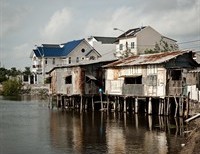
Photo By: Flickr/alkis
One day a Pharisee asked Jesus, " Teacher, which commandment in the law is the greatest?" He said to him, "You shall love the Lord, your God, with all your heart, with all your soul, and with all your mind. This is the greatest and the first commandment. The second is like it: You shall love your neighbor as yourself. The whole law and the prophets depend on these two commandments." MT 22: 36-40
Then the righteous will say to him, "Lord, when did we see you hungry and feed you, or thirsty and give you drink? When did we see you a stranger and welcome you, or naked and clothe you? When did we see you ill or in prison and visit you?" And the king will say to them in reply, "Amen, I say to you whatever you did for one of these least brothers of mine, you did for me." MT 25: 37-40
If anyone says "I love God," but hates his brother, he is a liar; for whoever does not love a brother whom he has seen cannot love God whom he has not seen. This is the commandment we have from him: whoever loves God must also love his brother. 1 JN 4: 20-21
"Amen, amen I say to you, whoever receives the one I send receives me, and whoever receives me receives the one who sent me." JN 13: 20
These quotations from the New Testament make a clear point. There are other verses I could have chosen from both the Old and New Testaments which teach the same point. This is how we are to treat one another. Not just those who are like us, who share the same religion as us, but all of humanity. Call to mind the Parable of The Good Samaritan: Jews and Samaritans hated each other, yet a Samaritan helped an injured Jew.
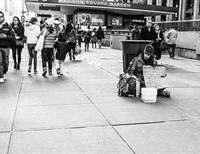
We are in a time of crisis: Thousands of refugees, most of them from Syria, nearly all of them Muslims are fleeing the fighting going on there. They are seeking asylum. They are entering several European countries, and a good number of them want to come to the United States. But there are many Americans, most of whom call themselves Christian, who don't want them here. They give several reasons: They are not like us, they are Muslim, they might be terrorists among them, they don't value human life.
I don't see any exceptions in the verses I quoted above which allow us to choose who are our neighbors, who are our brothers we are commanded to love and give aid and comfort to.
In our history, not so long ago, we treated Americans of Japanese descent shamefully. Do we want to act like that again? Or do we wish to follow the teachings of Jesus, and the commandments He reminded us of, and show our love of God by welcoming those who are in desparate need of our help.
Yes, there is some concern that in every group of refugees there may be a few imposters who wish us harm, but I believe a good vetting process will catch and weed out most of them. Do we, as a country that many say is Christian, turn our backs on what Jesus calls the two greatest commandments? Do we listen to the rhetoric of hate and fear we hear in this election year? Or do we follow the higher teaching God gives us, to love our neighbor.
Once, our country proudly put forth the sentiment found in the poem, The New Colossus, by Emma Lazarus. We even have the poem placed on display in the Statue of Liberty. This was once our guiding principle for our treatment of refugees. Can we make it that way again?
This is the final stanza of that Poem:
"Give me your tired, your poor,
Your huddled masses yearning to breathe free,
The wretched refuse of your teeming shore.
Send these, the homeless, tempest-tost to me,
I lift my lamp beside the golden door."
Many of those who cry against letting the refugees in claim to be Christians, followers of Christ. Isn't it about time they search Scripture and their consciences and act like it?
Recommended Stories
About the Author
I live in Lubbock, Texas and have been married for 47 years and counting. We have 5 children, 6 grandchildren, 1 great-grandchild, and 1 due soon. I served 4 years in the Air Force as a Medical Service Specialist during the Vietnam conflict and served 14 months at USAF Hospital, Clark AFB, Phillipines, taking care of Marines and Republic of Korea soldiers who were wounded in Vietnam. I completed undergraduate studies at University of Houston and obtained a Bachelor's Degree from Midwestern State University, graduated cum laude. Following that, I did post-graduate studies at Texas Tech University and Loyola Institute of Ministry,Extension Program. i am a Retired Educator,and have taught History and English at the secondary level. I am also a Retired Permanent Deacon, and for several years I wrote a Q&A column for a diocesan newspaper about the Catholic faith. In addition, I taught Church History for a diocesan Diaconate Formation Program and was director of the RCIA program in my parish for several years.