
You Can't Run the Church on Hail Marys: The Paradox of Archbishop Paul Marcinkus
Sponsored

Catholic365 is sponsored by
Road to Purity



Jesus asked his disciples “Who do people say that the Son of Man is?” It is interesting that Jesus starts his interaction with the disciples here by asking them what is really an academic question: Who is Jesus? More books have probably been written over the centuries trying to answer that question than have been written about any other single topic. The disciples then respond with what is essentially an academic answer: “Some say John the Baptist, others Elijah, still others Jeremiah or one of the prophets.” Academically speaking, Jesus is, according to the Catechism of the Catholic Church, “the second Person of the Holy Trinity, co-eternal with the Father, and is one Person but has two natures and is fully divine and fully human. In his divine nature, Jesus has all the attributes of God and in His human nature, Jesus is like us in every respect except for sin.” This is important information and it is of course necessary to know who Jesus is. However, it is clear that Jesus wants his disciples to go a step further when he asks them “But who do you say that I am?” In other words, who is Jesus really to you? Who is the Jesus that you follow? How does Jesus matter to you in your day to day life? In our first and second readings today for the Solemnity of Sts Peter and Paul, two of the greatest if not the greatest of the Church’s saints, we can see who Jesus really is to them - not the intellectual answer because that, while necessary, is also necessarily going to not be sufficient when we find ourselves like Peter in the first reading and spiritually at least “secured by double chains.” We see then that, for Peter, Jesus is as he relates at the end: “Now I [Peter] know for certain that the Lord sent his angel and rescued me from the hand of Herod and from all that the Jewish people have been expecting.” Paul, who certainly went through many trials in his life, spells out who Jesus is to him: “The Lord stood by me and gave me strength, so that through me the proclamation might be completed and all the Gentiles might hear it. And I was rescued from the Lion’s mouth. The Lord will rescue me from every evil threat and will bring me safely to his heavenly Kingdom.” We have all certainly been told who Jesus is but the kind of question that Jesus asks his disciples here is not an exam in a theology class but is rather something that is an examination of our own lives and is also a question that we have to answer for ourselves and we also have to accept that the answer to that question can and will change as we get older. The problem, though, when we try to answer the question of Who is Jesus to us is that we can limit ourselves to easy answers and to answers that are only feel good ones. It is certainly easy to go to the National Parks and say that Jesus is there - however it is a great deal more difficult to say who Jesus is when you just, for example, lost a job or had a misfortune befall you. But, the Incarnation means that Jesus is with us always and not just in the times that we perceive to be good. Looked at this way, there is no final and firm answer to the question of who Jesus is. The way we would answer that question when we were kids is very different from the way we would answer that question later in life and will still change and develop. Embrace the tension in that because Jesus’ question is not about a specific correct answer and is less about an intellectual understanding and is more about our heart and is the same thing as going from knowing about someone to actually knowing that someone. God does not speak with a physical voice but rather with a spiritual one and one that can be heard by the heart alone. A missionary several centuries ago in Western Africa found this out when he was translating the Bible into Songhai. There was, however, no word for “to believe” in the Songhai language and the missionary asked a local how to translate it and the local, after thinking about his response, said “it means to hear with the heart.”
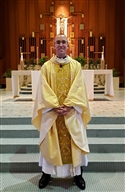
Fr. Carlton is a priest for the Archdiocese of Chicago. Before joining the Archdiocese, he served in the Navy and was a high school theology teacher. Currently, he is engaged in pastoral ministry in Chicago.



