
You Can't Run the Church on Hail Marys: The Paradox of Archbishop Paul Marcinkus
Sponsored

Catholic365 is sponsored by
Road to Purity



Do not work for food that perishes but for food that endures for eternal life. It is a good question for us to ask what kind of bread have we been eating as a society in the last several decades. The size of the American economy has increased by a factor of roughly nine since 1980 and the stock market, which has been around 42000 recently, started the month of November, 1982 at roughly 775, which means that the stock market is nearly 55 times higher than the levels in late 1982. The number of people living in extreme poverty in the developing world, which is generally taken as living on less than $1 a day, has gone down by more than half since 1980. By any standards, the material conditions on the whole, certainly in our country, and in much of the rest of the world, have markedly increased in the last forty years. So, in our country, at least, there is plenty of bread. But what kind of bread is this? When I think of an answer to this question, I think of what Robert Kennedy said about economic growth in the United States in the mid 1960s: “Too much and too long, we seem to have surrendered community excellence and community values in the mere accumulation of material things. Our gross national product...if we should judge the United States by that – counts air pollution and cigarette advertising, and ambulances to clear our highways of carnage. It counts special locks for our door and the jails for those who break them. It counts the destruction of our redwoods and the loss of our natural wonder in chaotic sprawl. It counts Whitman’s rifle and Speck’s knife, and the television programs which glorify violence in order to sell toys to our children. Yet the gross national product does not allow for the health of our children, the quality of their education, or the joy of their play. It does not include the beauty of our poetry or the strength of our marriages; the intelligence of our public debate or the integrity of our public officials. It measures neither our wit nor our courage; neither our wisdom nor our learning; neither our compassion nor our devotion to our country; it measures everything, in short, except that which makes life worthwhile.” Lots of bread around but when we look at the totality of bread we find that not everything is nutritious. Interestingly, at the same time that, in the last century, our material life has increased exponentially, the level of happiness among people has also gone down. This says something about the quality of the bread that we have been eating and is also a sign that that bread is not the bread that is going to last. If you want to know what kind of bread lasts, you have to look, as Kennedy tells, beyond the numbers and beyond the actual bread and see where this bread is coming from and what is in the bread. This is exactly what the crowd in the Gospels is not doing. They go around looking for Jesus not because they are interested in thanking him for the previous miracles or they want to learn something from him but simply because they are concerned that they missed the bread that Jesus was cooking. As He tells them: “...you are looking for me not because you saw signs but because you ate the loaves and were filled.” What bread, then, are we eating? Are we eating bread that goes away and that always mean we need to look for something more or do we believe in the bread that Jesus is talking about here – the kind where we take Him into our lives and our transformed by that?
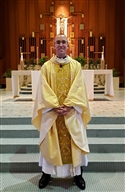
Fr. Carlton is a priest for the Archdiocese of Chicago. Before joining the Archdiocese, he served in the Navy and was a high school theology teacher. Currently, he is engaged in pastoral ministry in Chicago.



