A Timely Reminder for the Laity: Catholic Teaching on Love, Sexuality, and Our Common Call to Chastity
Sponsored

Catholic365 is sponsored by
Road to Purity



“There is neither Jew nor Greek, there is neither slave nor free person, there is not male and female; for you are all one in Christ Jesus.” (Galatians 3:28)
This past weekend, I accompanied my father, Charles Earl McClain, Sr., from my native Prince George’s County, Maryland, to his native Durham, North Carolina, so that he could attend the weekend festivities for the sixty-second reunion of the Hillside High School Class of 1954. Throughout the weekend, I had the opportunity to meet many of my father’s kind, funny, good-natured classmates and listen to their captivating stories. At various points throughout the weekend, I asked my father what it was like growing up as a young black man in the South in the 1930s, 40s, and 50s, and the topic of school segregation readily came up. Coincidentally, the U.S. Supreme Court handed down their favorable and rightly famous Brown v. Board of Education decision, a sweeping victory for the racial integration of schools in the South, mere days before my father and his classmates graduated from Hillside High School. Thus, my father never knew anything other than segregation during his school days, but in the coming decade, he was able to see the continued successes of the Civil Rights Movement of the early 1960s. In fact, my father was so inspired by the advocacy of President John F. Kennedy, our nation’s first and, to-date, only Catholic head of state, that he later converted to Roman Catholicism himself. I wanted to provide this anecdote in order to set the stage for the broader matter at hand, which serves as the reason for this piece.
It may surprise some to learn that there is no physical description of Jesus from within any of the four canonical Gospels – Matthew, Mark, Luke, or John. We know that Jesus was an Israelite male who died around the age of thirty-three years old, and that is about it. Jesus has been depicted in visual art, not to mention within literature, with practically every combination of physical features imaginable throughout the course of nearly two-thousand years, but we have no idea what he looked like. And perhaps it is better that way. After all, he came for all of us, and the Catholic Church’s official teachings have reiterated that time and time again. Let us recall, for example, how in the earliest days of the Church’s evangelizing efforts, the Apostle Philip brought the Good News as far as to the people of Ethiopia: Acts 8:26-40.
In chapter 3, verse 28 of Saint Paul’s Letter to the Galatians, which is quoted at the opening of this piece, Paul (the great “Apostle to the Gentiles”) indeed reminded us that all people enjoy equality in God’s eyes. Although the condition of the term “equality” has been relegated to that of a buzzword in modern times, its actual significance remains in force: we have equal human worth, value, and dignity, all provided and celebrated by the Lord, without qualification. Although each of us is, of course, distinct – in appearance, physiology, either male or female, and of other characteristics – and therefore able to be differentiated from others, we are all made in God’s “image” and “likeness” (cf. Genesis 1:26-27).
The above factors are vital to remember before entering into a consideration of what the Catholic Church has professed for nearly two-thousand years of race relations. In the interest of full disclosure, it is readily evident that it would be impractical within this setting to provide an exhaustive overview of the extent of two-thousand years of race relations framed by the teachings of the Catholic faith. However, as we bear witness to the unfortunately tense state of race relations in some segments of American society, we must recall that the Catholic Church’s teachings reflect those of Christ, who came to lovingly extend his offer of redemptive salvation to all of us. (Note: In modern English, when we speak of race, we are typically actually talking about the anthropological term ethnicity. However, since this piece is not an exercise in semantics, and the term race has become more mainstream, we will simply reflect on “race” relations.)
Let us begin with the obvious, in order to bring it to light and be able to advance the discussion: over the course of nearly two millennia, some Catholics have tainted the Church’s reputation as the Body of Christ by committing acts of actual racism. These incidents have unfortunately and admittedly even occurred through the twenty-first century. During the period of American slavery, some bishops and other priests owned slaves. Some clerics tolerated the racial segregation of schools in the South. Some Catholics have considered some ethnic groups to have different value than others, such as some prominent figures who misappropriated the mantle of the Church during the era of global exploration and European colonization, in order to achieve “glory” and “gold,” while disregarding God in the process. However, in the midst of this racial discord, who are the heroic figures – many of whom have been canonized within the communion of saints – who rose above ill will and the prevailing power-driven rhetoric of those circumstances in order to be the face of Christ to those of other races?
In sum, the Catholic Church had already been around for approximately a millennium and a half when it began to have to actually address race relations per se. Of course, there were interactions with people of other faith traditions – e.g., Judaism and Islam – in predominantly Christian lands around the Mediterranean. However, particular considerations regarding the dynamics between various faiths is a different discussion for another day. Thus, from the Church’s founding through the early Renaissance, in terms of distinctions, the Church’s interests were more in one’s religion than necessarily in one’s ethnicity.
Let us look at what transpired in terms of the Church’s reaffirmation of Christ’s teachings as of the Age of Exploration in the late fifteenth century. Broadly speaking, during the Age of Exploration, many in the Church came to recognize that evangelization does not mean replacing someone’s unique cultural identity; rather, just as the early Church began in the midst of different cultures (Middle Eastern, North African, Roman, and Germanic, among various others), the gospel is directed toward all of humanity. Thus, it is possible to remain faithful to the gospel while honoring the use of different languages and unique cultural gifts. Yet, as alluded to previously, we must reassert that, unfortunately, some worldly-minded Catholics acted in bold violation of Catholic social teaching by not heeding the gospel-centered proclamations of their ecclesial superiors, particularly the pope. Meanwhile, others abided by Catholic doctrine, listening to the Lord and his will in the process.
Thus, we can look to the example of the great Spanish Jesuit priest Saint Peter Claver (1581-1654). While many of Peter’s fellow Spaniards were trafficking slaves within Colombia and other areas of the Spanish colonies, he chose to do the will of God – he brought the gospel and administered the sacraments to multitudes of slaves over the course of decades. He lived among them and cared for them when they were sick or had another human need. He served them and spoke out against their tormentors. He celebrated their common humanity. We see the same attitude of humility, service, and reconciliation in the life of Saint Martin de Porres, who happened to be of mixed ethnicities. Martin de Porres saw that, in serving his neighbor, he was serving Christ, in response to his call in Matthew 25:31-46, frequently deemed “the Judgment of the Nations.”
We can likewise look to the example of popes, the vicars of Christ, who acted in accord with the Church’s Magisterium by issuing various documents condemning slavery and other human rights abuses. (An EWTN article by Fr. Joel Panzer, titled “The Popes and Slavery: Setting the Record Straight,” provides a substantial review of this historical sequence.) These papal writings include, in chronological order:
In the midst of societal discord, with nearly two thousand years of wisdom in this regard, where do we as Catholics go from here? Let us continue to pray for the fostering of positive race relations, which the Catholic Church has overwhelmingly supported for going on two millennia. As one example among various, the Archdiocese of Washington’s Catholic Standard recently shared the National Black Catholic Congress’s call to prayer and action, which is in the interest of enduring peace and reconciliation. There is also good work being done by the USCCB’s Secretariat of Cultural Diversity in the Church. Our common human dignity and worth, granted by the Lord, cannot be abridged, adjusted, or otherwise altered. The rich tapestry of ethnic backgrounds of which the Catholic Church is comprised is a reflection of our true equality before God, since we are all made in his image and likeness. Let us allow our love for God – and for our neighbor by extension – to be in our hearts and our minds as we go forth, in accordance with Christ’s final command to his Disciples at the conclusion of his earthly ministry, just prior to his Ascension: “Then Jesus approached and said to them, ‘All power in heaven and on earth have been given to me. Go, therefore, and make disciples of all nations, baptizing them in the name of the Father, and of the Son, and of the Holy Spirit, teaching them to observe all that I have commanded you. And behold, I am with you always, until the end of the age’” (Matthew 28:19-20).
A lifelong resident of the Archdiocese of Washington, Justin has taught theology and Spanish at his alma mater, Bishop McNamara High School in Forestville, Maryland, since 2006.
Justin has written widely on various aspects of the Catholic faith. His books include Called to Teach: Daily Inspiration for Catholic Educators, Called to Pray: Daily Prayers for Catholic Schools, The History of the Catholic Church (a textbook), and Alleluia to Amen: The Prayer Book for Catholic Parishes. Justin is active in pro-life ministries, and serves on the volunteer board of directors for the Forestville Pregnancy Center.
Justin holds an M.A. in Spanish Language and Culture from the Universidad de Salamanca (Spain), an M.A. in International History from Staffordshire University (England), and an M.A. in Theology and Christian Ministry from the Franciscan University of Steubenville. Justin has studied philosophy and theology at Seton Hall University, and Church history from the University of Notre Dame’s Satellite Theological Education Program, for whom he has likewise taught various online courses.
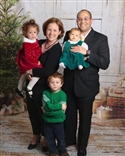
Justin, his wife Bernadette, and their children live in Bowie, Maryland, where they attend Sacred Heart Catholic Church. Justin is a lay member of the Order of Saint Dominic. You can follow him on Twitter (@JustinMcClainOP).