Sabbath: Should we worship on Saturday or Sunday?

Convert for Jesus


Photo By: Flickr/KairosPhotography
DARE WE HOPE for the CONVERSION of ALL SOULS?
By Sergio Garibay and Michael Gomez (AND special thanks to some close friends)
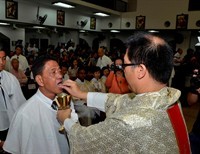
What's that truth on why you should become Catholic or that truth that will affirm your Catholic Faith? Well, that is the Eucharist.
If you wonder what is the Eucharist, let me explain: The Eucharist is the true body and blood of Christ under the appearance of bread and wine.
“…This is the work of God, that you believe in the one he sent. For the bread of God is that which comes down from heaven and gives life to the world.” (St John 6:29,33) Christ, he is the one that came down from heaven, not only did he come down to meet humankind, he came and died for our sins; the Eucharist, and the Calvary are sides of the same coin. “…I am the bread of life; whoever comes to me will never hunger, and whoever believes in me will never thirst.” (St John 6:35) For the Eucharist is the way to never to be hungry, the eternal beauty of love, and exactly, one year after this event, Jesus leads us to know more about the sacrament of the Eucharist in the last supper, “I am the true vine, and my Father is the vine grower.” (St John 15:1), “While they were eating, Jesus took bread, said the blessing, broke it and giving it to his disciples said, 'Take and eat; this is my body.' Then he took a cup, gave thanks, and gave it to them, saying, 'Drink from it, all of you, for this is my blood of the covenant, which will be shed on behalf of many for the forgiveness of sins. I tell you, from now on I shall not drink this fruit of the vine until the day when I drink it with you in the kingdom of my Father.'” (St Matthew 26:26-29).
If you are asking yourself now: "Didn't Christ said this only metaphorically?" WELL, I will show you how Jesus did not speak just metaphorically, for example in St John 6:31, 32, 49, 59,Jesus talks about the Manna (Physical food), furthermore, Jesus uses the word to chew: τργω (trogein) in St John 6:54, 56, 58, (Jn 6:58 "This is the bread which came down from heaven, not such as the fathers ate and died; he who eats this bread will live for ever.”) and how do we know this is referring to chewing/eating actual food? Well this word is only used once more in the Bible besides those verses, and it is used in the following verse: Mt 24:38 "For as in those days before the flood they were eating and drinking, marrying and giving in marriage, until the day when Noah entered the ark." Here we see St Matthew referring to people eating actual food, thus, the same word is use by Jesus when referring to his flesh. More proof exists since Jesus uses the word to eat: σθω (phagein) in St John 6:51,53 this is the most used form of the use of the verb "to eat" in the Bible, we know it also refers to food since we can see St Matthew use the same word -phagein- to refer to actual food eating in Mt 6:25 “Therefore I tell you, do not be anxious about your life, what you shall eat or what you shall drink, nor about your body, what you shall put on. Is not life more than food, and the body more than clothing?". It shouldn't amaze us that when the Jews heard him, they were so astonished and many didn't believe him, so they left him (Rf John 6:66).
1 Corinthians 11: 27-30 "Therefore whosoever shall eat this bread, or drink the chalice of the Lord unworthily, shall be guilty of the body and of the blood of the Lord. But let a man prove himself: and so let him eat of that bread, and drink of the chalice. For he that eateth and drinketh unworthily, eateth and drinketh judgment to himself, not discerning the body of the Lord.Therefore are there many infirm and weak among you, and many sleep." How can eating bread and drinking wine unworthily be such great of a sin? Has Paul gone nuts? No, he has not. Paul's statement would only make sense if the bread and wine became the real Body and Blood of Jesus. 1 Corinthians 10:16 "The chalice of benediction, which we bless, is it not the communion of the blood of Christ? And the bread, which we break, is it not the partaking of the body of the Lord?" Paul's comment is trying to express that when we receive communion, we actually participate in the Body and Blood of Jesus Christ, not just mere symbols.
Why Bread and Wine?
Genesis 14:17-20
"When Abram returned from his defeat of Chedorlaomer and the kings who were allied with him, the king of Sodom went out to greet him in the Valley of Shaveh (that is, the King’s Valley). Melchizedek, king of Salem, brought out bread and wine. He was a priest of God Most High. He blessed Abram with these words ‘Blessed be Abram by God Most High, the creator of heaven and earth; and blessed be God Most High, who delivered your foes into your hand.’ Then Abram gave him a tenth of everything.” This verse is actually very important when comes to understanding the importance of Bread and Wine in the Eucharist. It shows that even in the first book of the Old Testament, the High Priest Melchizedek recognizes the importance of the “Bread” and the “Wine”. They are more than a method of celebration, but they show the importance of using them after winning a battle for the freedom of the chosen people. As John 6:49-53 and Matthew 26:26-28 refer to the “Bread” and “Wine” as the Eucharist, which also shows the way to celebrate Salvation and the way the King (Jesus) celebrates a feast (Note: Matthew 26 occurs during the Passover which is the most important feast in the Judeo religion and culture which represents freedom). Furthermore, when Adam and Eve fall, God said, "In the sweat of your face you shall eat bread till you return to the ground, for out of it, you were taken; you are dust, and to dust you shall return." (Genesis 3:19). The use of bread is the symbolism of the fall; when Jesus uses the Bread, it is a sign to show that maybe we will return to dust again, just as the bread changes, we will change as well.
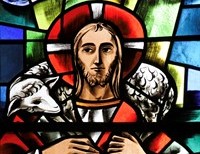
Why is Jesus given the title "The Lamb Of God"?
In Acts 8:32-35 and 1 Peter 1:19, it is said that Jesus is like a lamb. John is the only one that dares to call Jesus "The Lamb" as we see in John 1:36 and all throughout Apocalypse. In the Old Testament, the lamb was identified with sacrifice. Abel was the first to bring a sacrificial offering to God (Rf. Genesis 4:3-4) Similar burnt offerings from Noah (Rf. Genesis 8:20-21), Abraham (Rf. Genesis 15:8-10; 22:13), Jacob (Rf. Genesis 46:1), and others soon follow. Two sacrifices in Genesis deserve our most careful attention. Melchizedek's sacrifice is one of them (Rf. Genesis 14:18-20). Melchizedek appears as the first priest and he foreshadows Jesus Christ (Rf. Hebrews 7:1-17). Melchizedek is both priest and king just like Jesus. Genesis describes him as King of Salem. Salem would later become Jerusalem which means "City of Peace" (Psalms 76:2). Melchizedek's sacrifice was very different from others because it did not include animals, but bread and wine. Jesus also offered bread and wine, at the Last Supper where he instituted the Eucharist. The other sacrifice that needs our attention is Abraham's. In Genesis 22, God tells Abraham to sacrifice his son, Isaac, at the land of Moriah. When Isaac asks where was the victim Abraham replied, "God will provide Himself the lamb for a burnt offering my son" (Genesis 22:8). In the end, the angel of God stopped Abraham from sacrificing his son and provided a ram to be sacrificed. This story foreshadows the dying of Christ on the cross. Jesus, like Isaac, was a faithful father's only beloved son. Jesus carried the wood for His own sacrifice just like Isaac. The place where Jesus died was one of the hillocks on Moriah's range. Jesus is identified with Isaac in Matthew 1:1 as "the son of Abraham". There was no punctuation in the Hebrew language, so try this alternate reading of the verse of Genesis 22:8 "God will provide Himself, the Lamb, for a burnt offering." As we see here, we can see why Jesus is given the title "The Lamb of God". In Leviticus 16, there are sacrifices for the removal of sins. That is what Jesus did on the cross; He died for humanities' sins so they may be forgiven. Without the priest, there was no sacrifice, so there was no forgiveness. Today, without the priest, there is no Confession, and if there is no Confession there is no forgiveness of sins. Without the priest, there is no Eucharist, no sacrifice. That's why the priesthood today is very important. Also, when we receive Communion, our venial sins are removed, so the sacrifice removes venial sins just like how sacrifices in the Old Testament removed the sins of the Israelites. The priesthood and their sacrifices in the Old Testament foreshadow the priesthood and their sacrifices in the New Testament. Jesus is the Lamb that is offered in the Eucharist just like how lambs were sacrificed in the Old Testament. This helps us understand why Jesus is the sacrifice in the New Testament and why His sacrifice is made present every time the Eucharist is offered, and how all of that relates to the Old Testament.
"Speak ye to the whole assembly of the children of Israel, and say to them: On the tenth day of this month let every man take a lamb by their families and houses. But if the number be less than may suffice to eat the lamb, he shall take unto him his neighbour that joineth to his house, according to the number of souls which may be enough to eat the lamb. And it shall be a lamb without blemish, a male, of one year: according to which rite also you shall take a kid." (Exodus 12:3-5), Jesus being the Lamb of the New Covenant has a connection to the Old Covenant lamb. In the Old Testament, the blood of the lamb represented purification, the forgiveness of our sins, through this blood the chosen ones were redeemed, however, it wasn't enough to sacrifice the Lamb (Rf. Exodus 12:21-22) the People must partake in eating the Lamb (Rf. Exodus 12:3-4), and this practice must continue until the end of the times (Rf Exodus 12:24-27). The words Synagogue and Church are synonyms, one of them in Hebrew (Synagogue), and the other one in Greek, in the altar the priests had sacrifices (Rf Exodus 27:1-7). Jesus as well said, "...do this in memory of me" (Luke 22:19).
The Protestant interpretation relies on the fact that the phrase to eat flesh and drink blood means to "commune with". However, in multiple bible verses Psalm 14:4 27:2,
Isaiah 9:18-20 49:26, Micah 3:3, II Samuel 23:15-17,Revelation 17:6, the eating of a person's flesh means to assault, or attack, someone. It is never shown as a metaphor for communion, spiritual, or otherwise. Would Jesus use a metaphor that He knew people would misinterpret?
What did Early Christians believe when it came to the Eucharist?
The early Fathers agree with the belief of the Eucharist and the natures of the Eucharist as I quote:
-The Didache, Chapter 9.
"On the Lord's Day of the Lord come together, break bread and hold Eucharist, after confessing your transgressions that your offering may be pure; but let none who has a quarrel with his fellow join in your meeting until they are reconciled, that your sacrifice is not defiled. For this is that which was spoken by the Lord, 'In every place and time offer me a pure sacrifice, for I am a great king,' saith the Lord, "and my name is wonderful among the heathen.'"
In 80 AD, the word Eucharist is already used to show that Christians believed in the Transubstantiation, furthermore it is seen with how extreme reverence Christians talked in the first Century about the Eucharist. Some claim that the Roman Emperor introduced the doctrines of Blood and Flesh around the late 4th Century to cover a pagan tradition, however, we can see this is wrong by just reading St. Ignatius of Antioch (a disciple of St. John the Apostle) text written in 110 AD (around 320 years prior the Birth of Emperor Constantine).
"Letter to the Smyrnaeans", by Saint Ignatius of Antioch paragraph 6. circa 80-110 A.D
"Consider how contrary to the mind of God are heterodox in regard to the grace of God which has come to us. They have no regard for charity, none for the widow, the orphan, the oppressed, none for the man in prison, the hungry or the thirsty. They abstain from the Eucharist and from prayer because they do not admit that the Eucharist is the flesh of our Savior Jesus Christ, the flesh which suffered for our sins and which the Father, in His graciousness, raised from the dead."
Another of St. Ignatius of Antioch writings, "Letter to the Ephesians", paragraph 20, c. 80-110 A.D
"Come together in common, one and all without exception in charity, in one faith and in one Jesus Christ, who is of the race of David according to the flesh, the son of man, and the Son of God, so that with undivided mind you may obey the bishop and the priests, and break one Bread which is the medicine of immortality and the antidote against death, enabling us to live forever in Jesus Christ."
St. Ignatius of Antioch' writings clearly reflect the idea that Early Christians believed in the Transubstantiation, which completely debunks the false sayings that state that the Roman Emperor Constantine introduced the doctrine of Transubstantiation.
Therefore, we come to the conclusion that the Protestant's view on communion is a misinterpretation of the Bible and they indirectly call Jesus a liar in this way. Jesus said it, Paul said it, and the early Church Fathers said it. The Eucharist is one of the most obvious doctrines in the Bible. We have Jesus in the Eucharist. What do you have?
"From the Eucharist comes strength to live the Christian life and zeal to share that life with others" - Pope John Paul II
Thank you, Michael (@colcatapo), Aldo (@Catholic_soldier), and John (@Jeremiah.host) for your help. (Instagram accounts)
This article is available as a PDF online at: https://view.publitas.com/p222-8792/convert-for-jesus/
Recommended Stories
About the Author
My name is Sergio Garibay. I am a young Catholic who enjoys reading and writing Catholic Political Theory & Theology. I consider myself a Neo-Platonic Christian with a large emphasis on The Cappadocians Fathers as well Communio Theologians and Existential Thomism. I have a Bachelors in Economics & a minor in Political Science and I'm currently discerning the priesthood. I am enrolled in the Angelic Confraternity and have a high desire towards interfaith analysis on eschatology. My favorite Catholic figures are Metropolitan Andrej Septyc’kyj, Kyr Josyf Slipyj, Pope Benedict XVI, Fr Hans Urs von Balthasar, Fr Henri de Lubac SJ, Jacques Maritain, Étienne Gilson, St Ignatius of Loyola & St Thomas Aquinas. I welcome each of you to join me in a conservation about the Catholic Faith.
My podcast: https://linktr.ee/CatholicPortal
My Instagram: https://www.instagram.com/Catholic_Portal/
My Twitter: https://twitter.com/Catholic_Portal?s=09
My Facebook group: https://www.facebook.com/groups/christiantrad/?ref=share
More Stories By :