Remembering Kayla Mueller

Jesus and Extraterrestrial Life: Meditation on John 10:14-18


This article will discuss a theory that is not Church teaching or doctrine. It is a theory I have not encountered elsewhere, but feel should be pondered and further explored. I do not wish to offend anyone in writing this article and if it comes across as heretical or absurd, please discredit or discard it. I write simply with hope that this theory may open the eyes of the Christian faithful to explore the created order in a new way. The theory is this: if there is intelligent life elsewhere, our Lord and Savior will be sent to save them too, as God is God of the entire cosmos.
Analyzing John 10:14-18 we are presented with a beautiful and curious teaching from our Lord. Jesus tells us:
“I am the good shepherd. I know my own and my own know me, just as the Father knows me and I know the Father; and I lay down my life for my sheep. And there are other sheep I have that are not of this fold, and these I have to lead as well. They too will listen to my voice, and there will be only one flock, and one shepherd. The Father loves me, because I lay down my life in order to take it up again. No one takes it from me; I lay it down of my own free will, and as it is in my power to lay it down, so it is in my power to take it up again; and this is the command I have been given by my Father.”
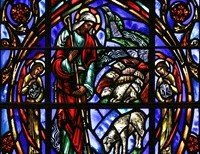
It is from this passage that the above theory comes. We must look at it very closely. First and foremost, we come to understand Jesus as the good shepherd. The good shepherd lays down his life for his sheep – Jesus died to save humanity from sin and damnation and gather them into a loving unity with the Trinity. Within the Gospel narratives, Jesus gathers the first sheep; his apostles, disciples and all repentant sinners. He comes first to his own, the Jewish people (John 4:22) and then to all peoples, both Jew and gentile alike (Matthew 28:19). Within the above teaching, Jesus' speaks of the sheep that are his followers; those who have heard him and followed him and have obeyed his words (John 10:15).
The following verse (10:16) however presents us with an opportunity for a vast field of interpretation. Jesus says, “And there are other sheep I have that are not of this fold, and these I have to lead as well.” Within the context of the Gospel of John, these 'other sheep' are likely the Gentiles, or those who are not Jewish. As beautifully spoken to Nicodemus, “Yes, God loved the world so much that he gave his only Son, so that everyone who believes in him may not be lost but may have eternal life” (John 3:16). The Gospel tells us the message of Christ is for all peoples of all races of all times. Therefore it is certainly fitting that those who are not of 'this fold' are the Gentiles, or those people who are not yet familiar with the reality Yahweh.
Could it be feasible however that Christ is already referring to the entire human race when he says “I lay down my life for my sheep” (v15)? Based on what comes after the following verse, I believe it is not unrealistic to explore a far deeper explanation of verse 16. Though it may seem ludicrous, what if Christ is not referring to the Gentiles as those who are not of 'this fold' but to alien life, or intelligent beings who are not of the one fold of the human race? I believe the remainder of the passage raises this possibility.
Now if Christ's teaching of himself as the good shepherd had concluded at verse 16, this possibility would have no substance or thought whatsoever. But our Lord continues in a very mysterious way. Here I will repeat the remaining verses.
“The Father loves me, because I lay down my life in order to take it up again. No one takes it from me; I lay it down of my own free will, and as it is in my power to lay it down, so it is in my power to take it up again; and this is the command I have been given by my Father” (John 10:17-18).
Jesus lays down his life in complete obedience to the command given by his Father. From these verses we understand that it is the Father's will that the Christ, his Son, redeems humanity through his death and resurrection. And Jesus obeys this command of his own free will. Jesus states that, 'it is in my power to lay it down again, so it is in my power to take it up again; and this command I have been given by my Father” (v18). This verse is central to the above theory. Within this context, I believe there is other intelligent life and that, if fallen through sin, Christ has the power to lay down his life and take it up again for them too. I say this because Christ has been given this command – to lay down his life in order to take it up again. And Christ says that it is within his power, power given to him by the Father, to lay it down and to take it up again.
The mystery of the Trinity is beyond human comprehension in the fullest sense. Just looking up at the sky we see stars that exist millions of light years away and vast expanses of sky that go on and on in what appear to be limitless and endless directions. Please do not hold it against me, but I believe there is a great possibility that there exists elsewhere intelligent beings who have been given by God a soul and free-will. What makes us human is our ability for choice, reason and a relationship with God. The Trinity is a creator- it creates all things and creates them good. It is not impossible to believe that God has created intelligent beings in some other place in time and space that are also designed for a relationship with God
I believe these verses in the Gospel of John point to this possibility. In no way will I state it as a fact, just a possibility or theory. Christ states that there are sheep that do not belong to this fold. I have interpreted this verse to mean that there are beings who do not belong to the human race whom Christ will also lead to himself (John 12:32). And he will do this in the same way he has done it for us, by laying down his life in order to take it up again. This command given him by the Father entails a plurality: Christ can lay down his life and take it up again for all of God's creations, and he can do this with the same spirit of eternal love in order to take away the sins of another world.
It is important to note that the Christ would come to lay down his life only if it were necessary, meaning, only if those beings had fallen through sin. There is the possibility that others in God's created order have not sinned and have progressed in a different way from humanity. If this is the case, they would become more like the angels, intimately close to God but not in the way humanity has been elevated to partake of the Divine Nature through union with Christ. But those beings who have not known sin, if possible, would be beings of pure good-will.
I must remind myself and whoever has taken the time to read, that all of this is only theory and the result of various musings. But exactly how salvation history would take place among a fallen race of intelligent beings is up in the air (no pun intended). It is my opinion that Christ would come in ways similar to the ways he entered the race of humanity, born from within and conceived in one who has known no sin. I also believe he would be named Jesus, in whatever spoken word present among those at his coming, as it is the name above all names (Philippians 2:8-11). He would also be their good shepherd and would lead them to his Father, because they too will listen to his voice.
But why is any of this relevant or important to our world and our relationship with God and each other? It certainly may not be relevant at all. Yet it is something beautiful to consider and ponder, that God's creation knows possibilities we do not know of and cannot yet conceive. It is beautiful to know that the universe is a benevolent place and that all outside of the Earth, as it too is from God, has a place and purpose in his marvelous design. And it does not strike me as totally incomprehensible that he would create and extend himself to other beings with whom he can give the gift of relationship and eternal life. These too I believe are necessary in God's plan of salvation and may help us greater comprehend the ineffable love of the Trinity. Perhaps in the distant future the human race may indeed contact or be contacted by a race who also knows and loves God and desires to share with us facets of the faith that we have not yet understood or explored. We also may be called to extend the faith to other worlds in the ways it has been revealed to us.
I pray you have not taken offense at this article. So much theology has not been discussed here, for example, whether God would send prophets before sending his Son, whether he would choose a peoples to carry forth his name, whether Christ would give of himself in a similar way, that is, through the Holy Eucharist, whatever form it might take, if and how the written word would be given or transposed, and if these too will experience the glories of the resurrection and a new gleaming city. Again, this article presupposes intelligent life with free-will elsewhere other than earth. If this idea seems ridiculous, please disregard this article (1 Thess 5:21). If at all intriguing, please feel free to comment or continue pondering this theory.
Recommended Stories
About the Author
John Mayer is a recent graduate of the University of Scranton's Masters of the Arts program in Theology and Religious Studies. He is a practicing Catholic who hopes to enter the field of religious education as a teacher of theology. He currently lives at home with his mother and father in northern New Jersey.
More Stories By :