On Ideologues and Collectivist Narratives
Sponsored

Catholic365 is sponsored by
Road to Purity




After reading a recent short story I wrote, my wife turned from her bar stool at our kitchen counter and shot me a disconcerting look; she paused, looked back at the computer, then back at me, and asked “why would you write something like that?” She is not the first person to approach me, either in person or via electronic media to inquire as to why my writing tends to be on the macabre side. The truth is, there is actually a very deep, spiritual motivation behind my writing; a muse that I have tapped into in one capacity or another since my childhood.
People remember events from their childhood for a wide array of reasons, but I can remember my first day of first grade for one very important reason. A sidenote: anyone who knows me knows that I am a Catholic. Although I’m relatively certain that my parents took me to Mass as a preschooler, I cannot consciously remember anything about it. Granted I was just a child and children tend to selectively choose what is important enough to etch into their minds and what isn’t. But when I entered the first grade, in Catholic school for the first time, I was mesmerized by a painting that hung on the wall in my classroom of Christ crucified. I stared at it every free moment I had. I was taken by the look of intense pain on Christ’s face; the horror in the eyes of the women at the foot of the cross; even the blood. It didn’t frighten me as much as it made me wonder, who was this man and why would people would do something so brutal to him
When Lent came around that year, Fr. George came into our classroom to pass out small, sepia toned prayer cards bearing the image of Mathias Grunewald’s depiction of Christ on the cross. This, for me, was a priceless gift. It was possibly more graphic than the painting on the classroom wall and best yet, I could take it with me everywhere I went! I treated that prayer card like a sacred treasure. I recall keeping it under my pillow some nights and always carrying it the top left shirt pocket of my school uniform. If you’re expecting me to say that I still have it and carry it with me everywhere to this very day, the truth is, I haven’t a clue as to where or when I lost it, but the image remains firmly ingrained in my memories.
To attempt to study humankind without both acknowledging the existence of and being exposed to the savagery of man is to conduct an incomplete study. Barbarism has sadly been a fundamental part of mankind’s dual nature since the dawn of recorded history. Many will argue that mankind’s brutality has gotten progressively worse as the centuries have turned into millennia but I could easily give you a laundry list of historic examples proving otherwise. Humans possess an enormous capacity for benevolence and compassion but also an equally immense capacity for malignity and savagery. I have always been interested in both. It is my Catholic faith that inspires me to take comfort in the incredible humanitarian work that mankind performs daily, but it is that same faith that also enables me to process the ugly side of life.
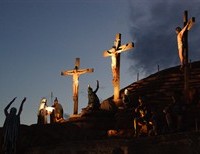
Death is the only inevitability in life. Yet as Catholics, we can take comfort in the fact that Christ conquered death for us and so despite that inevitability, we know that death is not the end, but rather the beginning. That belief is what enables me to tap into the dark side of humankind’s behavior and to write about it in ways that might come across as being uncomfortably convincing. I take no pleasure in viewing or discussing the vulgar and violent nature of mankind, but like Flannery O'Connor, my faith keeps me grounded when delving into the grotesque side of man's behavior. The Cross and the Passion Christ endured is an everlasting example of the savagery of man and as hard as it might be to behold, we can take refuge in it because it shows us that no matter what hardships we might endure, Christ knows our pain.
Joseph Michael is a social worker and writer from Brooklyn, NY. Born into a Sicilian immigrant Catholic family, he attended parochial school throughout his childhood. He studied Journalism at Arizona State University and completed a Culinary Arts degree through Le Cordon Bleu, working for over a decade in restaurants and country clubs throughout California, New York and Wisconsin. He then earned an M.A. in Pastoral Counseling at Fordham University followed by a Master of Social Work degree from New Mexico State University. A writer since high school, his work has focused primarily on faith-based and political commentary. He has worked extensively in the mental health field, providing therapy in residential treatment facilities, behavioral health hospitals and clinics and now works as a crisis interventionist in correctional healthcare. He and his wife, also a social worker, reside in Arizona. Joseph is a Knight of Columbus and has strong devotions to Our Lady, St. Padre Pio and St. Michael. He plays ice hockey, watches baseball, cooks and does martial arts in his free time. Feel free to contact him at jdimarius@fordham.edu.