Philip Rivers Most Valuable Catholic

From Eucharist to Evolution

Photo By: Flickr/wplynn
A Reflection on how science found a home in the Catholic mind
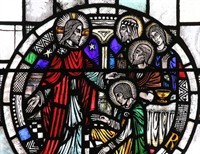
It is no mystery that the central sacrament of Catholic life is the Eucharist. This institution has been the focal point of the Church since Christ scandalized thousands by imploring them to eat his flesh. But for the person who accepts it, how does the mind reconcile? For one, there is the necessity for an active decision to accept Christ's real presence in the Sacrament. Also, one needs to let go, to some degree, her understanding of the physical world. Last, the Sacrament requires an ability to accept what one cannot sense. Curiously, how might this be of benefit to the field of science? Let's try to unpack.
Faith
A necessary aspect of faith is the conscious decision to have it. What does this do to the mind? For one, it accepts certain phenomena is larger than one can understand. A side effect of any serious reflection of one's smallness is humility. Humility often requires a man's acceptance of not knowing. And it cannot be overstated that to be humble as a Christian, in many ways, is to be like a child. One marquee of childhood is living in a constant state of wonder, and you need not pour through many of the lives of the saints to see that same sense of awe. And thus it is difficult to live in this state without a parent's favorite question, "Why?" Obviously, awe and wonder coupled with a zeal for questions are building blocks of scientific inquiry.
Transubstantiation
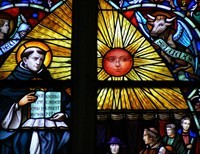
Unquestionably, faith is necessary to accept transubstantiation. Again, it was scandalous in the Gospels, and it is disparaged outside of liturgical churches. And in one's heart, if scandal is not approached in this institution at some point, he is probably not being completely honest with himself. Indeed, for even the most zealous of us can only venture so far before giving up and accepting, on faith, its truth while also learning to embrace its mysterious nature. But this is where the Eucharistic celebration may be one of the most powerful tools in the unique way a Catholic interacts with her environment. Communion, for one who has deeply reflected, opens the mind up to paradox. It looks like bread and wine, but it is the Flesh and Blood of our Creator. And indeed, to keep us honest about the truth of this mystery, the good Lord reminds us with the occasional miracle. But how does paradox give one a leg up in understanding the world around us? For one, it allows the mind to reconcile what may seem like contradictions on the surface. Evolution, a major hurdle for our protestant brother's and sister's comes to us with a greater amount of ease. But, when one approaches mystery regularly, is it any surprise that he can make sense of the creation story and man's material origins as simultaneous truths? Alister McGrath, in a seminar about the intersection of Christian life and Darwinism, suggested if Darwin had written his seminal book in Rome rather than England, the conversation would be wholly different than the way it is discussed today. Indeed, for a God who can make Flesh and Blood of bread and wine, is anything impossible? And for the Catholic who spent her life kneeling before the altar participating in the mystery, does she not know all is possible even when she does not fully understand? Still, it's important to recognize that accepting mystery does not mean the mind ceases the desire to comprehend. This is summed up well by Aquinas, who at the end of his life reflected on his writings by comparing them to straw when approaching God's majesty.
It would be a lie to say that all great science comes from Catholics. But truly, Catholicism has been a potent incubator. In fact, a great deal of scientific advancement has happened behind the walls of Catholic institutions. But considering the centrality of the Eucharist in Catholic life, is this really surprising? The very institution, taken seriously, cannot lead to any other place than one of openness to the inexplicable. And once there, the Western mind has had a habit of proceeding forward with a passion to know. For nothing has ever been accomplished by a group of peers, sitting in a circle, assuring each other of the impossibility of an idea. And nothing would ever have been discovered if the Church as a whole was not welcoming to new discovery. If it had not embraced seeing the impossible transform to the improbable and then the improbable become material truth we would still live in the dark ages. An openness to this cycle almost takes a superhuman willingness to embrace the unknown, and for it to happen at such a large scale over so many centuries requires the centrality of an event that happens throughout time that keeps the mind rooted in the understanding that the improbable, no matter how scandalous, and no matter it's virulent opposition is possible. And from there, one is a step away from a solid foundation for scientific thought.
Recommended Stories
About the Author
I am a husband and father who isn't quitting his day job. I write to be understood and to understand.
My Twitter handle is: @laffyjaphy
Website: https://laffyjaphy.wordpress.com/