I will be there tomorrow

The Easter Vigil Part One: The Catholc Passover Celebration

Photo By: Flickr/Fr Lawrence Lew, O.P.
Most of us have heard of the Seder, the ceremonial Passover meal celebrated by Jewish people the world over. It follows a certain ritual, a certain order. The order is set forth in the Haggadah, a Jewish text which gives the order of the Seder. In addition to the order of events, the Haggadah also includes a ritual handwashing, blessings (especially over the bread and wine), Scripture in the form of relating the Exodus story, a ritual breaking of the bread and giving a piece to the participants, and songs of praise.
Like a catechism, which is designed around questions and answers, there are certain questions that are asked which lead to answers that tell the story of the beginning of the Jewish people and their religion. Perhaps the first question (usually asked by a young child), is most familiar to Christians: “Why is this night different from all other nights?”
This, and the questions that follow are answered by sections from The Torah, or the first five books of the Bible, which we call the Pentateuch. The responses to the questions tell the story of the bondage of the Israelites in Egypt and the flight out into the desert. This event, and the Covenant made with God in the desert, was the defining moment of the Jewish people. The Seder is a means of remembering and celebrating those events, and also of teaching the children the history of their people.
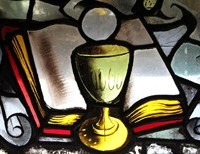
Most likely, the Last Supper Jesus celebrated with his disciples was a Seder celebration. The matzoh, or unleavened bread was blessed and broken by Jesus as the leader of the celebration, and passed to the disciples. The cup of wine, likely the third of four cups traditionally drunk at a Seder was called the Cup of Blessing. Jesus also blessed and gave this wine to drink. And he told his disciples to “Do this in remembrance of me.”
And we do what he commanded at every Mass, whether it is on a weekday or Sunday. We use unleavened bread, and we drink the wine, transformed into the Body and Blood of Christ. We listen to passages from Scripture, telling of the history of the Jews in the Old Testament reading, we sing the Psalm, a song unto the Lord, just as the Jews have joyful songs at their Seder. We hear the teachings of the apostles in the Epistle, and the story of Jesus in the Gospel. We even have candles burning at the table, just as they do at the Seder table.
The Mass has always been described as two things: A bloodless sacrifice, and a communal meal of believers. The sacrifice is a spiritual one, representing the actual physical sacrifice of Jesus for our redemption. As a meal, it is similar to the Passover Seder, because it is based on the Last Supper. But the Easter Vigil is even more like the Passover Seder. Even the Exsultet, the great prayer/hymn sung by a deacon or priest when the procession reaches the altar says that this particular celebration is our Passover Feast (Seder).
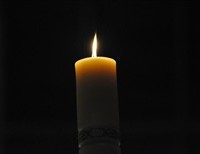
We start the celebration with the lighting and blessing of the fire. The Paschal Candle is blessed, then lit with the flames from the Easter fire, and is carried through the congregation to the altar. The candle represents Christ, the Light of the World, illuminating the world and us with his burning light of salvation for us all.
Instead of just one Old Testament reading and one reading from the Psalms, there can be as many as seven of them. They tell the story of the Creation, and the history of the Jewish people, just as at a Seder.
And, of course we celebrate Communion, the Eucharist, the pinnacle of the liturgy. In which we consume the pieces of the broken body of Christ, becoming one again with Him.
Those are some of the similarities between a Seder and the Vigil Mass. In my next article, I will discuss some important symbolism at the Vigil celebration.
Recommended Stories
About the Author
I live in Lubbock, Texas and have been married for 47 years and counting. We have 5 children, 6 grandchildren, 1 great-grandchild, and 1 due soon. I served 4 years in the Air Force as a Medical Service Specialist during the Vietnam conflict and served 14 months at USAF Hospital, Clark AFB, Phillipines, taking care of Marines and Republic of Korea soldiers who were wounded in Vietnam. I completed undergraduate studies at University of Houston and obtained a Bachelor's Degree from Midwestern State University, graduated cum laude. Following that, I did post-graduate studies at Texas Tech University and Loyola Institute of Ministry,Extension Program. i am a Retired Educator,and have taught History and English at the secondary level. I am also a Retired Permanent Deacon, and for several years I wrote a Q&A column for a diocesan newspaper about the Catholic faith. In addition, I taught Church History for a diocesan Diaconate Formation Program and was director of the RCIA program in my parish for several years.