That Time Our Lady of Guadalupe Drove Out a Demon
Sponsored

Catholic365 is sponsored by
Road to Purity




Before the tabernacle was built in the desert and the temple was erected in Jerusalem, the meeting place or a contact point between humanity and God was usually on a mountain.
Mountains are considered holy because…
I know what you’re thinking. It’s called the Garden of Eden so it can’t be a mountain. Well, according to Ezekiel 28:13-14 it says.
“You were in Eden, the garden of God ... I placed you; you were on the holy mountain of God; in the midst of the stones of fire you walked.
Theologians see Eden as a cosmic temple and since every other temple is on the top of a mountain, Eden as a temple would be too. Furthermore, there are rivers of water that flow from Eden. In the natural world rivers flow with gravity, away from mountains.
And a river went out of Eden to water the garden; and from thence it was parted, and became into four heads. (Genesis 2:10)
Eden as a cosmic temple means that it is the dwelling place of God on earth. Like the temple in Jerusalem it has an inner sanctum, the Tree of Life in the Garden. Then it has an outer courtyard, the land of eden and finally an outer perimeter that encloses Eden, the dry land. It is where Adam can converse with God and walk with him at the breezy time of day. Humanity and God are in an ordered and right relationship in this paradisiacal garden until the Fall. Up until then it is on Mount Eden that man not only meets God but is in an intimate friendship with him. (see Genesis 1-2).
Before Moses scaled Sinai, it was already considered to be the holy mountain of God. The clouds hovered over it like smoke and the earth rumbled from it in the form of an earthquake. There were lightning flashes and thunder too. It’s like Sinai had its own weather system.
There was a feeling that Sinai was forbidden to man. It was too dangerous to approach the peaks of God’s holy and secret place.
Yet, Moses did climb the mountain and stayed for forty days. At first he was beckoned by God through the burning bush which called him and through which God revealed his holy name, “I Am Who Am”. God also revealed his plan of deliverance and liberation for his people.
On the mountain, Moses became sanctified as was seen by his radiant appearance. His face shone like the light of the sun and his hair became white. As he came down with the Ten Commandment tablets he heard the revelry and music that announced from a distance that the people were in the process of breaking that first commandment. They were prostrating before a false god, the golden calf.
After it was all said and done Moses finally got the people to agree to the terms of the covenant and he sacrificed a bull, splashed the people with its blood as he said, “This is the blood of the covenant”. They verbally gave their assent to obey the Commandments of God. (see Exodus 19-24).
Moses, the lawgiver standing on the foot of Mount Sinai prefigured Jesus on the Mount of Beatitude giving the sermon on the Mount which culminated in the Law of Love.
The greatest prophet in the Old Testament after Moses is Elijah. It was Elijah who appeared with Moses on Mount Tabor as Christ became transfigured. The three of them were conversing on the mountain, Jesus, Moses and Elijah.
Elijah had his own mountain encounter with God. Unlike Sinai, which was somewhere in a desert between Egypt and the Holy Land, Mount Carmel was part of the northern, coastal range of Israel. Ancient wine and oil presses have been discovered at various locations on Mount Carmel.
Tradition has it that Elijah lived as a hermit in a grotto at the foot of Mount Carmel and he built an altar higher up on the mountain. The famous contest between the God of Elijah and the god Baal took place on Mount Carmel. Elijah told them to build an altar to Baal and offer a sacrifice. He would do the same but his sacrifice would be offered to the one true God.
Whichever sacrifice was consumed with fire would prove once and for all whose God was actually God.
The prophets of Baal went first and they laid the sacrifice on the altar but to no avail. They began to cut themselves and cry out with occultic incantations to Baal but nothing happened. Elijah began to mock them saying, “Cry louder. Maybe he can’t hear you”.
When Elijah offered his sacrifice he covered it with water several times. Suddenly, after Elijah prayed to God to accept his sacrifice it burst into flames. And when all the people saw it, they fell on their faces and said, “The Lord, he is God; the Lord, he is God.” The prophets of Baal fled in terror but they were put to death by Elijah signifying the eradication of evil from God’s holy mountain. ( see 1 Kings 18:20-40).
Later, the understudy to Elijah, the prophet Elisha later traveled to Carmel straight after cursing a group of young men because they had mocked him and the ascension of Elijah by jeering, "Go on up, bald man!" After this, bears came out of the forest and mauled fortytwo of them.
The Carmelite religious order has its medieval roots at this spot. The main church inside the Carmelites' Stella Maris Monastery is said to contain the Cave of Elijah, a grotto associated with the Biblical prophet Elijah.
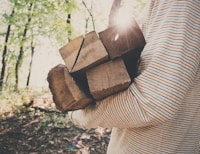
When Abraham took his son Isaac up a mountain to offer him as a sacrifice (see Genesis 22) he had Isaac, in a very Christlike way, carry the wood. The name of the mountain was Moriah. Isaac said to his father, "Here's the wood and the fire but where's the lamb for the sacrifice?" Abraham responded, "The Lord will provide the lamb for the sacrifice".
As Christians we know that the Lamb that God provided was called by John the Baptist, "The Lamb of God" as he approached the waters of the Jordan. Jesus became the ultimate sacrifice offered on a mountain close to Moriah called Calvary.
Mount Moriah went on to become the holiest site in Jerusalem called the Temple Mount. It is where Solomon built the first temple. Later Herod rebuilt it and Jesus was found there as a child. He called it the house of his Father. He later wept for the temple as he predicted that it would be destroyed. It was destroyed by the Romans in the year 70 AD. Now a Muslim mosque built in the 600's AD, called the Dome of the Rock, sits on the Temple Mount and covers the rock on which Abraham offered Isaac.
I am a life-long Catholic, husband, dad, teacher and former football coach. I've been teaching the Catholic Faith to young men, religious educators and catechists since 1998. My academic background, MA is in Theology and Catechetics. Email: gary@apexcatechetics.com