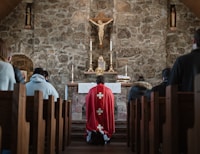
Lord, I Am not Worthy: Lenten Musings, Part II
Sponsored

Catholic365 is sponsored by
Road to Purity




One does not live by bread alone, but by every word that comes forth from the mouth of God.
—Matthew 4:4
A Lenten season of increased praying, fasting, and giving does not necessarily come easy to everyone. The discipline of Lent can easily push us out of our comfort zones. This discomfort, though, presents tremendous opportunities for reflection and growth as the best learning happens outside the comfort zone. Lent is not supposed to be an easy time for Catholics to glide through in preparation for Easter dinner. Rather, it is a time of dedicated engagement in practices of devotion to our faith. Some of these practices create emptiness and silence. It is in these states that can be attuned to God’s word, not just in a traditional scriptural sense, but in a very personal conversational way.
These 40 days and 40 nights are of deep prayer, depriving ourselves of worldly things, and emptying our calendars and purses for the greater glory of God. Let us fill this silence and the emptiness with God, with His words to us, with his revelation. Listening to God involves recognizing the various methods He uses to communicate. A communication method is called a medium (e.g., television, email, etc.). That’s where we get the word media; it’s plural. While God is unlikely to email us or shoot us a text, let us focus on three media He does use to communicate with His people.
The First Medium: The Inspired Word of God
Blessed are those who hear the word of God and observe it.
—Luke 11:28
When one contemplates the Word of God and how He communicates to us, sacred scripture comes quickly—if not first—to mind. The Holy Bible is considered to be the inspired Word of God. This inspiration is key to understanding scripture and how to read and reflect upon it—especially as a Lenten practice. The Bible is not one cohesive narrative; it is not a continuous story with a beginning and an end by a single author. Nor is the Bible a history textbook containing complete, exact, and literal facts and accounts of historical events. The best comparison to modern publications might be to that of an anthology. Of course, this anthology happens to have a divine editor.
The Holy Bible is a compellation of individual parables, prayers, and accounts crafted by countless authors over thousands of years. The Jewish people read and prayed upon the Hebrew Bible—the Old Testament—for millennia before the birth, death, and resurrection of Christ. Only after those events did the authors of the New Testament begin their work. It wasn’t until late in fourth century AD that the early Church compiled those writings and solidified the complete Christian Bible. Yes, the Catholic Church predates the Bible. We operated for almost 400 years with only the Hebrew Bible and apostolic tradition.
In considering these facts, one may begin to view the Bible as a mishmash of literary elements haphazardly clumped into two volumes. The cohesion of the Bible as we know it today, though, is in God’s inspiration. The countless authors of the thousands of years of content contained in sacred scripture were each divinely inspired. If one were to read the Holy Bible from cover to cover, confusion may insue. Characters emerge and vanish never to be referenced again, plots begin and end, and there is no well-placed climax before an ending that ties everything together. Plus, the Gospels tell the same stories. This is all because scripture is not written to be read in such a way. The psalms are the prayers of early Jews, crafted for us to use in praising and appealing to God. The Genesis creation story is a symbolic account of the beginning of everything (CCC 337). The Gospels present various accounts of the life of Christ, while Acts of the Apostles and Paul’s letters report early evangelization and conversion.
God indeed speaks to us through his inspired scriptural word. He just didn’t write a novel or a reference text. During this Lenten season listen carefully to the readings presented at Holy Mass each week, or every day. Read a book of the Bible for what it is—a component of this divine anthology. Contemplate what God is saying to you through His inspired word. Ask how the story, prayer, or account related to your life today, what message it contains for you, and why it matters to your relationship with the divine editor. That is how we listen to the God’s inspired word in the most personal way. Then, when the message is clear, act. Emulate Christ in His mercy and grace, be the prodigal son in his contrition, pray the psalms and give glory to God.
Take heed; the word was inspired for you to hear.
The Second Medium: The Love of Thy Neighbor
My mother and my brothers are those who hear the word of God and act on it.
—Luke 8:21
Sometimes, while sitting in church on Sunday listening to the homily, it seems like Father is talking directly to us. It’s like his homily is a message intended only for one person and we are that person on that Sunday in that church. Sometimes in church we hear exactly what we need to hear.
Every so often a friend, family member, or coworker shows up or calls just when we need a friendly voice or a kind face. It’s almost as if the person heard us cry out in darkness and silence and heeded that call. He or she came to us at a time of need without specific request. Every so often people are right there exactly when we need them, and they speak the comforting words we need to hear.
From time to time, people in our lives comment on our spirituality or devotion to Christ and His Church. Perhaps they even ask if we have ever considered a vocation to the priesthood, religious life, or secular orders. They admire our faith and wonder if we might be a lector or cantor or an extraordinary minister of Holy Communion. From time to time, the people around us see our witness, are inspired by it, and they let us know.
These people are likely unaware of the significant effect their words or presence have in certain moments. Alas, God speaks to us through them. Our neighbors are instruments of communication, conveyers of a message, vessels of the Holy Spirit. “The Advocate, the holy Spirit that the Father will send in my name—he will teach you everything and remind you of all that I told you” (John 14:26). Now, not everyone is carrying a message from God; not all those we encounter have our best interest in mind. That’s important to remember when discerning God’s communication. When we really listen to those around us, though, when we pay close attention loving words and deeds, we hear God’s voice, and we see His face. The above examples are not coincidence, they are examples of divine communication. This Lent, be attentive to the good words of others and the kindness of our neighbors. Hear the voice of God in those who show love. “Jesus … does not tire of sowing the gift of His word generously,” Pope Francis said in 2023. “He always hopes that we can bear abundant fruit. We too are required to sow tirelessly.”
Be aware; God talks to us through His people.
The Third Medium: The Reason of Faith
“Faith and reason are like two wings on which the human spirit rises to the contemplation of truth.”
—Saint John Paul II
Even when listening and recognizing God’s message as described above, hearing and then understanding what God is communicating can be daunting. He no longer sends the angel Gabriel to present a roadmap of His intentions as He did for Mary. Deciphering the message is up to each of us today, but as Pope John Paul II points out, our spirit can contemplate the truth through faith and reason. We must have faith that God loves each of us. In fact, as difficult as this might be to comprehend, there has never been a time when He has not loved each one of us. It is through faith in this love that we seek to understand what He is telling us. As we pray in Psalm 23, “He guides me along right paths” (3). God wants what is best for us; that is central to each of His messages to us.
When a young man found himself contemplating a call to the priesthood many years ago, he reached out to his pastor for some direction. Father began the conversation by asking, “Do you think being a priest would make you happy?” God will only call us to or point us in the direction of actions, decision, or situations which will fulfill us. In His eternal love, He does not call us to misery. Understanding this helps us to apply reason to what the heart feels in faith. When something feels right, good, holy, it is a safe assumption that God is filling our heart with such joy. Contemplating that joy, its reasons, and its specific function in each of our lives is the application of reason that enhances and validates our faith. We build God’s kingdom most when we understand how He wants us to do it. Applying some critical thinking to what we feel deeply in our hearts this Lent will take His message to a level of action on our part.
Indeed, the Holy Spirit fills our hearts and guides us in righteous acts and on right paths. The Spirit does not guide us in passivity, though. “We run the risk of imagining God was a magician, with a magic wand able to do everything,” Pope Francis tells us. “But that is not so” (Neuman). We must actively contemplate the message, the guidance, and act upon it—heeding the call. No one who ever heard the voice of God succeeded in apathy. To the contrary, His word—when faithfully contemplated and understood—drives action beyond what we believe possible. Feel the call this Lent, seek to understand its meaning, and act on it.
Go forth; faith and reason create faith in action.
Works Cited
Catechism of the Catholic Church, Second Edition. Libreria Editrice Vaticana, 2016.
Francis. “Angelus.” The Holy See, 16 July 2023.
John Paul II. “Fides et Ratio: On the Relationship Between Faith and Reason.” The Holy See, 14 September 1998.
Neuman, Scott. “Pope Says God Not ‘A Magician, With A Magic Wand.’” National Public Radio, 28 October 2014.
New American Bible. World Bible Publishers, 1987.
John Baldino is a Secular Franciscan and a tenured Assistant Professor in Phiosophy and Religious Studies at Lackawanna College in Scranton, Pennsylvania. He also serves director of Lackawanna's Center for Teaching and Learning and is an Adjucnt Instrcutor in Liberal Arts and Sciences at Excelsior University in Albany, New York. Prior to working in higher education, John spent two decades in the media industry working with TV stations and media companies in the eastern United States. He is a published writer who regularly contributes to Catholic Insight Magazine and the scholarly journal Charity in Truth. Working with FAITH Catholic, John writes homilies, universal prayer, and scirptural commentary used by priests and deacons at parishes across the United States.
John holds a Bachelor of Arts, Communications; Graduate Certificate, Catholic Theology, and Master of Arts, Liberal Studies / Philosophy. He lives in a suburb of Scranton with his Yorkie, Liza. John spends his free time reading, writing, terrorizing his nieces and nephews, and binge-watching Star Trek reruns.