Affirming Truths and Dispelling Misconceptions About the Catholic Faith
Sponsored
Catholic365 is sponsored by
Road to Purity




Come, let us return to the Lord.
—Hosea 6:1
While Lent is a time of prayer, fasting, and almsgiving, it is not 40 high holy days reserved only for the most pious and devout. Nor is it a time to put one’s devotion on display for all to see in an effort to be perceived as holier than others. Rather, Lent presents opportunities for both devoted practicing Catholics and those who have strayed from, questioned, or doubted their Catholic faith. For Lent’s frequent fliers, the season offers a chance to lead by example while walking the fine line of humility. That’s a topic for a later reflection.
The person who has distanced himself or herself from the God and His Church can make tremendous use of these 40 days and 40 nights. People leave, reject, or become disenfranchised with their Church for a myriad of reasons. Though many are not necessarily reasonable, logical reasons for walking away from the largest and oldest denomination of Christianity in the world, they are real. These things indeed happen. Lent, though—in its nature of discipline—is an opportune time to indulge in desires to reconnect and further understand. And it does not matter how strong or faint or even fleeting those desires may be.
Prayer
“The Mass is the most perfect form of prayer.”
—Pope Paul VI
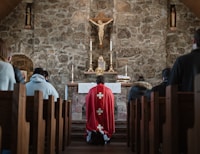
Go to Mass. Those who attend Sunday Mass regularly sometimes step-up Church attendance by participating in the Station of the Cross or even going to an additional Mass during the week. For those who have not been to Church in a long time, Lent is an opportunity to get reacquainted with Holy Mass. It’s in English now, by the way. There are seven Sundays following Ash Wednesday, up to and including Easter Sunday. Taking one hour on each of these Sundays just to go to Mass can be a huge stride in rediscovering the Catholic faith. These are seven opportunities to sit in a Church among fellow Christians, listen to the Word of God, and witness the presence of Christ in Eucharist.
Be present.
Shop. In many parts of the country—particularly the more densely populated metropolitan areas—there are many parishes and worship sites within reasonable commuting distance of each other. The liturgy itself, the readings, and the prayers of each Mass are the same at every parish around the world, but each experience is unique. The seven-Sunday Mass revisitor has a nice chance to shop parishes—and priests. Not every person clicks with the style and the homilies of every parish priest. Likewise, each parish community has its own feel and dynamic that is comfortable for some and out-of-the-ordinary for others.
Those seeking to return to the Church—or at least rediscover in some way—can go to Mass each Sunday from Ash Wednesday to Easter at a different worship site. It is okay to shop parishes. It is important to find a parish community which brings comfort and peace, a Mass style which is fulfilling and enriching, music which lifts the soul, and a pastor who is interesting and engaging. What each of these criteria mean for each individual Catholic differs. Each is free to attend Mass at any parish, particularly that parish which feels most like a spiritual home.
Find a fit; find a home.
Prepare. Rediscovery does not come without work and Mass can be more fulfilling with a bit of preparation. Readings from sacred scripture are integral to the Sunday experience. They are proclaimed priests, deacons, and lay lectors and are often the topic of the weekly homily. Someone who has been away from Mass for a while can enrich the experience by checking out the readings ahead of time. The United States Conference of Catholic Bishops publishes the readings for every Mass on a calendar on their website. Reviewing the Old Testament, New Testament, psalm, and Gospel readings before Mass helps put one in a good mindset. It’s also a nice opportunity for those who are inclined to study and research to observe similarities and draw connections among the readings. This solidifies the Church’s message for the week.
Go to Mass with a renewed spirit.
Fasting
“Ignorance denotes … lack of knowledge of those things that one has a natural aptitude to know.”
—St. Thomas Aquinas
Fast on ignorance. Socrates, the ancient Greek philosopher, believed ignorance to the greatest evil and arguably the root of all evil. This is the overarching theme in Plato’s Socratic dialogue, Meno. More than 2,400 years later, lack of knowledge or understanding—both inadvertent and by choice—remains widespread and tragic. Ignorance is a barrier to communion with God and His Church. Too often, people of varied religions believe things that are simply not taught by their religion. Catholics are hardly an exception. Some have even left the Church and turned to Protestant sects over misunderstood doctrine. Discovering, revisiting, and growing in one’s Catholic faith is dependent upon accurate understanding of what the Church teaches and why those teachings are in place.
To attain this level of understanding, it is key to consider the source and check the facts. The Catechism of the Catholic Church collects the entirety of the teachings of the Church in one convenient volume. The digital version is free and searchable, courtesy of the United States Conference of Catholic Bishops. When questioning, lacking clarity, or exploring Church teaching on a particular topic, a quick search of the Catechism points one to official Church position and reasoning. Remember, the teachings of the Church are rooted in sacred scripture. The Catechism offers scriptural references to support Church doctrine.
Seek to understand.
Eliminate misconception and misunderstanding. Another good way to develop an accurate understanding of what the Church teaches and why such doctrines are in place is to seek out an expert. During the shopping phase of Lenten prayer, a person may identify a priest or deacon with whom he or she feels comfortable. A quick question after Mass or a longer conversation during a scheduled meetup can open one’s mind to the real reasoning behind Church doctrine. Keep in mind, too, that priests and deacons are not the only experts in the teachings of the Church. Professors and theologians are filled with knowledge regarding the Catholic Church, what she teaches, and why we hold those teachings dear. While these experts are not always as easily accessible in person as priests and deacons, they tend to publish quite a bit. Read commentary from reputable, credible sources. Seek out these academic professionals in your local community and beyond. My contact information is at the bottom of this article. Feel free to use it.
Get the right answers from the right sources.
Almsgiving
“It is in giving that we receive.”
—St. Francis of Assisi (credited)
Time and talent. It is a misconception that almsgiving is synonymous with what many Protestant sects call tithing. While monetary donations fuel the Church and her mission to serve the people of God, money is not the only thing good Catholics offer to the local parish. Almsgiving is about sharing one’s abundance of time, talent, and treasure. For the person seeking to rediscover faith and possibly reconnect with the Church, time and talent are most beneficial. Connections form through interaction, and opportunities to interact with our Catholic brothers and sisters abound during the Lenten season. Sure, Lent is a solemn time of self-reflection and self-denial. It is also a time for fellowship. It is in communion with each other that we fully prepare for the passion and resurrection of our Lord.
Such spiritual and fraternal communion is certainly a key aspect of Holy Mass, but it happens outside the Sunday liturgy as well. Those seeking to reconnect would benefit from volunteering time at a parish event. Fry some fish with neighbors at the local parish on a Friday or two. Knead dough or cash out patrons at the neighborhood church’s pizza fritta sale. Maybe the youth group even needs a caring adult (with proper clearances, of course) to help with a service project. These kinds of activities are as involved and time-consuming as each volunteer wishes them to be. Most importantly, they are perfect opportunities to be part of a community, meet and understand fellow Catholics, and feel the faith in action.
Find belonging in community.
In Fine
Catholicism is beautiful. From the poetic scriptures to the smells and bells of Mass to the prayerful music of a Sunday morning, beauty abounds for each one of God’s people. Catholic faith in action—service to community needs and lifting up the lowly in prayer—is exquisite. For those who feel a desire for reconnection, rediscovery, or reexamination of their Catholic faith, the disciplines of Lent lay out a plan to bask in the glories of the Church and experience its splendor. One need not engage in every suggestion presented above to integrate this beauty into his or her life. Coming back to the Church, or even considering a return, is a personal journey unique to each of us. As the Church prepares for the new life of Easter, the lighter side of Lent as offered here for consideration just might bring new life to someone’s faith. For those who have drifted from the Church and their faith, a comforting reminder: God hasn’t moved.
Come back when you’re ready; God is patient.
Works Cited
Aquinas, Thomas. Summa Theologiae. Question 76, Article 2.
Catechism of the Catholic Church, 2nd edition. Libraria Editrice Vaticana, 2019.
Francis (credited). The Prayer of St. Francis, The Peace Prayer.
New American Bible. Catholic Word Press / World Bible Publishers, 1987.
Paul VI. Mense Maio. The Holy See, 29 April 1965.
Plato. Meno. c. 385 BC.
John Baldino is a Secular Franciscan and a tenured Assistant Professor in Phiosophy and Religious Studies at Lackawanna College in Scranton, Pennsylvania. He also serves director of Lackawanna's Center for Teaching and Learning and is an Adjucnt Instrcutor in Liberal Arts and Sciences at Excelsior University in Albany, New York. Prior to working in higher education, John spent two decades in the media industry working with TV stations and media companies in the eastern United States. He is a published writer who regularly contributes to Catholic Insight Magazine and the scholarly journal Charity in Truth. Working with FAITH Catholic, John writes homilies, universal prayer, and scirptural commentary used by priests and deacons at parishes across the United States.
John holds a Bachelor of Arts, Communications; Graduate Certificate, Catholic Theology, and Master of Arts, Liberal Studies / Philosophy. He lives in a suburb of Scranton with his Yorkie, Liza. John spends his free time reading, writing, terrorizing his nieces and nephews, and binge-watching Star Trek reruns.